

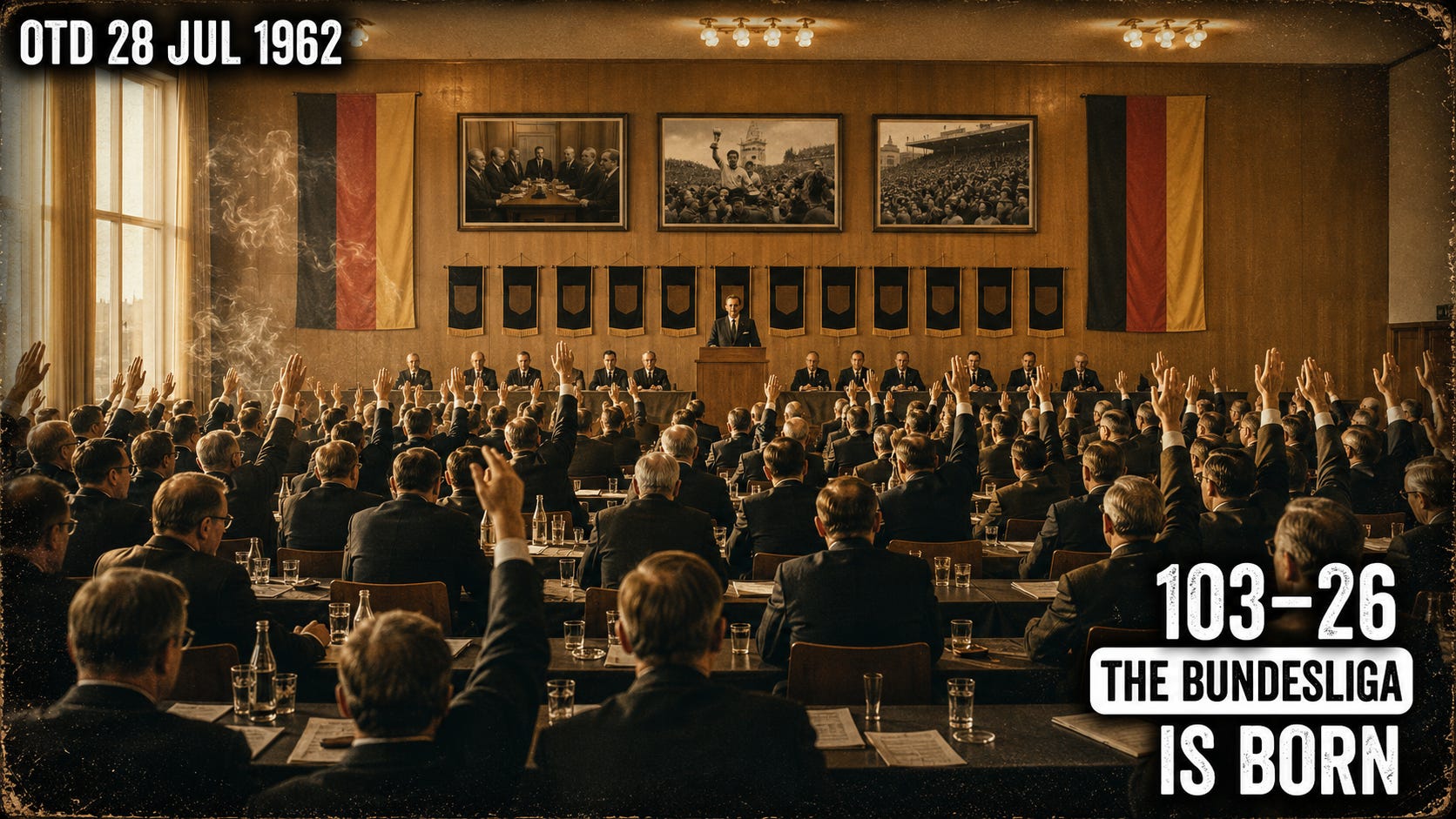
It is July 28, 1962. Dortmund. The DFB Bundestag. And German football votes itself into the modern age. The Bundesliga is approved. Not kicked off yet, that comes on August 24, 1963. But on this day the decision is made.
After decades of regional leagues, amateur ideals, hidden payments, and political disruption, West Germany finally agrees to create a single national professional league. One table. One champion. One top division.
To see why it took so long, start with what came before. For decades German football stayed regional: north, west, south, southwest, Berlin, each with its own culture and power centers, the champion decided through a final tournament after the regional seasons. That system had history and romance and local identity. It was not a modern professional league.
And by the 1920s that mattered, because the rest of Europe was moving. Italy was professionalizing. Spain launched La Liga. Central Europe was tactically and organizationally ahead through Austria, Hungary, Czechoslovakia, and the Mitropa Cup. Germany hesitated. Professionalism was officially resisted, but players were being compensated and clubs were finding ways, so German football had the worst of both worlds: not fully amateur, not properly professional.
Then politics intervened. The Nazi era turned sport into propaganda, reorganized the domestic game into Gauligen, and made the 1936 Berlin Olympics theater for the regime. The Anschluss swallowed Austrian football into a Greater German structure and damaged one of Europe’s great football cultures. Then came the war, and afterward a broken country: West Germany, East Germany, Saarland for a time as its own football case, and a DFB that had to be rebuilt.
Then came the miracle. Bern, 1954. West Germany beat Hungary 3-2, das Wunder von Bern, and football helped rehabilitate a nation. But here is the strange part: even after winning the World Cup, West Germany still had no national professional league. The national team had glory. The domestic structure still had a hole.
By the early 1960s that hole was impossible to ignore. German clubs were not consistently strong in Europe, the best talent was scattered across regional leagues, and the national coach Sepp Herberger wanted the elite concentrated. A quarter-final exit to Yugoslavia at the 1962 World Cup strengthened the reformers, and the argument became simple: if West Germany wants to compete with the best, its best players must play each other every week.
Franz Kremer of 1. FC Köln had wanted a national league for years. Herberger backed it for the national team. Hermann Neuberger operated the politics inside the DFB. And on July 28, 1962, in Dortmund, the vote came. There were 129 delegates, 103 in favor, 26 against. The Bundesliga was approved.
The decision created a strange audition season. A total of 46 clubs applied for the first Bundesliga. Only 16 could be chosen, on sporting record, economics, stadiums, regional balance, and political judgment, with a rule against two clubs from the same city. That mattered in Munich, where 1860 München were chosen and Bayern were not. Borussia Mönchengladbach were left out too. The clubs that would come to define the league were not in its first season.
Köln became the first champions in 1963. Bayern and Gladbach arrived in 1965, and the league found its first great rivalry: Beckenbauer, Müller, and Maier against Netzer, Vogts, and Heynckes. The national team followed, through Euro 1972, the 1974 World Cup, Euro 1980, and the 1990 World Cup. The Bundesliga gave German football the weekly furnace it had lacked.
Its identity became distinct. Not a closed franchise league. Promotion and relegation, huge crowds, standing terraces, the 50+1 rule, strict licensing, and the idea that a club is not only a product and a fan is not only a customer. Bayern came to dominate, and there is a perfect irony in that. The club that defines the Bundesliga was not invited to its birth. Hamburg, the last founding club never relegated, finally went down in 2018. The eternal club was a latecomer, and the founders did not last forever.
🎙️ THE PODCAST GOES DEEPER. The full episode has more about the vote, the controversial selection of the first sixteen clubs, and the 50+1 model. That’s the 10-minute version.
---
🎧 Listen on Spotify, Apple Podcasts, Amazon Music, Overcast, iHeart, and YouTube.
📩 Got an episode idea? otd@17lawsguy.com
Yesterday: 27 July 1928, Latvia and the first Baltic Cup.
Tomorrow: 29 July 1911, the IFA Shield, and the first all-Indian victory over a British team.