

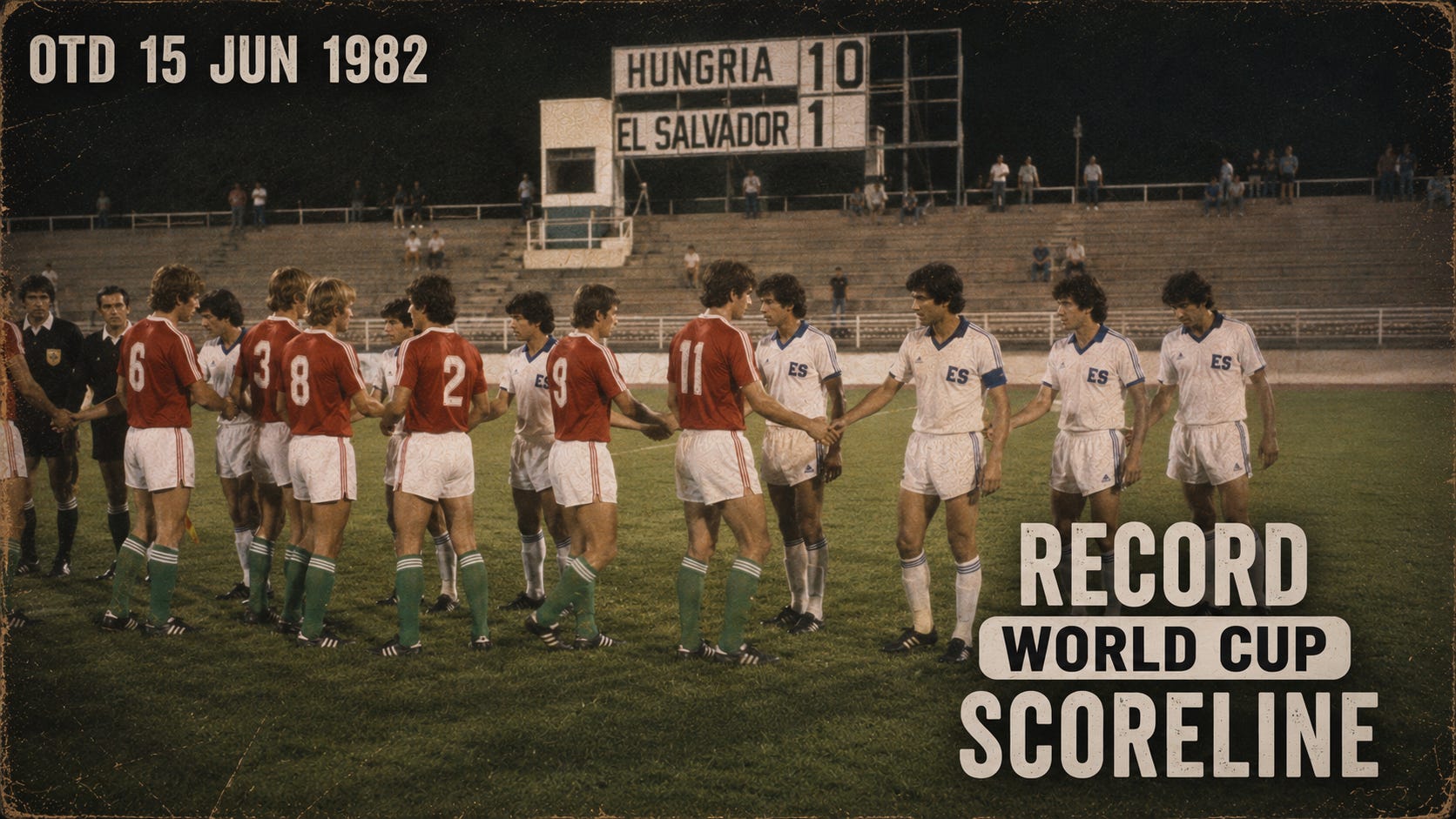
It is 15 June 1982, at the Nuevo Estadio in Elche, Spain. Hungary against El Salvador. And this is one of those World Cup stories where the scoreboard is famous but the people behind it deserve more than a punchline. Hungary 10, El Salvador 1. The largest margin of victory in World Cup history, the only time a team has scored double digits at the finals, a substitute hat-trick in seven minutes, and one Salvadoran goal that still matters more than any goal in a 10-1 defeat should be allowed to matter.
How did we get here? Hungary in 1982 were no longer the Magical Magyars of the 1950s, but they still carried a real football name: World Cup finalists in 1938 and 1954, Olympic champions three times. By 1982 they were a serious, organized, experienced state-socialist football nation, coached by Kálmán Mészöly, captained by Tibor Nyilasi, with László Fazekas, András Törőcsik and, on the bench, László Kiss. Not favorites to win the World Cup, but a team nobody should treat casually.
El Salvador were in a much darker place. This was their second World Cup, and the country was in civil war: government forces, guerrillas, death squads, Cold War politics, grief. Football was not separate from that. Training was disrupted, friendlies were hard to arrange, and players prepared while their country bled. Midfielder Mauricio Alfaro later said that when the team played, the killings could pause for a day. That was part of the pressure: to give a frightened country something other than terror. Their squad still had real names, above all Jorge “Mágico” González, a genuine genius later adored at Cádiz.
But the preparation was chaos. El Salvador arrived last, only three days before facing Hungary. They brought 20 players instead of the allowed 22, because officials took places in the delegation, and could not raise the money to fly the two omitted players out. They lacked equipment. Some tracksuits vanished. The Tango España match balls did not reach them, so they borrowed balls from Hungary before kickoff. They did not even have a pennant for the pre-match exchange, so goalkeeper Luis Guevara Mora carved “El Salvador” into a piece of pine. That is what they handed Hungary.
Then the match. And tactically, El Salvador made the choice that turned danger into disaster: they attacked. Not out of foolishness, but because they wanted the world to see a positive El Salvador, to be more than victims of a war. Against an organized Hungary, that left space everywhere. Nyilasi headed in after four minutes. Pölöskei made it two by the eleventh. Fazekas made it three by the twenty-third. By the hour it was 5-0.
Then, in the 64th minute, El Salvador scored. Mágico González was involved, the ball broke in the box, and Luis Ramírez Zapata controlled, swiveled and finished. Hungary 5, El Salvador 1. Ramírez ran away in joy, and this is the emotional core of the whole match. Some teammates tried to stop him celebrating, afraid it would anger Hungary and bring more goals. He celebrated anyway, because he had just scored El Salvador’s first World Cup goal. Still, to this day, their only World Cup goal. He was not celebrating the scoreline. He was celebrating proof of existence.
And then the fear came true. László Kiss, just on as a substitute, scored three times in seven minutes, still the only substitute hat-trick in World Cup history. Nyilasi finished the match as he had started it. Ten to one. A photograph of that scoreboard became one of the starkest images in World Cup history.
Here is the part the scoreline hides. Hungary did not ride the 10-1 to glory. They lost 4-1 to Argentina, drew with Belgium, and went out in the first group stage despite scoring ten in their opener. El Salvador, humiliated, actually became more solid, losing only 1-0 to Belgium and 2-0 to Argentina. But the journey home was cruel: several players were treated as embarrassments rather than men who had carried a country at war to the World Cup. Neither nation has returned to a World Cup since. Hungary’s last was 1986. El Salvador’s remains 1982. So the 10-1 became a strange monument for both: for Hungary, a record inside a failure; for El Salvador, a humiliation wrapped around their only goal.
Which leaves an uncomfortable question the 2026 World Cup, with 48 teams, makes newly relevant. What do we do with mismatches? Expansion gives smaller nations a path, and sometimes the minnow shocks the world (Cameroon beating Argentina, Senegal beating France, Morocco reaching a semi-final). But when the gap is too wide, football can become spectacle at someone’s expense, as last year’s Bayern Munich 10-0 over semi-professional Auckland City reminded us. I do not think there is a clean answer. A heavy defeat can wound players and reduce a country to a meme. But exclusion is cruel too, telling smaller nations the game belongs to others. Perhaps the right discomfort is exactly this: we should want the door open, and we should still care about who walks through it.
Because El Salvador 1982 were not just a team beaten 10-1. They were young men from a country at war, carrying hope into a stadium where football became too much, too fast. And one of them scored a goal his country has never managed since.
🎙️ THE PODCAST GOES DEEPER. The full episode has more on Hungary’s deep football lineage, El Salvador’s war-torn road and chaotic preparation, Mágico González, Ramírez Zapata’s goal and the teammates who tried to stop his celebration, Kiss’s seven-minute hat-trick, the 2007 commemorative friendly, and the ethics of World Cup mismatches. That is the 10-minute version.
---
🎧 Listen on Spotify, Apple Podcasts, Amazon Music, Overcast, iHeart, and YouTube.
📩 Got an episode idea? otd@17lawsguy.com
Yesterday: 14 June 1990, Roger Milla and the Corner-Flag Dance.
Tomorrow: 16 June 1950, the Maracanã opens.