

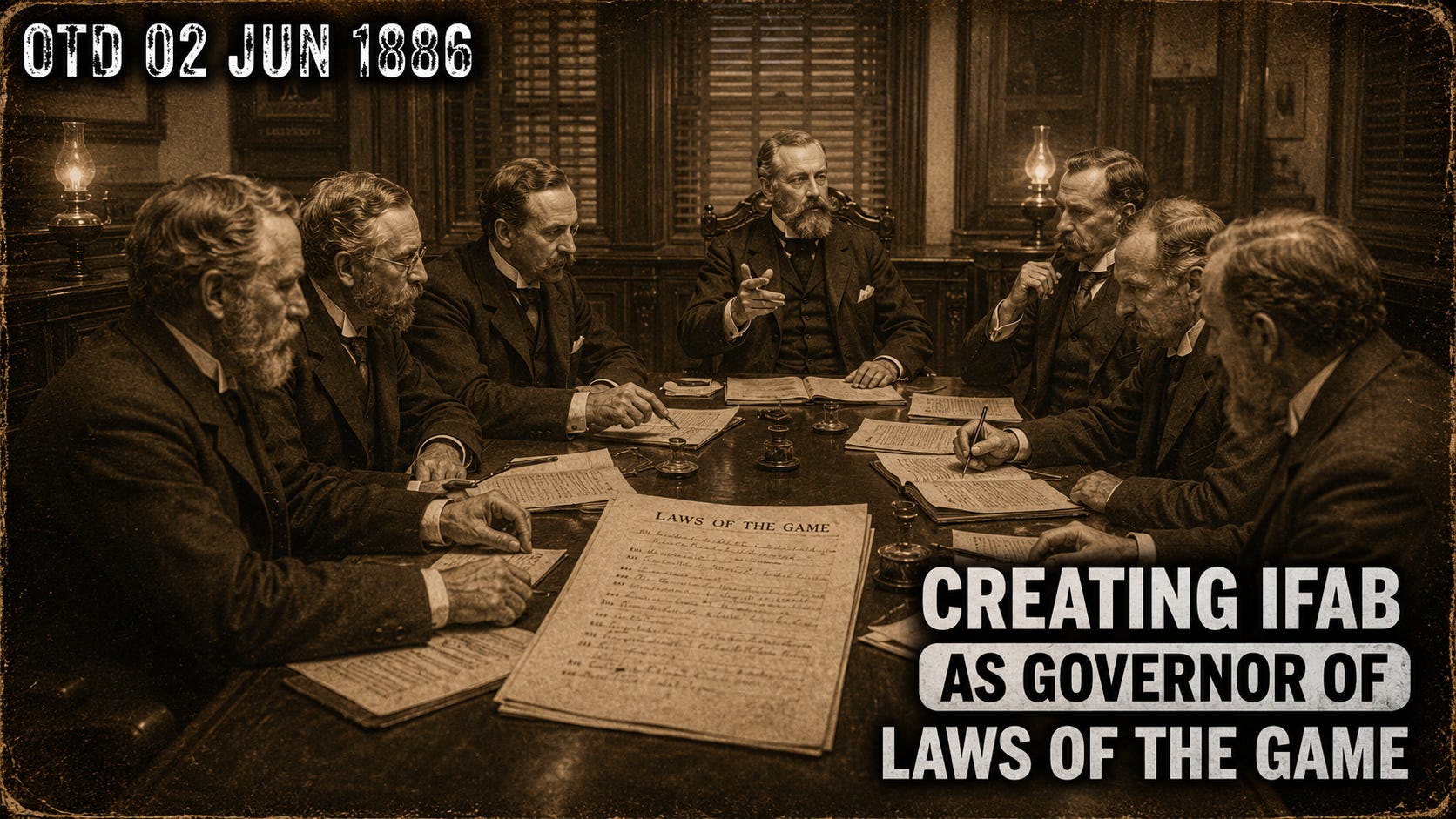
It is 2 June 1886, in London, in the Football Association’s rooms. And today football creates one of the most important institutions almost nobody talks about: the International Football Association Board. IFAB. The body that, to this day, guards the Laws of the Game.
Not FIFA. Not UEFA. Not the Premier League. IFAB. If football has a parliament for the rulebook, this is it.
How did we get here? In the 1860s, football wasn’t one game. It was a family of games — schools, towns and clubs each negotiating rules before kick-off, arguing over handling, hacking, even what counted as a goal. In 1863 the Football Association wrote the first universal Laws of association football. Universal was the ambition, not yet the reality.
Then football learned competition. The Youdan Cup in Sheffield in 1867 proved knockout football worked. The FA Cup began in 1871. And in 1872, Scotland met England at Hamilton Crescent in the first official international. Once you have international football, you need international rules — which sounds obvious now and wasn’t then, in a world of letters, telegrams, committee meetings and delegates travelling by train and boat. The game was built in public on pitches and in private around dinner tables.
By the 1870s and 80s the map had grown: the Scottish FA (1873), the Football Association of Wales (1876), the Irish FA (1880). Four associations, not always with identical laws. For internationals, the compromise was to play under the home association’s rules — workable, but awkward.
Then came the crisis that forced the issue: professionalism. By the early 1880s football’s centre of gravity was shifting to the industrial north, where clubs were quietly paying players. In 1885 the FA legalized professionalism in England. Scotland did not, and objected to even playing against professionals. Suddenly the question was bigger than match laws. Who decides international standards? Who owns the rulebook? The Irish FA proposed the answer: an annual conference of the four associations to govern the Laws.
That idea became the meeting of 2 June 1886. Major Francis Marindin in the chair for England, Charles Alcock as secretary, with delegates from Scotland, Wales and Ireland. Not a glamorous room — a room full of builders. They framed the rules of the new International Football Association Board: it would meet every June, hosted by each association in turn; minutes would be kept; a quorum was required; ordinary resolutions needed a three-quarters majority — but altering the Laws of the Game required unanimity. Decisions were binding, and no association’s change to the Laws was valid until the Board accepted it.
That was the moment. The rulebook now had a guardian. And the genius was the caution: changing football’s laws was made deliberately difficult. Not impossible. Difficult.
The very first law-related proposal that day? Major Marindin wanted to ban projections on the soles and heels of boots, except flat leather bars. Wales backed him; Scotland and Ireland didn’t; it was withdrawn. Small, yes — but it shows what IFAB was from day one: not theory, but the practical safety and standardisation of the game.
The Laws changed, of course — crossbars, penalties, the offside rewrites of 1925 and later, substitutes, the back-pass law, goal-line technology, VAR, concussion protocols. But they changed through a structure. The wording moves; the architecture endures. One global lawbook, guarded centrally, changed slowly. That’s why the 17 Laws have remained such durable scaffolding.
And here’s the part most fans never learn: FIFA doesn’t own the Laws. When FIFA was founded in 1904, it accepted that the Laws belonged to the Board. FIFA asked to join IFAB in 1912 and was told: not yet. It joined in 1913. Today the balance is fixed — the four British associations have one vote each, FIFA has four, and six of the eight votes are needed to change a Law. FIFA is necessary. FIFA alone is not sufficient. It’s a constitutional power-share hiding inside football, and one of the oldest in world sport.
In 2014, IFAB became an independent association under Swiss law, based in Zurich — same football family, same caution. Still strangely invisible. But every time you argue about handball, every time offside is reinterpreted, every time VAR expands, you’re watching the inheritance of that 1886 meeting. Football became global not because it moved fast, but because it moved slowly enough to hold together.
🎙️ THE PODCAST GOES DEEPER. The full episode has what this post compresses: the nine original IFAB rules; more about who the delegates were; the professionalism crisis; FIFA’s 1920-23 exclusion and 1924 return; the 1958 settling of the eight-vote balance. That’s the 10-minute version.
---
🎧 Listen on Spotify, Apple Podcasts, Amazon Music, Overcast, iHeart, and YouTube.
📩 Got an episode idea? otd@17lawsguy.com
Yesterday: 1 June 1978 — The Goalless Curse of World Cup Openers.
Lex Sportiva VS Lex Ludica