

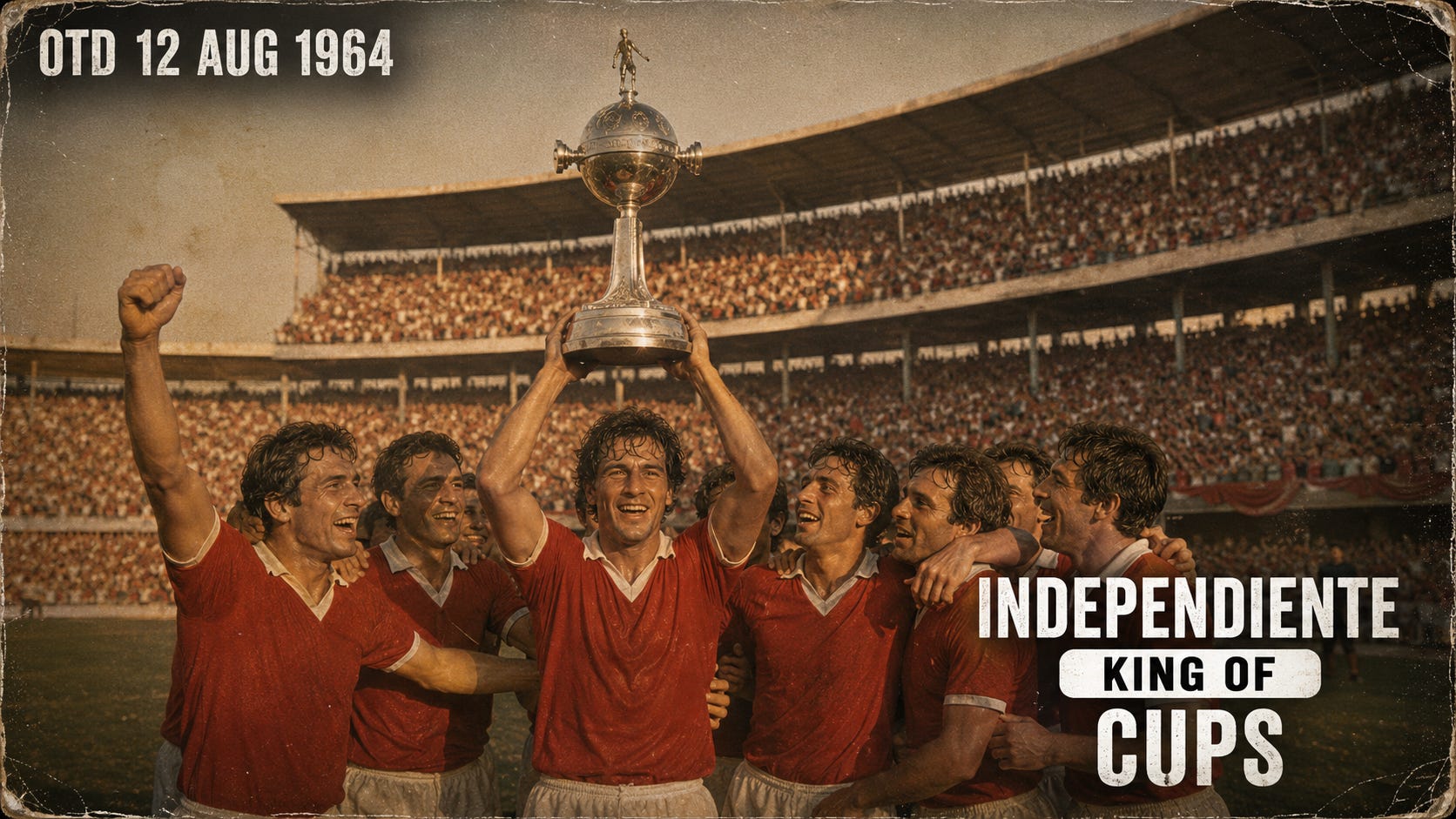
It is August 12, 1964. Avellaneda. La Doble Visera. Independiente against Nacional, the second leg of the Copa de Campeones de América final, the tournament we now know as the Copa Libertadores. The first leg in Montevideo was goalless. Now the stadium is full, around 80,000, and in the thirty-fifth minute Mario Rodríguez scores. Independiente 1, Nacional 0. And with that, Independiente are champions of South America. Argentina has its first Copa Libertadores winner, and the club that will become known as Rey de Copas, the King of Cups, has just found its crown.
Start with Argentina. Buenos Aires became one of the great football cities of the world, building the Río de la Plata game with Uruguay. Professionalism arrived in 1931, and the great clubs deepened: Boca, River, Racing, Independiente, San Lorenzo, the cinco grandes. But Independiente was its own thing, born from workers at a department store who decided they needed to be independent. Founded in 1904, they moved into Avellaneda, with Racing close by, two giants in one industrial neighborhood. They turned red, became Los Diablos Rojos, and won leagues in 1938 and 1939 behind Arsénio Erico. So Independiente already had history. But not yet this history.
Now the Libertadores. The tournament began in 1960, and the first four editions belonged to Uruguay and Brazil: Peñarol in 1960 and 1961, Santos in 1962 and 1963. Argentina had great clubs and no Libertadores winner. That is the gap Independiente walked into. Julio Grondona had become president in the early 1960s, still building the power he would later wield over Argentine football for decades, with Manuel Giúdice on the bench. Winning the 1963 Argentine title put them into the 1964 Copa.
The group was messy, and there was tragedy behind the scheduling: the Estadio Nacional disaster in Lima, during a Peru-Argentina Olympic qualifier in May 1964, meant Alianza Lima’s home matches were moved, so Alianza against Independiente was played in Avellaneda. Independiente beat Alianza 4-0, drew the moved match 2-2, and beat Millonarios 5-1. Then the strangest line: Millonarios against Independiente was not played, amid federation politics, with Independiente refusing to travel to Bogotá, and the points awarded to them anyway. Very Libertadores: politics, travel, and a walkover that is not quite clean. Independiente topped the group.
Now the semi-final, entered by Santos as defending champions. Pelé was not in the tie, but this was still a monster, with Gilmar and Zito. First leg at the Maracanã: Santos scored twice, Independiente three, a 3-2 win in Rio. Second leg in Avellaneda: Independiente won 2-1. The holders were gone, eliminated by an Argentine club that refused to be impressed. Then the final, against Nacional of Uruguay, fitting because Argentina’s first title would go through Uruguay. Montevideo first, goalless. Then Avellaneda, Mario Rodríguez in the thirty-fifth minute. One-nil, and that was enough. Independiente were champions.
This was a watershed. The Libertadores was new: not the old domestic argument, but continent against continent, and then, for the champion, Europe. Independiente’s win meant an Argentine club had conquered the continental machine. And it changed Independiente forever. Before 1964 they were a great Argentine club. After, they were the club of the Copa. They defended the title in 1965, then built the 1970s dynasty of four Libertadores in a row from 1972 to 1975, a feat no one else has matched, then 1984. Seven finals, seven wins. Rey de Copas is not marketing fluff. It is a trophy record turned into identity.
It also changed the Argentine image abroad. By the mid-1960s European football was learning that South American club football was war by other means: hard marking, gamesmanship, hostility. The 1964 win arrived two years before the 1966 World Cup, when European eyes already had a growing picture of Argentine football, technically serious, physically hard, and unwilling to behave like guests. That is the background to the arguments that would follow. And the later contrast is part of the story: the trophy room still says everything, but Independiente have not won a domestic league since 2002, which makes 1964 feel even larger, because the past is so enormous that every modern drought is measured against it.
🎙️ THE PODCAST GOES DEEPER. The full episode has the messy 1964 group and Bogotá walkover, the semi-final win over Pelé’s Santos, and the seven-finals Rey de Copas record. That’s the 10-minute version.
---
🎧 Listen on Spotify, Apple Podcasts, Amazon Music, Overcast, iHeart, and YouTube.
📩 Got an episode idea? otd@17lawsguy.com
Yesterday: 11 August 1999, the eclipse match that wasn’t.
Tomorrow: 13 August 1948, Sweden win Olympic gold.