

200 episodes today. Thank you for being here. For being curious about football’s stranger corners. For sending ideas. For sharing the show with friends.
—
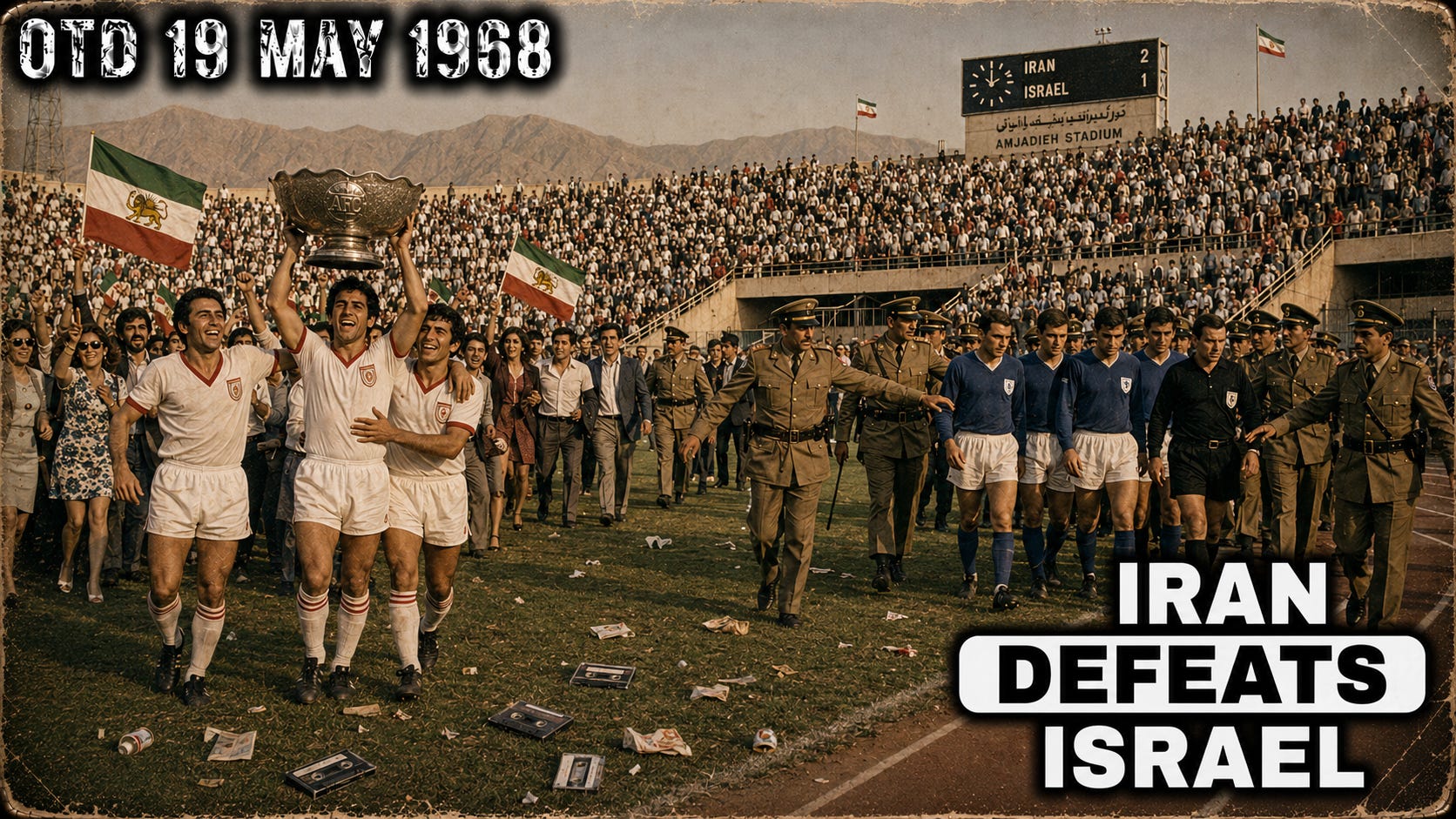
It is 19 May 1968. Tehran. Amjadieh Stadium. Iran against Israel. The last match of the Asian Cup.
Israel are the defending champions. Iran are hosting the tournament and playing in the Asian Cup finals for the first time.
Israel score first. So Iran need a response. And they get it late. Very late. But they win it.
Iran 2, Israel 1.
Iran are Asian champions for the first time.
But this is not just a football final. It is a match played one year after the Six-Day War, inside the delicate Shah-era relationship between Iran and Israel, in a stadium where celebration, nationalism, anti-Israeli politics and antisemitic hostility all collide.
This is the day Team Melli begins its great Asian decade — and the day Asian football’s Israel question becomes impossible to ignore.
The Asian Football Confederation had been founded in 1954, as we discussed in episode 189. The Asian Cup began two years later in Hong Kong. South Korea won the first two editions, in 1956 and 1960. Israel, after finishing runners-up twice, hosted and won the 1964 tournament.
That already tells you something about early Asian football. The map was different. Israel were inside the AFC. The continental structure was still fluid, still young.
Now put that inside 1968.
Iran — still ruled by Mohammad Reza Shah Pahlavi — was not yet the Islamic Republic. It was a monarchy, allied with the West, modernizing fast, and quietly connected to Israel in ways that mattered: oil, security, intelligence, trade. Iran had recognized Israel de facto in 1950, but relations were deliberately kept low-profile because Iran also had to live inside a Muslim and Middle Eastern political environment.
Then came the Six-Day War in 1967. Israel’s victory transformed the emotional and political landscape across the region. Iranian public sympathy for Palestinians and Arabs became more visible. The Shah’s government had to balance secret cooperation with Israel against public pressure, Arab solidarity, and the mood of the street.
So when Israel came to Tehran in May 1968, it was not just another defending champion arriving for a football tournament. It was a diplomatic event. A security event. A test.
On the pitch, it was a serious tournament. Five teams in a round-robin format, all at Amjadieh. No final in the modern sense. Just a league table. But because of the sequence of results, the last match became the final in everything but name.
Iran, coached by Mahmoud Bayati, came with players who would become national icons: Behzadi, Ghelichkhani, Hossein Kalani, Akbar Eftekhari, Ali Jabbari, Hassan Habibi, Jafar Kashani.
Israel had Mordechai Spiegler, Giora Spiegel, Moshe Romano, Shmuel Rosenthal and goalkeeper Itzhak Vissoker — a side with real pedigree, and the holders of the trophy.
Iran opened strongly. They beat Hong Kong 2-0. Then Taiwan 4-0. Then came Burma, who shocked Israel 1-0. That result changed the tournament. Iran beat Burma 3-1. Israel recovered by beating Taiwan 4-1.
So the final match was set. Iran could take the title by avoiding defeat. Israel had to win.
Amjadieh was overflowing. Officially around 30,000 inside. Other accounts speak of many more around the ground, outside the gates, in the streets, pushing the city into the match.
The first half ends 0-0. Then, early in the second half, Giora Spiegel scores from close range. Israel are ahead. Iran are under pressure.
But as Israel push for more, gaps open. In the 75th minute, Behzadi equalizes. Then, with a few minutes left, Parviz Ghelichkhani gives the match its defining moment. Left-footed, from distance, historic.
Iran 2, Israel 1.
The stadium erupts. Iran are champions of Asia.
But the eruption is not clean. Israeli accounts describe a frightening environment: anti-Israeli and antisemitic chants, objects thrown, even reports of cassettes and chicken heads landing near Israeli players. The referee, Alex Vaz of India, keeps the match going. After the final whistle, police and soldiers have to protect the officials and escort the Israeli players away.
So the match ends in two truths at once. A magnificent Iranian football victory. And a deeply ugly crowd atmosphere around the Israeli team. Both truths matter.
For Iran, it was the beginning of a golden football age. Iran won the Asian Cup again in 1972. And again in 1976. Three straight Asian Cups. No country has matched that sequence. They won the 1974 Asian Games. They qualified for the 1978 World Cup in Argentina, Iran’s first World Cup appearance.
For Israel, 1968 was the beginning of the end of their Asian football life. In 1974, Israel were removed from the AFC after a vote. Then came the wilderness — World Cup qualifying through Oceania, then Europe, then temporary arrangements. Eventually, UEFA began admitting Israel into European competition in the early 1990s. Full UEFA membership came in 1994. Israel, a West Asian country, became a European football nation because Asia could no longer contain it politically.
And the 1968 final became a hinge in Iran–Israel memory. Before 1979, Iran and Israel had quiet state-to-state cooperation. After the Islamic Revolution, that relationship was transformed into open hostility. The idea of Iran against Israel in a major football final became not just unlikely, but almost unimaginable.
That is why the footage of 1968 feels so strange now. Iran and Israel on the same pitch. At the Asian Cup. In Tehran. For a continental title.
For Iran, 1968 belongs to Behzadi, Ghelichkhani and the birth of a dynasty. For Israel, it belongs to a lost Asian past. For Asian football, it is one of those matches where a scoreboard just isn’t enough.
🎙️ The full episode (linked above) has more — including the deeper political context of Shah-era Iran-Israel cooperation, the Iranian player perspectives, the longer Iran-Israel diplomatic arc post-1979, and contemporary echoes around Iran’s qualification for the 2026 World Cup. The whole arc is in the audio.
---
🎧 Also available on Apple Podcasts, Amazon Music, Overcast, iHeart, and YouTube.
📩 Got an episode idea? otd@17lawsguy.com
Yesterday: 18 May 1931 — Argentina Turns Professional.
Tomorrow: 20 May 1993 — Olympique Marseille and Bernard Tapie.