

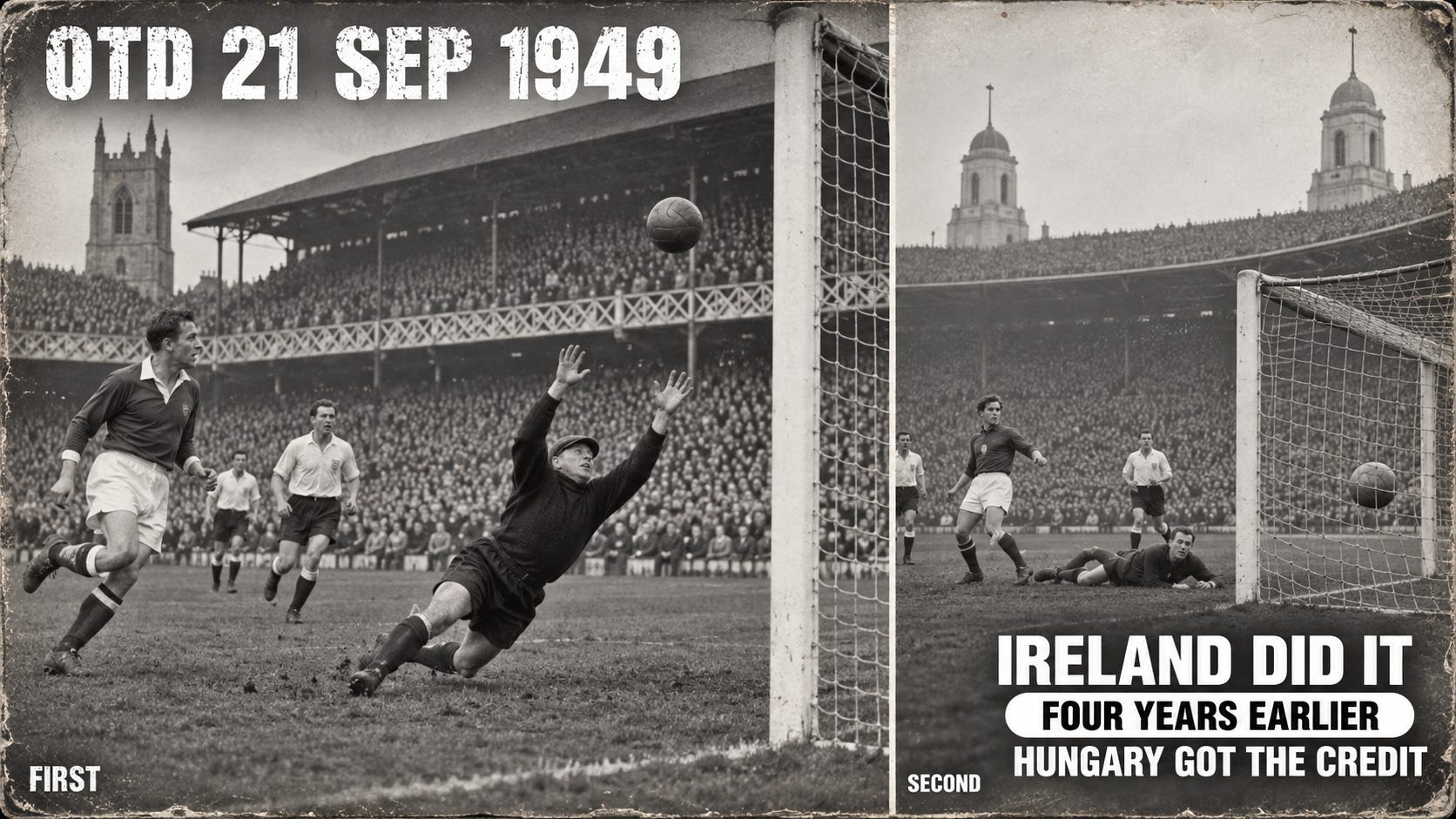
It is September 21, 1949, at Goodison Park in Liverpool, and England attack, and attack, and attack again. But Ireland’s goalkeeper, Tommy Godwin, will not be beaten. Captain Johnny Carey shackles Tom Finney. Con Martin scores from the penalty spot, and then, with five minutes left, Everton’s own captain Peter Farrell breaks through at his home ground and lifts the ball over England’s Bert Williams. England 0, Ireland 2. Four years before Hungary’s celebrated victory at Wembley, England have already suffered their first home defeat by opposition from outside the Home Championship. Except even the identity of the winning team is complicated.
How did we get here?
England had played their first international in 1872, and for decades most of their opponents came from the other Home Nations: Scotland, Wales, and an Ireland team organized by the Irish Football Association in Belfast. England lost home matches to all three; the Belfast-selected Ireland side had beaten them 3-0 at Ayresome Park in 1914. So England were not unbeaten at home. The famous record was narrower than that: England had never lost at home to a team from outside the four Home Championship associations. That distinction reflected British football’s view of itself. England, Scotland, Wales and Ireland had created international football and wrote its laws through the International Football Association Board, and matches between them were part of football’s family argument. Everyone else was foreign.
But the word “Ireland” had itself become impossible to pin down. The original Ireland team, which had lost 13-0 to England on its 1882 debut, represented the whole island under the Belfast-based IFA. Then came revolution, partition and the creation of the Irish Free State, and football divided too. A new association emerged in Dublin, eventually the Football Association of Ireland, or FAI, which FIFA recognized as the governing body for the Free State. But the Belfast IFA never surrendered its claim to represent the whole island. For years, both associations selected teams called Ireland, and both picked players from north and south of the border, so that a player could represent the FAI-selected Ireland in one match and the IFA-selected Ireland in another, sometimes against the same opponent. In September 1946, England played both within three days: beating the IFA-selected Ireland 7-2 in Belfast, then the FAI-selected Ireland 1-0 in Dublin, with Johnny Carey and Tom Aherne appearing in both Irish sides and Tom Finney scoring the late winner in Dublin. Three years later, Finney would meet them again.
By then the political language had shifted once more. The Republic of Ireland Act came into force in April 1949, ending Ireland’s formal connection to the British Commonwealth, and yet British legislation simultaneously declared that the Republic would not be treated as a foreign country under British law. So when football writers later called the Goodison match England’s first home defeat by a “foreign” side, they were not making a precise constitutional statement; they meant a team from outside the traditional Home Championship. Even that was complicated, because the visitors were selected by the Dublin-based FAI, but several of their players had also represented the Belfast-based IFA.
The match was officially a friendly, but it mattered. Both countries were preparing for World Cup qualification, and England had still never even entered the tournament, the Home Nations having long stayed outside FIFA before rejoining after the war to chase Brazil 1950 through the British Home Championship. The FAI-selected Ireland were in a separate qualifying group with Sweden and Finland, had already lost 3-1 in Sweden, and needed evidence they could compete with the elite. England were the largest possible test. Walter Winterbottom was without Stanley Matthews and Stan Mortensen, but this was no weak side: Bert Williams in goal, Billy Wright as captain, Neil Franklin at centre-half, Jimmy Dickinson, Wilf Mannion and Tom Finney all established, and Jesse Pye fresh from helping Wolverhampton win the FA Cup. Ireland had fewer stars, only seven of them attached to English First Division clubs, with Godwin and forward Tommy O’Connor coming from Shamrock Rovers. But they had experience of English football, organization, and a captain who knew exactly what he faced. Carey was from Dublin but had spent his club career at Manchester United, where Matt Busby made him captain, and earlier in 1949 England’s football writers had named him Footballer of the Year, the first player born outside Britain to win it. At Goodison he played right-back, directly opposite Finney, with one task: stop him.
England dominated the early play and pushed Ireland backwards, Godwin saving again and again while Carey repeatedly disrupted Finney down the left. Then Ireland countered. In the 33rd minute Tommy O’Connor released Peter Desmond, who drove into the area and was brought down. Penalty. Con Martin, an Aston Villa defender so versatile he could play almost anywhere, including in goal, converted for 1-0. England pressed harder, Peter Harris striking the crossbar and Pye going close, but Godwin and the defence held. Then, in the 85th minute, O’Connor found Farrell. Peter Farrell was not merely playing at Goodison; he was Everton’s captain, and he knew the grass, the angles and the moment. As Williams came off his line, Farrell lifted the ball over him and into the net. The Everton captain had completed England’s defeat at Everton’s stadium, and 51,000 spectators had witnessed history. England 0, Ireland 2. The next day’s papers strained to preserve an older map of football, the Manchester Guardian calling it England’s first home defeat by a team other than one of the Home Countries, the Times preferring that England had been unbeaten on British soil by a side from outside “these islands.” Neither formulation could change the score.
So what?
The first thing is that Ireland’s victory corrects one of football’s most persistent myths. Hungary’s 6-3 win at Wembley in November 1953 is almost always called England’s first home defeat by foreign opposition. It was not. The FAI-selected Ireland had won at Goodison four years earlier, and Hungary were the second side from outside the Home Championship tradition to do it. That does not make the two equivalent. Ireland beat England; Hungary dismantled England’s entire understanding of the game, their movement, their positional exchanges and their deep-lying centre-forward exposing an outdated system in front of the Wembley crowd. Goodison broke the statistical record. Wembley broke the mythology. Both are true, and only one is remembered.
The second thing is that the match shows how a national-team result can hide a political conflict. Written simply as “England 0, Ireland 2,” it looks uncomplicated, and it was anything but. Which Ireland? Selected by which association, eligible under which rules, representing which territory? Three of the winning side, Con Martin, Tom Aherne and Davy Walsh, would go on to represent the IFA-selected team during the very same 1950 World Cup qualifying competition in which they had just represented the FAI, and Reg Ryan did likewise. Four players turning out for two different associations in the same World Cup campaign was unsustainable, and after protests from the FAI, FIFA intervened, tying eligibility more clearly to the political border and eventually distinguishing, in its competitions, the Republic of Ireland from Northern Ireland. The Goodison team belongs to a brief, extraordinary period when two associations claimed the same football identity and some players answered to both.
The third thing is that the result demonstrates how memory chooses drama over chronology. Hungary’s victory had Wembley, six goals, Puskás dragging the ball back past Billy Wright, a tactical revelation, and a return match in Budapest that England lost 7-1. Ireland’s had a friendly in Liverpool, a penalty, a defensive masterclass and a late goal from the captain of the club whose stadium was hosting the game. It did not fit the grand narrative of English football suddenly discovering its vulnerability, so the earlier defeat gradually disappeared behind the later humiliation. The record that survives is rarely just the earliest instance; it is the one that told the better story. Ireland had the fact. Hungary had the fable, and the fable is what got passed down, retold in every history of English football until the quieter truth at Goodison slipped almost entirely out of view.
Three things to take away
First, on September 21, 1949, the FAI-selected Ireland beat England 2-0 at Goodison Park. Con Martin scored a first-half penalty and Peter Farrell added the second near the end.
Second, it was England’s first home defeat by a team from outside the traditional Home Championship associations. Hungary’s famous 6-3 win came four years later, and took the credit.
Third, the winners represented a football identity not yet settled. Several players had turned out for both rival Irish associations, and three of the Goodison team would play for the other Ireland in the same World Cup qualifying campaign.
On this day in 1949, Ireland beat England. They broke a record later credited to Hungary. And they did it while football was still deciding exactly which Ireland had won.
---
📩 Got an idea to an OTD story? otd@17lawsguy.com
Yesterday: 20 September 1900, the Olympic football match nobody knew was Olympic.
Tomorrow: 22 September 2015, Robert Lewandowski comes off the bench and scores five goals in nine minutes.