

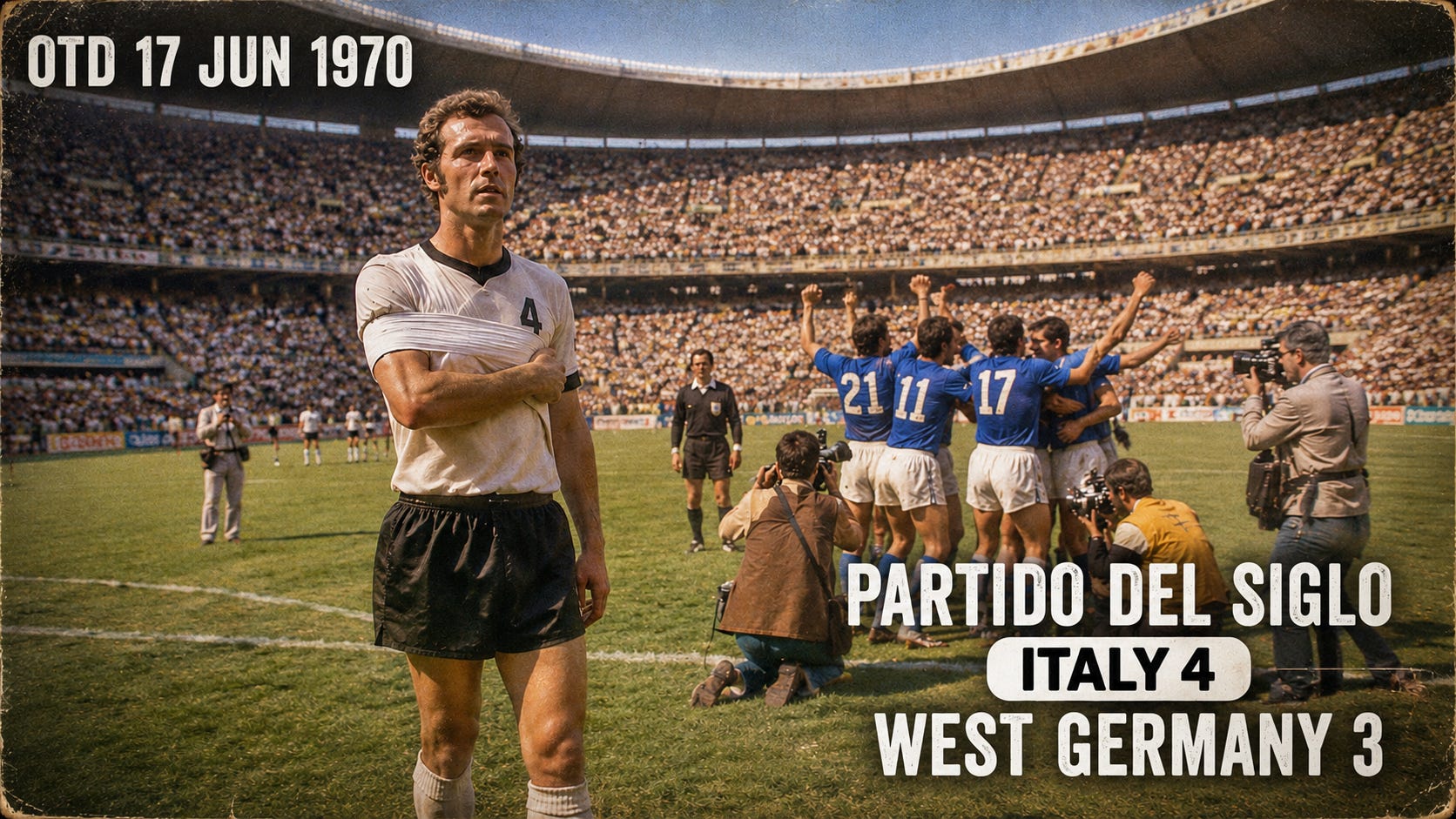
It is 17 June 1970, at the Estadio Azteca in Mexico City. Italy against West Germany, a World Cup semi-final. And today football gives us the Partido del Siglo, the Game of the Century. Italy 4, West Germany 3, after extra time. Seven goals, five of them in extra time, Franz Beckenbauer playing with one arm strapped to his chest, and a match that begins as a tactical contest and detonates into one of the most dramatic half-hours in World Cup history.
How did we get here? This was peak European football. Italy were not just Italy, they were the reigning European champions, having won Euro 1968 at home. They also carried old World Cup prestige, champions in 1934 and 1938. And the club game beneath them was immense: Milan had just won European Cups, Inter had won two, and catenaccio was a European language. The Italy squad was a museum of that world: Facchetti, Burgnich and Mazzola of Inter, Rivera of Milan, Riva and Albertosi of newly-crowned champions Cagliari. The coach, Ferruccio Valcareggi, wrestled with the staffetta, the relay of Mazzola or Rivera, often starting one and bringing the other on at half-time.
West Germany were the team about to define the decade. Finalists in 1966, World Cup winners back in 1954, and now building under Helmut Schön: Sepp Maier in goal, Beckenbauer becoming Der Kaiser, Gerd Müller the most terrifying finisher on earth, Uwe Seeler, Wolfgang Overath, Berti Vogts, and Karl-Heinz Schnellinger, who played his club football in Italy with Milan. The Bundesliga was entering its great age. Within a few years Bayern would win three European Cups in a row. So this semi-final was not simply two national teams. It was Serie A and the Bundesliga, catenaccio and movement, Italy’s reigning European champions against West Germany’s coming empire.
Italy’s group stage had not been glorious, one goal scored in three games, but they beat Mexico 4-1 in the quarter-final and suddenly looked alive. West Germany were more explosive throughout, and in their quarter-final took revenge on England for 1966, coming from 2-0 down to win 3-2 in extra time through Müller. And now the semi-final.
After only eight minutes, Italy struck: Boninsegna drove forward and finished low. 1-0. Then the match became what Italy wanted, control, space denied, Germany pushing, Italy blocking. For long stretches it was tense rather than wild, and the first half ended 1-0. The second half became a German siege, Overath, Grabowski, Seeler and Müller probing, Beckenbauer stepping forward. Then, around the 65th minute, the image that entered football history: Beckenbauer drove into the Italian area, was fouled, fell, and dislocated his shoulder. Today he would come off. But West Germany had used both permitted substitutions, so he played on, his damaged arm strapped across his chest before extra time. He could not really use it, could not properly enter duels, and kept playing. Courage becoming iconography.
And still Italy led, into stoppage time. Then West Germany threw the ball forward one last time, it came across the box, and there at the far post was Karl-Heinz Schnellinger, the AC Milan defender who had never scored for West Germany. He volleyed in. 1-1. The German commentator’s line became immortal: Ausgerechnet Schnellinger. Of all people.
And now, after 90 minutes of containment, the match exploded. In the fourth minute of extra time, Müller pounced. 2-1 Germany, Italy behind for the first time all night. Four minutes later, the defender Tarcisio Burgnich equalized. 2-2. Then Gigi Riva finished with that brutal left foot. 3-2 Italy. Then, in the 110th minute, Müller headed his second. 3-3. And here came a little psychological masterpiece: Gianni Rivera, blamed by Albertosi for Müller’s goal, knowing it, with the camera still replaying the equalizer, received Boninsegna’s low cross and side-footed it calmly home. 4-3 Italy. There were still minutes left, Beckenbauer still strapped and stubborn, but this time the score held. The Game of the Century.
Did people know at once what they had seen? Yes and no. They knew it was extraordinary, more than 30 million watched in Italy alone, many awake until nearly two in the morning, streets filling in celebration. But mythology takes time. The plaque outside the Azteca came later, and it now reads that the stadium pays homage to Italy and Germany, protagonists of the Partido del Siglo. Most matches get statistics. This one got architecture. The stadium itself says: remember this.
Italy paid a price. They reached the final against Brazil four days later and lost, in one of the great finals. Their epic semi-final became, cruelly, a gateway to exhaustion. West Germany turned their pain into power: European champions in 1972 with maybe their most beautiful side ever, world champions at home in 1974, while Bayern won three straight European Cups. Italy’s path was more jagged, but it led to revenge in the 1982 World Cup final, beating West Germany 3-1 in Madrid. If 1970 is the shared fever dream, 1982 is the Italian coronation. And the whole rivalry kept drawing its personnel and its language from Serie A and the Bundesliga.
That is why 17 June 1970 matters. The Game of the Century was not a random thriller. It was two football supercultures at full strength, and it became immortal because it changed identity again and again: Italy in control, Germany rescued, Germany ahead, Italy ahead, Germany level, Rivera redeemed, Beckenbauer injured and still playing.
🎙️ THE PODCAST GOES DEEPER. The full episode has more on Italy’s Euro 1968 win, the staffetta, West Germany’s quarter-final revenge over England, the goal-by-goal of extra time, the Beckenbauer injury, the aftermath for both nations through 1972, 1974 and the 1982 final, and the Azteca plaque. That is the 10-minute version.
---
🎧 Listen on Spotify, Apple Podcasts, Amazon Music, Overcast, iHeart, and YouTube.
📩 Got an episode idea? otd@17lawsguy.com
Yesterday: 16 June 1950, Maracanã Opens.
Tomorrow: 18 June 2002, South Korea, Italy, and Byron Moreno.