

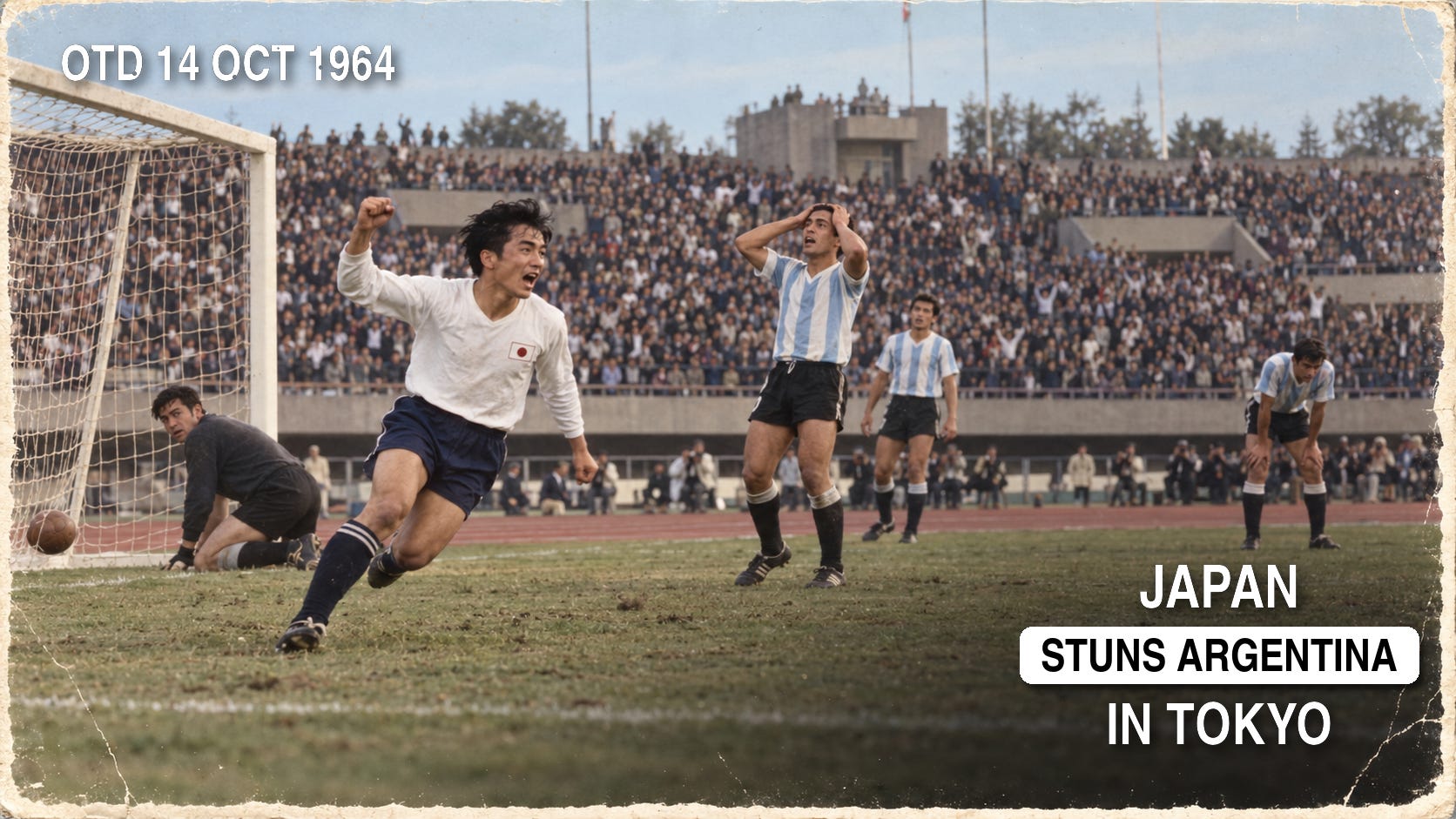
It is 14 October 1964, and Argentina are playing two international football matches on the same day, almost 11,000 miles apart.
In Santiago, the senior national team face Chile at the Estadio Nacional. This is the Argentina of Antonio Rattín, José Ramos Delgado, Ermindo Onega and Ángel Clemente Rojas, coached by José María Minella. They have already won the first leg of the Copa Carlos Dittborn 5-0. A 1-1 draw will complete the job.
In Tokyo, Argentina’s Olympic side lead Japan 2-1 with nine minutes remaining. Juan Carlos Domínguez has scored both goals. The Japanese hosts are heading toward defeat in their opening match at their own Games.
Then Saburo Kawabuchi equalizes in the 81st minute.
One minute later, Aritatsu Ogi scores again.
Japan 3-2 Argentina. The stadium erupts. Japan have beaten one of football’s great nations, reached an Olympic quarterfinal for the first time and given their country a victory that will still appear in the Japan Football Association’s institutional history decades later.
Kawabuchi’s place in that history has only begun. Twenty-nine years later, he will stand at the center of the launch of the J.League.
On this day, however, he is simply the man who has helped turn the final nine minutes into Japanese football’s first great homecoming.
How did we get here?
Argentina and Japan received football from Britain, but they made very different journeys with it.
In Argentina, the game traveled through ports, railways, clubs and British schools. Alexander Watson Hutton, a Scottish schoolteacher, became its most important early organizer. On 21 February 1893, he founded the Argentine Association Football League with representatives of Quilmes, Caledonians, St. Andrew’s, English High School, Lomas and Flores. It was not the country’s first attempted association, but it endured and became the institutional ancestor of the Argentine Football Association.
Argentina played Uruguay in what both associations recognize as their first official international in 1902. The rivalry across the Río de la Plata accelerated everything: regular internationals, the South American Championship from 1916, tactical invention and a football culture that quickly stopped feeling imported. By the 1920s, Argentina and Uruguay were among the world’s best.
The 1928 Olympic tournament brought Argentina’s first great football expedition beyond South America. They crossed the Atlantic, reached the final in Amsterdam and drew 1-1 with Uruguay before losing the replay 2-1. Olympic silver was followed by another defeat to Uruguay in the 1930 World Cup final. Argentina had not yet become world champions, but nobody could mistake them for an emerging football country.
Japan’s path was slower and more institutional.
The JFA traces the game’s introduction to 1873, when Royal Navy officer Archibald Lucius Douglas and other British instructors taught it to cadets at the naval academy in Tsukiji. Football then spread through schools and universities rather than a professional club system. Tokyo Higher Normal School represented Japan at the Far Eastern Championship Games in 1917. The Japan Football Association was founded in 1921 and joined FIFA in 1929.
Japan’s first Olympic football appearance produced a result that became the “Miracle of Berlin.” In 1936, they recovered from 2-0 down to beat Sweden 3-2. Italy then beat them 8-0 in the quarterfinals. Japan returned at Melbourne in 1956 after an extraordinary qualifier against South Korea: the teams were level on aggregate, so the Olympic place was decided by drawing lots. Australia eliminated Japan 2-0 in the opening round.
The competitive gap with Argentina remained enormous. Argentina had a professional league from 1931, world-famous clubs and generations of players exported across South America and Europe. Japan still depended on universities and company teams. The countries had no previous official senior international against one another. Their first meeting arrived because Tokyo had spent years insisting that the Olympics belonged in Asia.
Tokyo had originally been awarded the 1940 Games. Japan surrendered them in 1938 amid international pressure and the escalating war in China; the Games were eventually canceled altogether. After the Second World War, Tokyo returned to the Olympic movement and bid for 1960. Rome won that vote in 1955. Tokyo immediately pursued 1964 and won in 1959.
The Games became an announcement of postwar recovery. Japan built expressways, modernized Tokyo, opened the Tōkaidō Shinkansen days before the opening ceremony and used satellite transmission to send Olympic pictures across the Pacific. The first Summer Olympics staged in Asia were also a carefully constructed national reintroduction, nineteen years after defeat in war.
Football had its place in that project, but Japan knew that hosting qualification guaranteed only admission, not credibility.
The JFA brought Dettmar Cramer from West Germany in 1960 to help prepare the national team. Ken Naganuma was the head coach; Cramer was the transformative technical adviser whose authority often made him appear to be the team’s principal coach. He introduced a more systematic training culture: repeated work on fundamentals, movement, short passing, fitness and preparation planned over years rather than assembled around individual fixtures.
The players were not professionals in the modern sense. They came from universities and company teams, training around education or employment. Kunishige Kamamoto was still at Waseda University. Kawabuchi played for Furukawa Electric. Ogi represented Toyo Industries. Goalkeeper Kenzo Yokoyama and defender Ryozo Suzuki were also part of a generation that would carry Japanese football from corporate competition toward a national league.
Preparation did not make Japan look invincible. Their results in the months before the Games included difficult defeats, and an unsuccessful Merdeka Tournament campaign underlined the distance still to travel. Cramer’s contribution was not a promise that Japan would suddenly become Argentina. It was the creation of a team capable of recognizing and exploiting a moment.
Argentina had to qualify.
The South American pre-Olympic tournament was held in Peru in May 1964. Ernesto Duchini’s team beat Colombia 2-0, Ecuador 1-0, Chile 4-0 and Uruguay 3-1. Against Peru at Lima’s Estadio Nacional, Néstor Manfredi scored to put Argentina ahead.
What followed dwarfed football. A late Peruvian equalizer was disallowed. Spectators entered the field, police fired tear gas into the stands and people fleeing the gas found exits obstructed by closed shutters. At least 328 people died in the crush, making it the deadliest stadium disaster in football history. The match was abandoned with Argentina awarded a 1-0 victory. The tournament could not continue normally. Argentina, with five wins from five and an 11-1 goal record, qualified in first place; Brazil later defeated Peru in a playoff for the second berth.
Olympic football in 1964 was not an under-23 competition. That age restriction would arrive much later. It was governed by Olympic amateur rules, increasingly artificial in a sport whose strongest countries were professional. Argentina therefore traveled with a separate Olympic selection, not Minella’s senior side.
That distinction explains the two Argentinas of 14 October.
The senior team had enjoyed an outstanding year. At the Nations’ Cup in Brazil, Argentina beat Portugal 2-0, the hosts 3-0 and England 1-0. In September they beat Chile 5-0 in Buenos Aires in the first leg of the Copa Carlos Dittborn, a bilateral trophy named for the Chilean organizer who had driven the country’s successful 1962 World Cup preparations but died before the tournament began.
The return in Santiago was scheduled during the Olympics. Chile led through Carlos Verdejo in the 23rd minute. Rattín equalized in the 39th. Before 63,000 spectators, the senior sides finished 1-1, giving Argentina a 6-1 aggregate victory.
Tokyo told a different story.
Italy’s removal over amateur-eligibility questions had reduced Group D to three teams: Argentina, Ghana and Japan. Argentina opened on 12 October with a 1-1 draw against Ghana. Japan began two days later at Komazawa Stadium, before 13,000 spectators.
Naganuma selected Yokoyama in goal; Hiroshi Katayama, Yoshitada Yamaguchi, Suzuki, Mitsuo Kamata and captain Shigeo Yaegashi formed the defensive structure; Ogi, Kamamoto, Ryuichi Sugiyama, Kawabuchi and Teruki Miyamoto supplied the attacking threat. Argentina included goalkeeper Agustín Cejas and a defender who would become a giant of the country’s game: Roberto Perfumo.
Argentina struck first after twenty-four minutes through Domínguez. Japan went into halftime 1-0 down, but Sugiyama equalized in the 54th minute. Eight minutes later, Domínguez scored again.
Japan trailed 2-1 into the final ten minutes. Then the training, the home crowd and the refusal to accept the expected hierarchy converged.
Kawabuchi made it 2-2 in the 81st minute. The official JFA account also credits him with creating the next goal. In the 82nd, Ogi completed the turnaround.
No long siege separated the equalizer from the winner. Argentina had led twice. In roughly sixty seconds, they were behind.
Yugoslav referee Aleksandar Skorić eventually ended it: Japan 3-2 Argentina.
So what?
The result became a sensation in Japan because it compressed several national stories into one scoreline.
The host country had built an Olympics to demonstrate modernity. Its footballers then beat the representative of a country whose game already possessed professional leagues, continental titles, Olympic silver and World Cup finals. Japan were not claiming equality with Argentina. They had proved that disciplined preparation could produce an afternoon when the old hierarchy failed.
The institutional memory is unusually clear. The JFA still presents the match as a landmark; the Japan Football Museum displays Kawabuchi’s training gear and identifies his goal against Argentina. The International Olympic Committee credits the victory and Japan’s quarterfinal appearance with contributing substantially to football’s development in the country.
Argentina experienced it differently. The senior national team was playing in Santiago on the same date, and the Olympic side was neither the first-choice XI nor the center of the country’s football identity. Argentine records preserve the defeat, and later Argentine retrospectives recognize Japan’s giant-killing, but the result did not acquire the national-trauma status that a World Cup loss would have carried.
That does not make Japan’s win counterfeit. It tells us exactly what Olympic football was. The tournament brought together teams formed under unequal national interpretations of amateurism. Famous football countries could send selections far removed from their senior sides, while countries without professional football could field something closer to their best available team. The competition was real; the labels concealed different things.
Japan’s reward came immediately. The victory ensured that they would progress from the three-team group. Ghana beat Japan 3-2 two days later and won the section, but Japan entered the knockout stage for the first time. Czechoslovakia, the eventual silver medalists, beat them 4-0 in the quarterfinal. A subsequent classification match ended in a 6-1 defeat to Yugoslavia.
The ending therefore was not a medal, but a beginning.
In 1965, the Japan Soccer League created the country’s first national league, built around company teams. Cramer had advocated stronger regular competition, and many of the people shaped by his methods carried the idea forward. Four years after Tokyo, Japan won bronze at the Mexico City Olympics. Kamamoto scored seven goals to finish as the tournament’s leading scorer; Sugiyama supplied chances, Yokoyama saved a penalty in the bronze-medal match and Japan beat host Mexico 2-0.
That remains Japan’s only men’s Olympic football medal. Later generations came close: Japan finished fourth in 2012 and again at the delayed Tokyo Games in 2021. The senior national team did not reach a World Cup until 1998, but has qualified for every edition since. The distance from 1964 to that consistency runs through domestic structures rather than one isolated upset.
Nobody embodies that continuity better than Kawabuchi.
He had scored Japan’s 81st-minute equalizer and assisted Ogi’s winner. He later coached the national team, became a leading administrator and drove the professional-league project that launched as the J.League in 1993. The former Furukawa Electric player helped replace company identity with community-based professional clubs. A man inside Japan’s breakthrough victory over Argentina became one of the principal architects of the system designed to make such victories less surprising.
Ogi also became an important coach and administrator. Kamamoto became Japan’s defining striker of the era. The Tokyo team did not vanish into a commemorative photograph; its members helped build the next layer.
Argentina’s Olympic squad also contained careers that escaped the defeat. Cejas became one of Racing Club’s great goalkeepers and won the Copa Libertadores and Intercontinental Cup in 1967. Perfumo became “El Mariscal,” one of Argentina’s finest defenders, played at the 1966 and 1974 World Cups and won major titles with Racing, Cruzeiro and River Plate. Duchini became renowned for identifying and developing young talent. Domínguez’s two goals gave him the match’s most striking individual statistic, but not the result.
Argentina’s Olympic story eventually became far grander. The 1928 silver was followed by another silver in 1996. Marcelo Bielsa’s side won gold without conceding a goal in 2004. Argentina retained the title in 2008 with Lionel Messi, Ángel Di María, Sergio Agüero and Javier Mascherano; Mascherano became only the second male footballer to win two Olympic gold medals. Messi has often described Beijing as one of the most treasured achievements of his career.
Those later tournaments operated under a different settlement. From 1992, the men’s competition became under-23, with three over-age players allowed from 1996. The modern distinction between the Olympic side and the senior national team is explicit. In 1964, amateurism created the division while pretending that it did not.
The two scorelines on 14 October expose the fiction beautifully.
In Santiago, Argentina’s senior team fielded players already established in the country’s professional elite. Rattín, who would captain Argentina at the 1966 World Cup, scored the equalizer. In Tokyo, an Olympic selection featuring several future stars lost to Japan. Both teams wore the national colors. Both results entered official national records of their type. Only one represented Argentina’s strongest football team.
Japan did not need the stronger Argentina to make the day meaningful. They needed the Argentina in front of them, the one leading with nine minutes left.
The lasting importance of the match lies in what Japan did with the feeling it created. The victory connected Cramer’s training ground, the national league that followed, the 1968 bronze and Kawabuchi’s professional revolution. It supplied proof before the infrastructure was complete.
Football countries often mythologize a single upset as the moment everything changed. Structures rarely work that neatly. Japan’s rise took decades, contained failures and did not produce a World Cup appearance for another thirty-four years. Yet institutions need remembered afternoons: evidence that a plan can become visible on the field.
Japan found one at Komazawa.
Argentina played twice that day. The senior team completed a comfortable two-leg success in Chile. The Olympic team led twice in Tokyo. History remembers the result that nobody expected.
Three things to take away
Japan defeated an Argentine Olympic selection, not Argentina’s senior national team. Amateur-eligibility rules created separate squads, and the senior side drew 1-1 with Chile in Santiago on the same date.
The comeback took roughly one minute. Japan trailed 2-1 until Kawabuchi equalized in the 81st minute and Ogi scored the winner in the 82nd.
The goals connected Japan’s football past to its professional future. Kawabuchi later became the driving administrative force behind the J.League, while the Tokyo generation helped establish the Japan Soccer League and win Olympic bronze in 1968.
On This Day...
On 14 October 1964, Japan trailed Argentina twice in their opening match of the Tokyo Olympic football tournament. Sugiyama canceled out Domínguez’s first goal; Domínguez restored Argentina’s lead; then Kawabuchi and Ogi scored in the 81st and 82nd minutes. Japan won 3-2 and reached an Olympic quarterfinal for the first time. On the same date, Argentina’s senior team drew 1-1 with Chile in Santiago. One country had played twice. The result remembered around the world belonged to Japan.
---
Questions, corrections or story ideas: otd@17lawsguy.com
Yesterday: 13 October 1894, When Merseyside Wore Opposite Colors.