

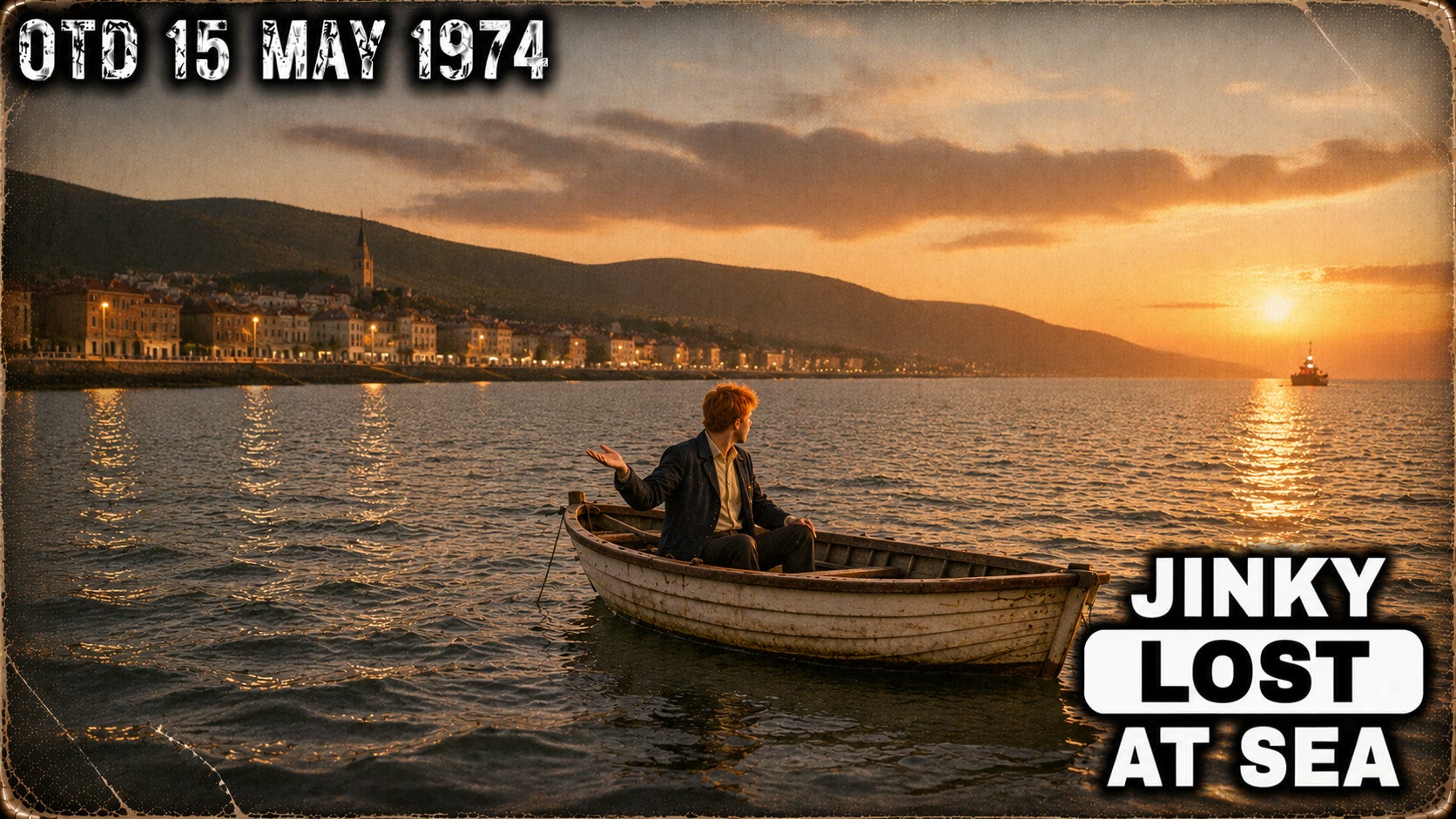
It is 15 May 1974. Largs, on the Firth of Clyde.
Scotland have just beaten Wales 2-0 at Hampden Park. The World Cup is a few weeks away. The players are allowed a few hours off.
And then Jimmy “Jinky” Johnstone, one of the greatest wingers Scotland has ever produced, climbs into a rowing boat.
A teammate gives the boat a push. The tide does the rest.
There are no usable oars. Or no rowlocks to use them properly. Either way, Jinky cannot row back.
Soon, Scotland’s World Cup winger is drifting out toward deeper water, and the coastguard has to be called.
This is the Largs boat incident: funny, dangerous, deeply 1970s, and somehow only a prelude — because three days later, Johnstone walks out at Hampden and helps Scotland beat England 2-0.
Scotland in 1974 was a serious team. Willie Ormond had taken them back to the World Cup for the first time since 1958. Qualification came through a tight group with Denmark and Czechoslovakia. Scotland hammered Denmark 4-1 away, then, at Hampden in September 1973, came from behind to beat Czechoslovakia 2-1. Jim Holton equalized. Joe Jordan scored the winner. Almost 96,000 people were there.
Scotland were going to West Germany. England were not.
That matters. England’s failure to qualify for 1974, after the famous 1-1 draw with Poland at Wembley and Jan Tomaszewski’s night of defiance, changed the mood of British football. So the 1973-74 British Home Championship became more than a mini-tournament. It was Scotland’s send-off.
On 14 May, Scotland beat Wales 2-0 at Hampden. Kenny Dalglish scored. Sandy Jardine added a penalty. On 18 May, Scotland would host England. In between, the squad were based in Largs, around thirty-three miles from Glasgow, at the Queen’s Hotel.
It sounds modest now. But the players liked it. It was homely. It placed them in that very British football culture of the era: hard training, hard matches, and then, when permission was given, a few drinks.
This is where Jinky enters.
Jimmy Johnstone was small, red-haired, fearless, elusive — a winger who seemed to dribble in riddles. At Celtic, he was already legend. A Lisbon Lion. European Cup winner in 1967. Part of the club’s nine-in-a-row Scottish title run. In 1967, he finished third in the Ballon d’Or voting. In 2002, Celtic supporters voted him their greatest player.
But for Scotland, his international career was strangely thin: only twenty-three caps. He was too brilliant to ignore, yet somehow never fully trusted, never fully built around. That tension follows this story.
After the Wales match, Johnstone and some teammates went out. The group included Sandy Jardine of Rangers, Erich Schaedler of Hibs, and Davie Hay, formerly of Celtic and now with Chelsea. They had a few drinks. They returned toward the hotel along the seafront. They saw a rowing boat.
Jinky climbed in.
Sandy Jardine later joked that he gave the boat a push and was “doing his bit for Rangers.” The joke worked because of who they were: Celtic’s Jinky, Rangers’ Jardine, Scotland teammates, club rivalry turned dressing-room mischief.
But then the joke became real. The boat moved out. The tide carried it. The players realized Johnstone could not get back. Some accounts say there were no oars. Others say the problem was no rowlocks. Either way, he was adrift.
There was an attempted rescue. Another boat was found. Davie Hay and Erich Schaedler tried to go after him. That boat leaked. They had to turn back.
So now the coastguard was involved.
This was not just boys being boys. This was Scotland’s World Cup camp, a national-team player, out on the water, needing rescue in the middle of the night. The press loved it. The SFA did not.
Astonishingly, it did not stop Jinky.
Three days later, Scotland played England at Hampden. And Johnstone was brilliant. Scotland won 2-0. Both goals were England own goals — Mike Pejic and Colin Todd — but the match is remembered for Scotland’s pace, threat, and superiority. Johnstone ran England ragged. Emlyn Hughes later said he was embarrassed to come off the pitch, and that Jimmy Johnstone had absolutely crucified him.
That is the absurd beauty of the story. One day, Jinky is being rescued by the coastguard. A few days later, he is tormenting England.
But consequences did follow. Johnstone was disciplined. He was selected for the World Cup squad, but he did not play a minute in West Germany. Whether that was pure selection, distrust, punishment, or all of those mixed together, the result was the same. Scotland went unbeaten in the tournament — beat Zaire, drew with Brazil, drew with Yugoslavia — and still went out on goal difference. Jinky watched.
That is one of football’s quiet what-ifs. Would he have changed anything? Maybe not. But when a side exits unbeaten, every unused weapon becomes a question.
The story also belongs to a wider culture that has changed. In 1970s British football, alcohol was everywhere. Players drank. Managers sometimes tolerated it, sometimes joined the social world around it, sometimes fought it. George Best became the most famous warning sign of genius and alcohol intertwined, but he was not alone.
A modern World Cup camp is controlled: security, media, phones, GPS, nutrition, recovery, safeguarding, reputation management. The head coach would not simply send players into town for a few drinks two days before England.
But alcohol has not left football. It has moved — into the fan journey, into sponsor culture, into pub culture, into national-team travel. Scotland’s return to the World Cup in 2026 is already a Tartan Army story as much as a football story: travel plans, bars, songs, kilts, and the old hope that everyone gets home safely.
That is the real lesson of Largs. The game grew up. But not because it stopped being human.
🎙️ The full episode (linked above) has more — including Jinky’s later career arc (San Jose Earthquakes, Sheffield United, Dundee, Shelbourne, Elgin City), the wider Scottish national-team incidents (the 1975 Copenhagen nightclub aftermath, the 1990 Maurice Johnston curfew break), and the legislative changes after the 1980 Scottish Cup final riot. The whole arc is in the audio.
---
🎧 Also available on Apple Podcasts, Amazon Music, Overcast, iHeart, and YouTube.
📩 Got an episode idea? otd@17lawsguy.com
Yesterday: 14 May 1931 — The First Shirt Swap.
Tomorrow: 16 May 1968 — Estudiantes begin their Copa Libertadores dynasty.