

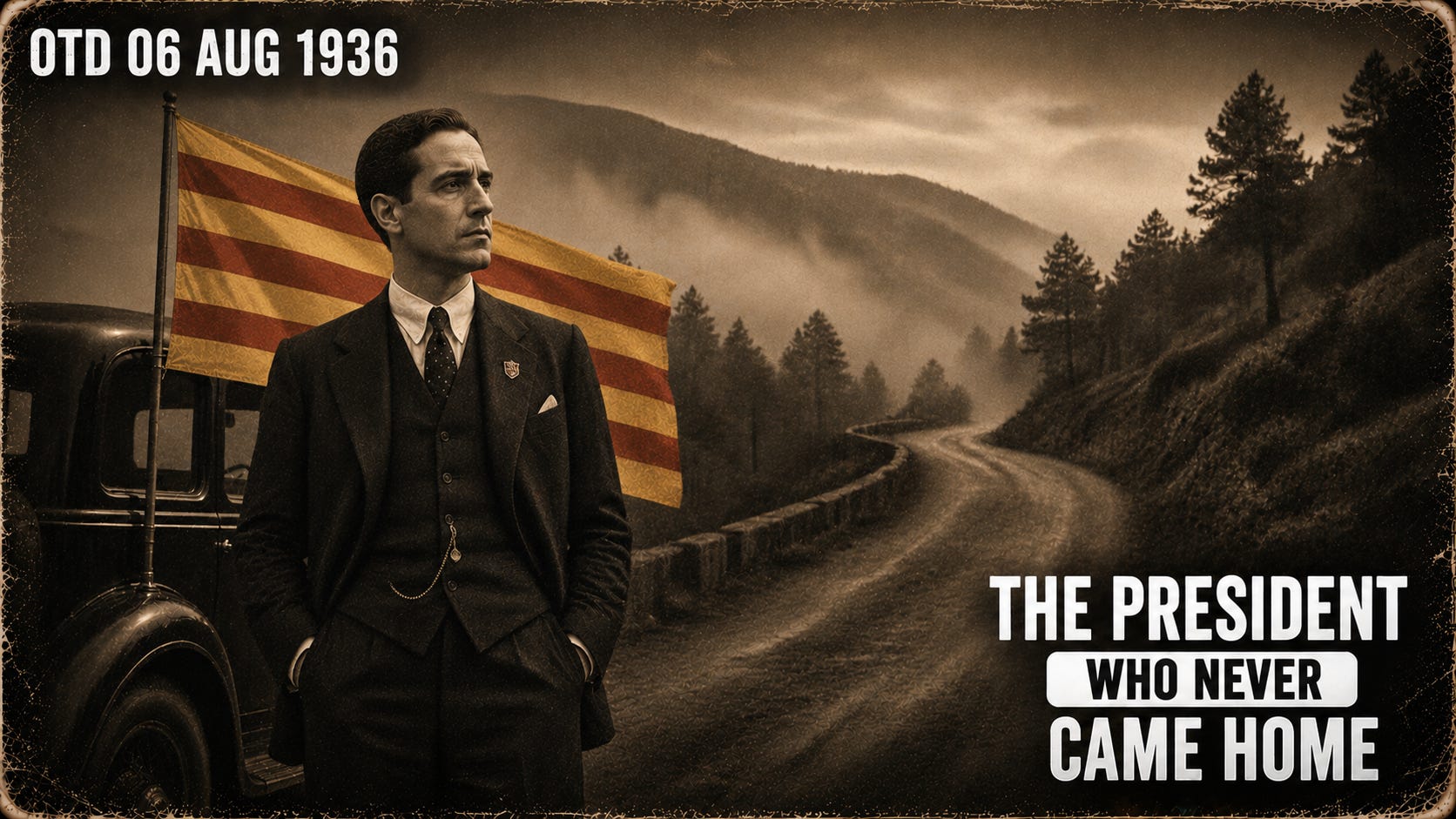
It is August 6, 1936. The Sierra de Guadarrama, northwest of Madrid. A car crosses into the wrong zone of a country that has just fallen into civil war. Inside is Josep Sunyol i Garriga: president of FC Barcelona, Catalan republican politician, publisher, deputy in the Spanish parliament, a man who believed sport and citizenship belonged together. He is stopped by Francoist forces, identified, and shot without trial. Barcelona’s martyr president.
To understand him, start with Barcelona in the 1920s. FC Barcelona was already more than a club before anyone turned that phrase into brand language. Under Primo de Rivera, Catalan identity was treated as a threat. The key moment came in 1925 at Les Corts, when the crowd whistled the Spanish anthem and applauded the British one. The response was brutal: Les Corts was closed, and founder Joan Gamper was forced away. Football was not outside politics, not in Catalonia, not then. That episode made Barça a stronger symbol of Catalan identity, so when the club won the first Spanish league title in 1929, a club was becoming a flag.
Now Sunyol. Born in Barcelona in 1898 into a wealthy family, he became a businessman, journalist, sports organizer, and politician. But his most important idea was simple: sport is not a distraction from civic life, sport is civic life. In 1930 he founded the weekly La Rambla, its slogan esport i ciutadania, sport and citizenship, covering politics and football together, understanding that football crowds are also citizens. There is a lovely detail here. When Barça played away, fans gathered outside La Rambla’s office near Canaletes for score updates posted on a board, and that habit became part of the tradition of Barça celebrations at Canaletes. He was not just writing about the club. He was shaping how the city gathered around it.
Politically he moved into Esquerra Republicana and was elected to parliament in 1931, 1933, and 1936. He sat where Catalan republicanism, sport, journalism, and Barça all met, joining the board in the late 1920s and becoming president in 1935. In 1936 Barça lost the Copa final to Real Madrid, his only major final as president, a symbolic defeat before history turned darker.
In July 1936 the Civil War began, Republicans and Nationalists fighting for the state itself. Barcelona was Republican, and the Sierra de Guadarrama became an early front-line zone. Sunyol was in Madrid, and hearing that Republican forces were doing better than they were near the front, he decided to see it himself. This is where the tragedy becomes almost unbearable. He traveled not as a soldier but as a citizen of the Republic, with a journalist, a lieutenant, and a driver. At kilometer 52 of the Madrid-La Coruña road, they crossed into Nationalist territory without realizing it and were stopped. Sunyol reportedly greeted the men as if they were Republicans. The mistake was fatal. Documents were found, he tried to assert his status as a deputy, and a firing squad was formed. Before the shots, he still had time to cry out for the Republic and for a free Catalonia. He was 38.
His death is one of the clearest reasons why Barça’s political meaning was not invented afterward. The president of FC Barcelona was executed by Francoist forces because of who he was: Catalanist, Republican, public, visible. And his death began a sequence of blows. In 1937 the club toured Mexico and the United States to survive, and some players did not return. In 1938 a bomb struck the club’s headquarters. President killed, team dispersed, headquarters bombed, then dictatorship and the suppression of Catalan identity. Even dead, Sunyol was targeted: the new regime opened a file describing him as responsible for the anti-Spanish direction of FC Barcelona. Recognition came late, only after democracy returned: a street, a monolith, a plaque, a 2011 tribute at the Camp Nou, and in 2015 an Any Sunyol to restore his dignity, with the presidential box given his name. For Sunyol, sport and citizenship were not marketing words. They were a program. If a club can become a flag, enemies of that flag will notice. He understood the promise. His murder shows the cost.
🎙️ THE PODCAST GOES DEEPER. The full episode has the 1925 Les Corts closure, La Rambla and the Canaletes tradition, and the late recovery of Sunyol’s memory. That’s the 10-minute version.
---
🎧 Listen on Spotify, Apple Podcasts, Amazon Music, Overcast, iHeart, and YouTube.
📩 Got an episode idea? otd@17lawsguy.com
Yesterday: 5 August 1973, Chile, Peru, and the road to the ghost match.