

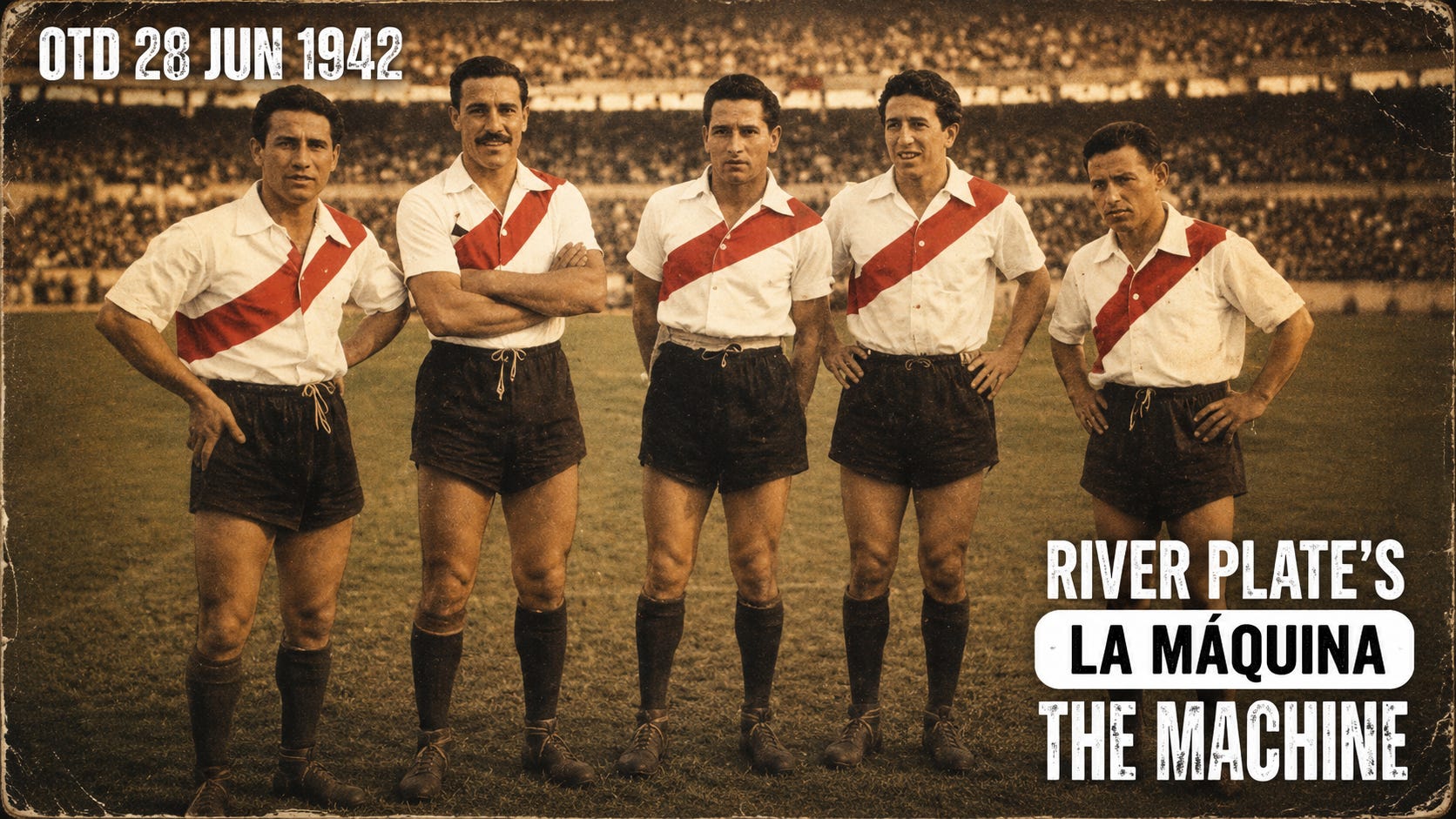
It is 28 June 1942, in Buenos Aires, at the Monumental. River Plate against Platense. And today, a forward line takes the field together for the first time: Muñoz, Moreno, Pedernera, Labruna, Loustau. Five attackers, one nickname. La Máquina. The Machine. River win 1-0, an ordinary-sounding scoreline for the first appearance of one of the most mythologized teams in football history.
Football reached Argentina through British schools, railways and ports, and Buenos Aires grew into one of the great football cities on earth, home to a distinctly Argentine idea of the game the locals called la nuestra, ours: touch, pause, deception, timing, intelligence, rather than English long-ball orthodoxy. When professionalism arrived in the 1930s, the big Buenos Aires clubs could finally become talent machines, and River, Millonarios, the Millionaires, became one of the finest laboratories of that style.
What made La Máquina different was movement above all. Adolfo Pedernera, nominally the centre-forward, dropped deep to conduct and connect, a false nine decades before the phrase existed. Around him the front five rotated, changed lanes, and made room for one another, the ball moving faster than the opponents could understand. On paper it was an ordinary formation. On the pitch it was something nobody quite had the words for, until a journalist found the name. A rival of theirs gave the truest tribute: he played against them wanting to win, but as a football fan he would rather have been in the stands watching them.
And here is the wonderful catch, the part that makes the myth so strange. The famous five played together only eighteen times. Eighteen. Lineups changed, injuries struck, players came and went, one left for Mexico mid-decade. The real River of the 1940s was broader than the postcard. And yet, more than eighty years later, we still recite all five names, because the postcard captured an idea rather than a spreadsheet: football as motion, as intelligence, as collective improvisation.
That idea travelled astonishingly far, and the chain is worth pulling, though I will leave its full length for the episode. A young Alfredo Di Stéfano grew up inside River’s world, absorbed it, and became the explosion that followed Pedernera’s brain. A players’ strike then scattered Argentine talent abroad, Pedernera to Colombia’s outlaw golden age, and Di Stéfano with the current that eventually carried him to Real Madrid and the first great European Cup dynasty. We should not say La Máquina caused all that. But without it, the thread that runs to Madrid’s five straight European Cups simply does not exist in the same way.
That is the lesson of La Máquina. A team does not need hundreds of matches to become eternal. It needs the right players, at the right club, in the right culture, playing football people did not yet have words for. Then someone finds the words.
🎙️ THE PODCAST GOES DEEPER. The full episode has what this post holds back: the origin of the nickname before the five had played together, how the rotations actually worked, the supporting players who made the front five look inevitable, the 1948 strike and Colombia’s El Dorado, and the full chain from Pedernera to Di Stéfano to Bernabéu and Real Madrid. That is the 10-minute version.
---
🎧 Listen on Spotify, Apple Podcasts, Amazon Music, Overcast, iHeart, and YouTube.
📩 Got an episode idea? otd@17lawsguy.com
Yesterday: 27 June 1954, The Battle of Berne.
Tomorrow: 29 June 1958, the day Brazil finally became Brazil.