

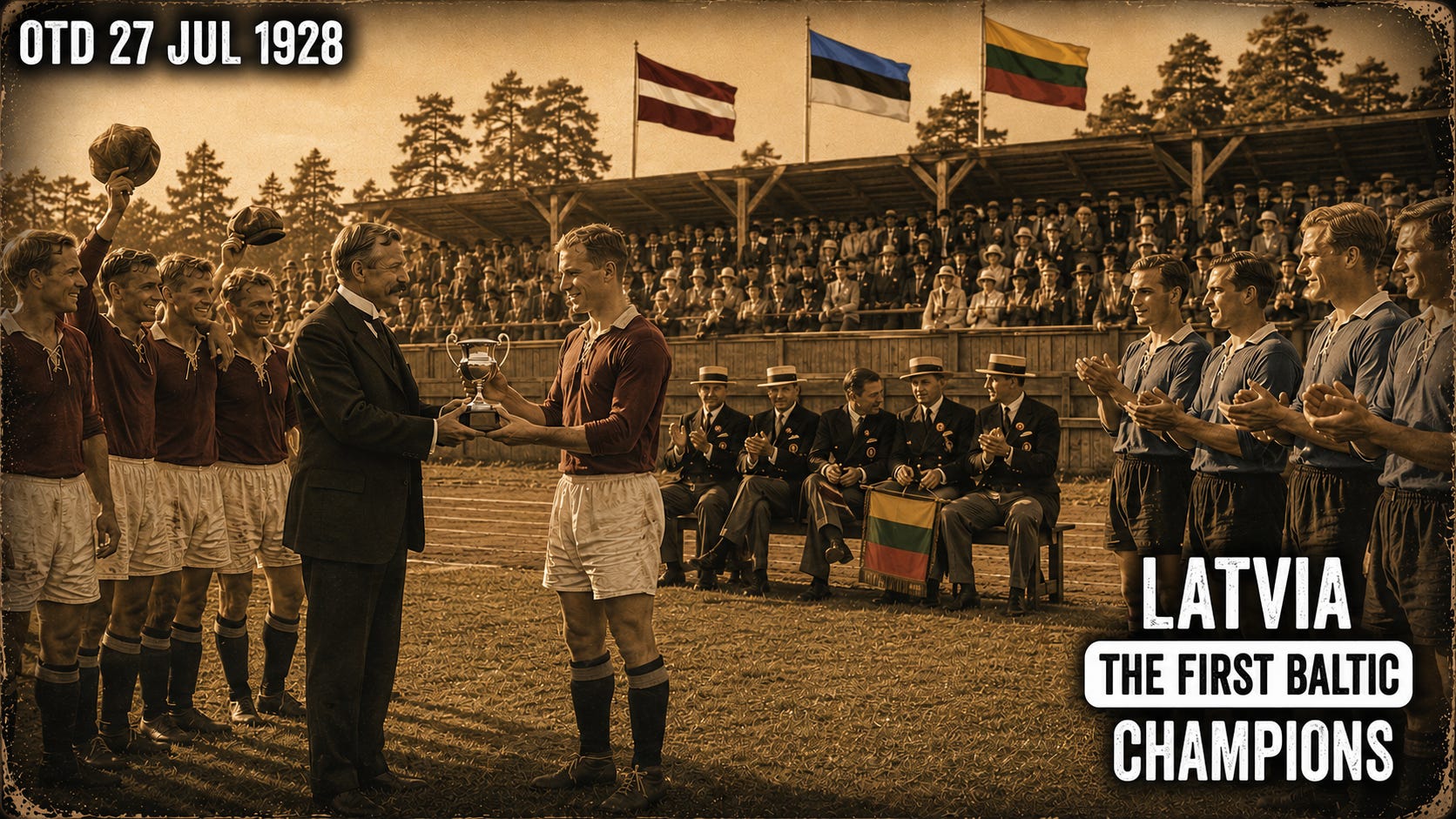
It is July 27, 1928. Tallinn. Kadriorg Stadium. Estonia against Latvia, the final match of the first Baltic Cup. Latvia win 1-0, and become the first Baltic champions.
A small tournament. Not a small story. Because in 1928, European football is arguing with itself about the Olympics, professionalism, FIFA’s authority, regional competitions, and whether a World Cup should exist at all. The Baltic Cup is born inside that argument.
Start with the Europe that produced it. The First World War has redrawn the map. Empires have fallen. Latvia, Estonia, and Lithuania are independent, young, and building ministries, armies, schools, currencies, flags, and football teams. In this period international football is never only sport. A fixture is a diplomatic act. A shirt is a state document with sleeves. For the Baltic countries, football becomes a way of saying: we are here, we belong to Europe, and we can meet our neighbors as equals.
Meanwhile the sport’s administration is in open conflict. Olympic football has become the closest thing to a world championship, and Uruguay’s victories in Paris in 1924 and Amsterdam in 1928 have shown Europe that world football is bigger than Europe imagined. FIFA sees the problem clearly: the Olympic tournament is prestigious, but it belongs to the Olympic movement, and that movement is trapped in amateurism while football moves somewhere else. Professionalism is already legal or emerging in Austria, Hungary, Czechoslovakia, and Italy.
So Europe organizes in layers. Hugo Meisl and others create the Mitropa Cup in 1927, a club competition for Central Europe decades before the European Cup. The Central European International Cup starts long before the European Championship. And the resistance organizes too: in 1928, England, Scotland, Wales, and Ireland withdraw from FIFA again over amateurism and broken-time payments, while Denmark, Sweden, and Norway are uneasy about where FIFA is heading.
That is the weather. The Nordic countries have their championship. The Balkans are about to create the Balkan Cup. And the Baltics create the Baltic Cup. Not one manifesto, but a map of self-organization: if FIFA is building a world tournament, these regions want competitions that fit their geography, their politics, and their level.
Latvia, Estonia, and Lithuania had been playing each other through the 1920s, but there was no trophy. Estonia had claimed informal regional superiority. Latvia and Lithuania had ambitions of their own. So the three associations turn neighborhood football into a tournament: Tallinn, Kadriorg Stadium, three teams, three matches, a round robin, July 25 to 27.
On July 25, Latvia beat Lithuania 3-0. On July 26, Estonia beat Lithuania 6-0, with Arnold Pihlak scoring heavily enough to finish as the tournament’s top scorer. Which makes July 27 decisive: the hosts against the team that has already won. A small stadium, a modest crowd, and a genuine international final in miniature.
Latvia score. Estonia do not. Estonia 0, Latvia 1.
Latvia go on to be the strongest side of the pre-war Baltic Cup, winning it repeatedly before the Second World War closes that world entirely. Occupation, annexation, and Soviet control erase the independent national teams from the international map, and the tournament in its original meaning cannot continue. Which is exactly why its return in the early 1990s matters so much: when the three countries regain independence, the cup becomes restored statehood in football form. The old shirts are back. The old neighbors are back. The old argument is back.
Latvia’s greatest later echo comes in 2004, when they beat Turkey in a playoff to reach Euro 2004 and draw 0-0 with Germany, still the only Baltic men’s team to reach a European Championship.
As for the rebellion, FIFA won. The World Cup went ahead in 1930, imperfect and thinly attended by Europe, and proved the idea could live. Italy 1934 proved it could grow. But the layers survived, and one of the oldest of them was built in three days in Tallinn by three countries that had only just appeared on the map.
🎙️ THE PODCAST GOES DEEPER. The full episode has the Home Nations’ 1928 withdrawal from FIFA, the Mitropa Cup and Nordic parallels, and the Baltic Cup’s Soviet interruption. That’s the 10-minute version.
---
🎧 Listen on Spotify, Apple Podcasts, Amazon Music, Overcast, iHeart, and YouTube.
📩 Got an episode idea? otd@17lawsguy.com
Yesterday: 26 July 1979, Bolivia beating Brazil and Argentina in eight days in La Paz.
Tomorrow: 28 July 1962, the birth of the Bundesliga.