

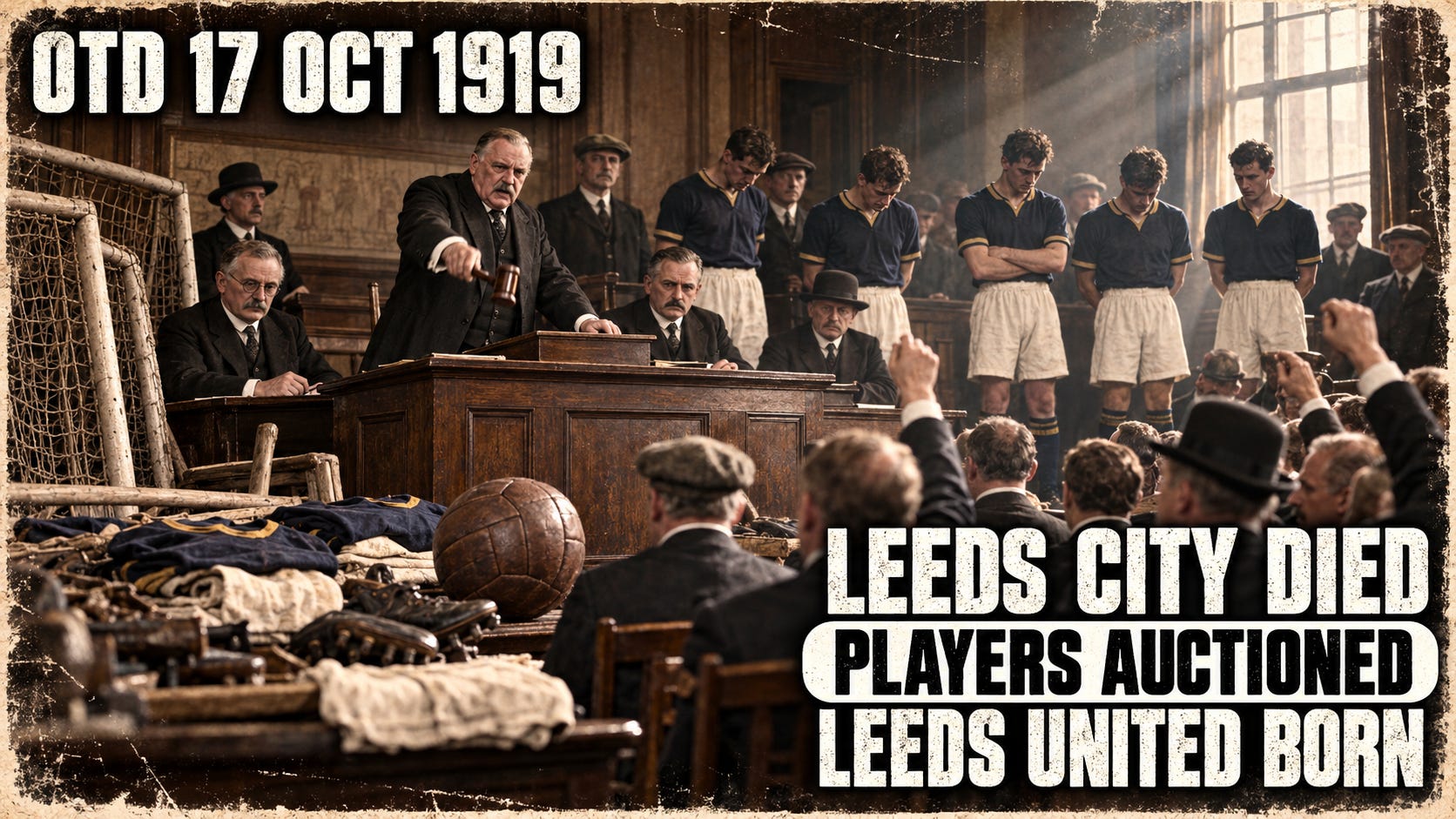
At two o’clock on October 17, 1919, representatives of roughly 30 football clubs gathered inside Leeds’s Metropole Hotel. They were not there to discuss a fixture, vote on a rule, or celebrate the return of peacetime football. They had come to bid.
Leeds City had just been expelled from the Football League. Its players needed new employers. So did its shirts, shorts, boots, nets, and goalposts. The club was being dismantled in a hotel room, lot by lot, as if it were a failed factory.
The language surrounding the sale was ugly even at the time. Critics called it a “slave market” and “blood money.” The League presented it as an emergency placement system, a fast way to keep professional players in work after their club had been erased during the season. Both descriptions captured something true. The auction found jobs, but it did so by turning human careers into public inventory.
And then, only hours later, about 1,000 supporters crowded into Salem Hall in Holbeck and voted unanimously to create a new professional club. They called it Leeds United.
One October day therefore contained a funeral, an auction, and a birth. Yet the scandal that brought everyone to those rooms had been building for years.
How did we get here?
Leeds was a major industrial city, but association football had struggled to establish the kind of hold enjoyed by the rugby game. Leeds City was formed in 1904 and moved into Elland Road after Holbeck Rugby Club folded. The club entered the Football League in 1905 and spent its entire League life in the Second Division.
The early years were not glamorous. Secretary-manager Gilbert Gillies was followed by Frank Scott-Walford, results remained modest, and crowds did not always match the ambitions of a large city club. Elland Road was improved, including the construction of the stand later remembered as the Scratching Shed, but the economics were fragile. In 1912, the bank called in an overdraft of about £7,000. Chairman Norris Hepworth reportedly put in £15,000 to keep the club alive.
Then came Herbert Chapman.
Chapman arrived in 1912 with a reputation still to make. He helped persuade the League to re-elect Leeds City, recruited intelligently, and introduced ideas that later became signatures of his management: careful preparation, attention to players’ physical condition, and an insistence that a club should think beyond the next Saturday. City finished sixth in 1912-13. In 1913-14 they climbed to fourth, their best League position, missing promotion by two points. Billy McLeod scored heavily, crowds grew, and a club that had nearly disappeared began to look capable of reaching the First Division.
There were already warnings. Leeds were fined after an inquiry found that three players had been promised more than the maximum wage. But the fine was survivable, and the football was improving. Chapman believed Leeds could support a top-level side. For a brief moment, the evidence was beginning to agree with him.
The First World War changed everything. The Football League suspended its national competitions after 1914-15, although regional wartime football continued. Players were scattered among the armed forces and essential industries, so clubs relied on guests who were registered elsewhere. The authorities permitted expenses, but not ordinary professional wages. The policy was meant to acknowledge national sacrifice and prevent clubs from commercially exploiting wartime competition.
It also created a temptation almost designed to be broken. Good players drew crowds. Crowds produced gate money. Clubs wanted good players. Quiet payments were widely suspected, and probably widespread, but secrecy made the system dependent on loyalty, personal alliances, and records that nobody outside a club was supposed to see.
Chapman left day-to-day football work for a senior position at the Barnbow munitions works. His assistant, George Cripps, handled administration, while chairman Joseph Connor and fellow director J. C. Whitehurst became involved in team selection. This was not merely an improvised chain of command. It was a collection of people who distrusted one another.
Connor accused Cripps of mishandling the finances. The board installed an accountant’s clerk to keep the books, while Cripps retained football duties. Players then threatened to strike if Cripps traveled with them. When Chapman returned in 1918, Cripps was pushed back toward his old subordinate role and threatened to sue for wrongful dismissal.
Cripps also possessed leverage. He claimed he could prove that Leeds City had paid players illegally during the war. Some of the guests were famous, including England internationals Charlie Buchan and Fanny Walden. A compromise followed. Cripps received a settlement, and documents connected to the payments were placed in the custody of the club’s solicitor. The immediate dispute was contained. The danger was not.
The next fracture involved fullback Charlie Copeland. Before the League resumed in 1919, Copeland wanted better terms. Leeds offered £3 10s for reserve appearances and £4 for first-team football, with no summer wage. He demanded £6. The board refused and released him to Coventry City.
Copeland retaliated. In July 1919, he wrote to the Football League alleging that Leeds City had made illegal payments and bonuses during the wartime competitions. He also indicated that documentary evidence existed. His solicitor was James Bromley, the same former City director who had represented Cripps. A pay dispute had opened a door into years of boardroom warfare.
The central allegations concerned unlawful player payments in a wartime competition, while the surviving story also contains accusations of coercion, private settlements, and financial concealment. But the authorities did not expose a neat ledger proving every payment. The decisive offense was the club’s refusal to produce the records demanded by a joint FA and Football League inquiry.
On September 26, the inquiry ordered City to provide the relevant documents by October 6. The board argued that the papers were private or unavailable. The directors resigned. Later accounts even describe the books being destroyed in a fire, although the murkiness surrounding the records is precisely why the story has accumulated competing versions.
What is clear is that football’s authorities lost patience. League president John McKenna had warned during the war that clubs breaking the no-pay rule should be put out of the game. Now the governing bodies had an accused club that would not open its files. Noncooperation became, in their eyes, proof enough.
Leeds City’s last match came at Wolverhampton Wanderers on October 4. A rail strike forced the party to travel by charabanc. Leeds won 4-2, with Billy McLeod scoring three times. In one of the strangest details in this entire story, the club party reportedly gave Copeland a lift on the return journey.
There would be no next match. City’s visit to South Shields was postponed. The Football League expelled the club after eight games of the 1919-20 season. Five officials, including Connor, Whitehurst, and Chapman, were banned for life. The punishment fell not only on those who had controlled the books, but also on a manager whose wartime employment had kept him away from much of the conduct under investigation.
The Football League now faced an extraordinary problem. A Second Division club had vanished in October, leaving results already recorded and fixtures still to play. Port Vale supplied the solution.
Vale had missed election to the enlarged League in March by one vote. On October 13, they were admitted in Leeds City’s place. They inherited City’s record of four wins, two draws, and two defeats, as well as the remaining schedule. Five days later, short of properly registered players and with no time to prepare their ground, Port Vale began their League life with a 2-0 defeat at South Shields.
This was sporting identity treated as an administrative slot. Leeds City’s points and fixture line continued, but under another club’s name and with another club’s players. Football had found a way to finish its table even while destroying one of its members.
That left Leeds City’s squad. At the Metropole Hotel on October 17, the League staged its auction. The best-known club account says 16 first-team players were bought by nine clubs for £9,250. Other detailed reconstructions count a wider group of 22 players and a total of £10,150. The difference appears to depend on which registrations and lots are included. The essential fact is not disputed: the workforce and physical property of a professional club were sold in one afternoon.
Billy McLeod brought the highest bid, £1,250 from Notts County. Other players went to Aston Villa, Manchester City, Sheffield Wednesday, South Shields, Rotherham County, Grimsby Town, Lincoln City, and elsewhere. Billy Kirton moved to Aston Villa and, before the season was over, scored the winning goal against Huddersfield Town in the FA Cup final.
The setting made the indignity sharper. A club born with civic ambition was reduced to an invitation asking League representatives whether they desired the transfer of any Leeds player and could attend a hotel at 2 p.m. The gavel was a verdict on more than footballers. Shirts, boots, nets, and goalposts followed them into the sale.
Alf Masser refused to accept that league football in Leeds should be sold away with the equipment. Masser, a solicitor and former Leeds City vice-chairman, helped organize a public meeting at Salem Hall. Around 1,000 people attended. They voted to form a new professional club and a supporters’ club. The chosen name made the ambition explicit: Leeds United.
It was not a legal continuation of Leeds City. It did not inherit City’s Football League membership or players. It was a fresh institution built by people determined that the city should not lose the game because a board had failed it.
United joined the Midland League later that month, taking the place vacated by Leeds City’s reserves. Yorkshire Amateurs gave up their tenancy of Elland Road so the new club could use it. Leeds United played their first friendly there in November, then began competitive life against reserve and works teams. On May 31, 1920, the League elected Leeds United to the Second Division.
Their first Football League opponents were Port Vale.
So what?
The most obvious consequence was institutional. Leeds City disappeared, but football in Leeds did not. The ground remained. The supporters remained. The idea that the city deserved a major club remained. Leeds United eventually won league championships, domestic cups, and European trophies, creating a history so large that Leeds City can feel like a preface. On October 17, 1919, however, that future depended on people walking from an auction toward a public meeting and choosing construction over mourning.
Port Vale’s consequence was just as concrete. A club rejected by one vote in March entered the Football League in October and has remained part of the League story ever since. Their admission was improvised, but not random: they were next in the election ballot, geographically practical, and ready to accept the inherited calendar. The arrangement remains one of English football’s strangest acts of continuity, a season transferred in progress from one legal body to another.
The players’ fate complicates any simple claim that the auction rescued them. It did place many quickly with new clubs, which mattered in an era without modern contractual protection or a transfer window. Yet its form exposed how little agency professionals possessed under the retain-and-transfer system. The player was employed labor, registered property, and a balance-sheet asset at the same time. The Metropole sale made that contradiction visible enough for contemporaries to recoil from it.
Then there is Herbert Chapman. His life ban could have removed one of football’s most consequential managers before his most important work began. He successfully argued that he had been working at Barnbow when the wartime payments were made. With Huddersfield Town’s support, his punishment was lifted.
At Huddersfield, Chapman won the 1922 FA Cup and the first two of the club’s three consecutive League titles. At Arsenal, beginning in 1925, he helped construct the institution’s first great side, winning the FA Cup and two championships before his untimely death in 1934. He embraced tactical reorganization, specialist coaching, scouting, medical care, floodlights, numbered shirts, white balls, and the idea that a manager should shape the whole club rather than merely select eleven names.
The chain is almost absurd. Boardroom secrecy at Leeds nearly removed Chapman from football. His rescue helped Huddersfield become champions. Hilton Crowther, Huddersfield’s chairman, had also considered moving or combining that club with the new Leeds United before local resistance stopped him. Leeds City’s collapse therefore touched the creation of Leeds United, Port Vale’s League status, Huddersfield’s golden age, and Arsenal’s transformation.
The governance lesson is less romantic. Leeds City were accused of breaking a rule that others probably broke, and then received a punishment of startling severity because their directors refused scrutiny. That does not make the process exemplary. Chapman’s blanket ban showed the danger of collective punishment. The conflicting accounts of the evidence show why transparent hearings and rights of appeal matter. But the episode established a principle that still shapes football regulation: concealment and noncooperation can become separate offenses, not merely obstacles to proving the original charge.
Leeds City also became a warning about clubs whose civic importance can tempt officials to believe they are untouchable. The authorities did not decide that a big city had to be protected at any price. They removed its club during the season. A century later, Bury’s expulsion in 2019 revived the same questions about owners, records, solvency, supporters, and whether punishment aimed at a corporate body inevitably strikes people who did not cause the failure.
Yet October 17 offers a counterweight to that bleakness. A club is a company, but it is not only a company. Leeds City’s directors could lose the records, the membership, the squad, and the equipment. They could not auction the audience. When the supporters gathered at Salem Hall, they proved that the social institution could outlive the legal one.
That is why the day belongs to two clubs. Leeds City should not be remembered merely as the embarrassing name before Leeds United. It was a 15-year attempt to establish League football in the city, one that nearly reached the First Division under Chapman and then collapsed under weak governance, personal feuds, forbidden payments, and defiance of an inquiry. Leeds United were not simply waiting to replace it. They had to be imagined, organized, and voted into existence.
Three things to take away
First, the official death of Leeds City was caused as much by management failure as by the alleged payments. Wartime rule-breaking provided the charge, but hostile relationships, private settlements, missing documents, and refusal to cooperate turned a serious case into extinction.
Second, the consequences spread far beyond Leeds. Port Vale entered the League midseason and inherited City’s record. Auctioned players rebuilt careers elsewhere. Herbert Chapman escaped a life ban and went on to reshape Huddersfield Town, Arsenal, and the manager’s place in English football.
Third, Leeds United began not with a takeover or a rebrand, but with an act of collective will. The old club was sold in the afternoon. The new club was approved that evening.
On This Day, October 17, 1919, Leeds City’s players, kit, nets, and goalposts went under the hammer at the Metropole Hotel. Hours later, 1,000 people filled Salem Hall and founded Leeds United. The authorities could auction a football club’s possessions. The city showed them that they could not auction its appetite for football.
Ideas, corrections, or your own football-history leads: otd@17lawsguy.com
Yesterday: E0350 - The Witch Who Won the World at Old Trafford.
Brilliant 👏