

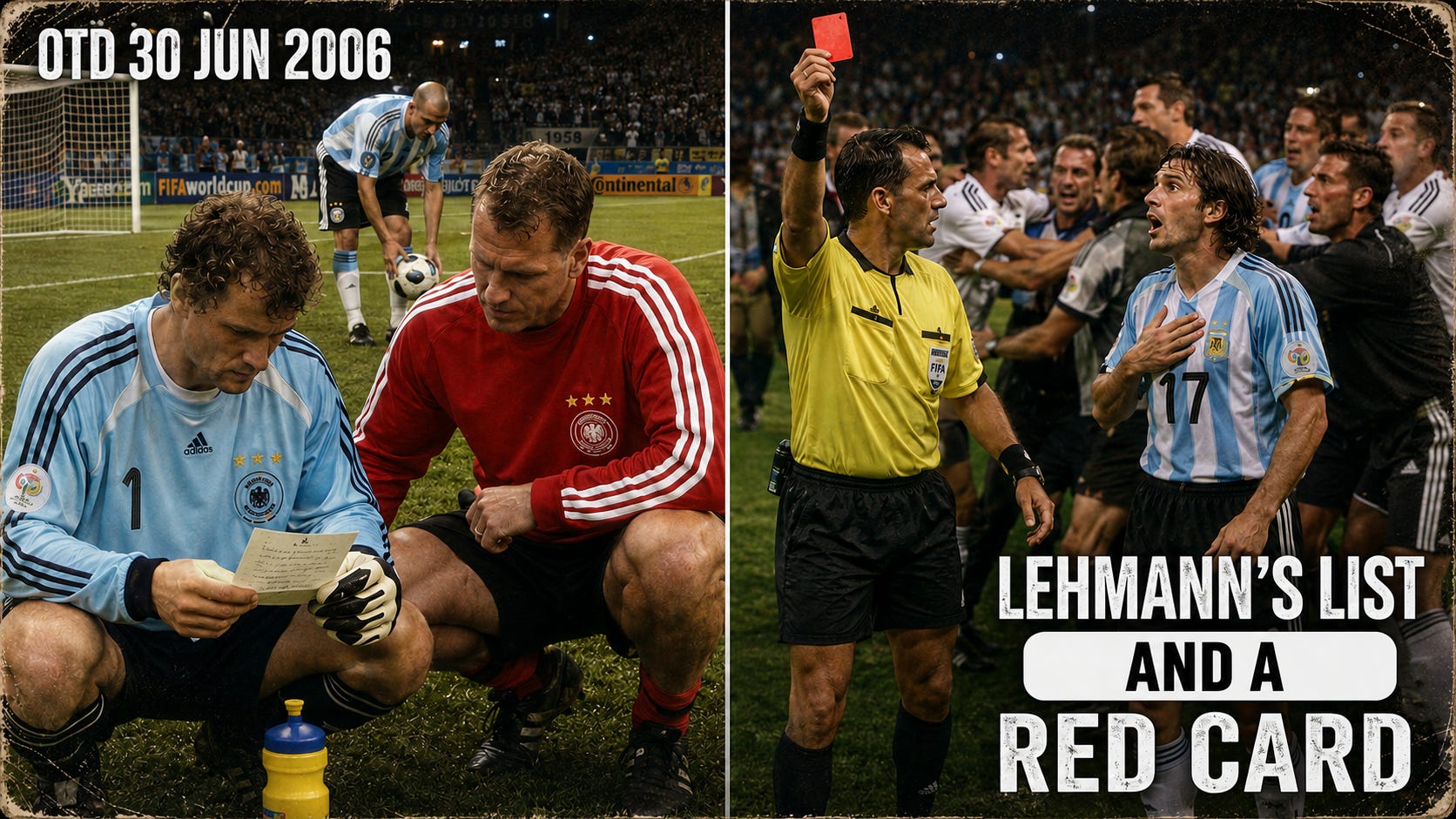
It is 30 June 2006, in Berlin. Germany against Argentina, a World Cup quarter-final, 1-1 after extra time. A penalty shootout. And Germany’s goalkeeper, Jens Lehmann, has a small piece of paper tucked into his sock. Not a superstition. A list: Argentina’s penalty tendencies, where they tend to shoot, how they approach the ball. He reads it between kicks. He saves from Roberto Ayala. He saves from Esteban Cambiasso. Germany win the PSO 4-2. This is a rivalry that refuses to end politely.
To feel the charge in it, you have to know this fixture already carried a final’s memory, twice. Argentina beat West Germany in the 1986 World Cup final. West Germany beat Argentina in the 1990 rematch in Rome, Maradona in tears, his team down to nine. So by 2006 these two met with two finals between them and no love lost.
Both arrived at a hinge. Germany, hosting, were young again under Jürgen Klinsmann, faster and bolder than the grinding sides of the recent past, and Lehmann, not the 2002 hero Oliver Kahn, wore the gloves. Argentina, between the Maradona and the Messi eras, had assembled one of their most elegant teams in years, a side many Argentines did not just respect but loved, with a 19-year-old Lionel Messi on the bench.
The match itself turned on choices. Argentina led through an Ayala header, then their goalkeeper was hurt, and a cascade of substitutions followed. The conductor, Juan Román Riquelme, came off. Messi stayed seated. Germany pushed, Miroslav Klose equalized late, and a lead that had looked secure was gone.
Then the shootout, and the list. The note had been prepared by the German staff, with goalkeeping coach Andreas Köpke central to the research. It contained no magic, only tendencies. But in a shootout, tendencies can feel like prophecy, and the cameras caught Lehmann consulting it between kicks like a man reading the future. There was a quieter, almost finer moment too: Oliver Kahn, the displaced number one, walking over to shake his rival’s hand before the kicks, unity shown live to the stadium. Then Lehmann read, and saved, and read, and saved again.
—-
What happened after the final whistle is the other half of the story: a brawl in the centre circle, and an unused Argentine substitute becoming the first player in World Cup history to be sent off after a match had already finished.
Lehmann’s list did not change the Laws. Notes were always allowed, penalty research was always permitted. What Germany did was make the invisible visible, and in doing so they turned preparation into theatre. After 2006, the image of the goalkeeper armed with data became part of every shootout, notes on bottles, towels, socks, wristbands. The paper itself was ordinary. What it represented, that the duel is won in the homework as much as the dive, became the lasting idea.
🎙️ THE PODCAST GOES DEEPER. The full episode has more about the rivalry, the substitution cascade that cost Argentina Riquelme, the kick-by-kick shootout, the post-match brawl and the Cufré red card, the later disciplinary actions including Torsten Frings and Maxi Rodriguez, and how the rivalry ran on to the 2014 final. That is the 10-minute version.
---
🎧 Listen on Spotify, Apple Podcasts, Amazon Music, Overcast, iHeart, and YouTube.
📩 Got an episode idea? otd@17lawsguy.com
Yesterday: 29 June 1958, when Brazil finally became Brazil.
Tomorrow: 1 July 1990, Cameroon’s impossible run ends.