

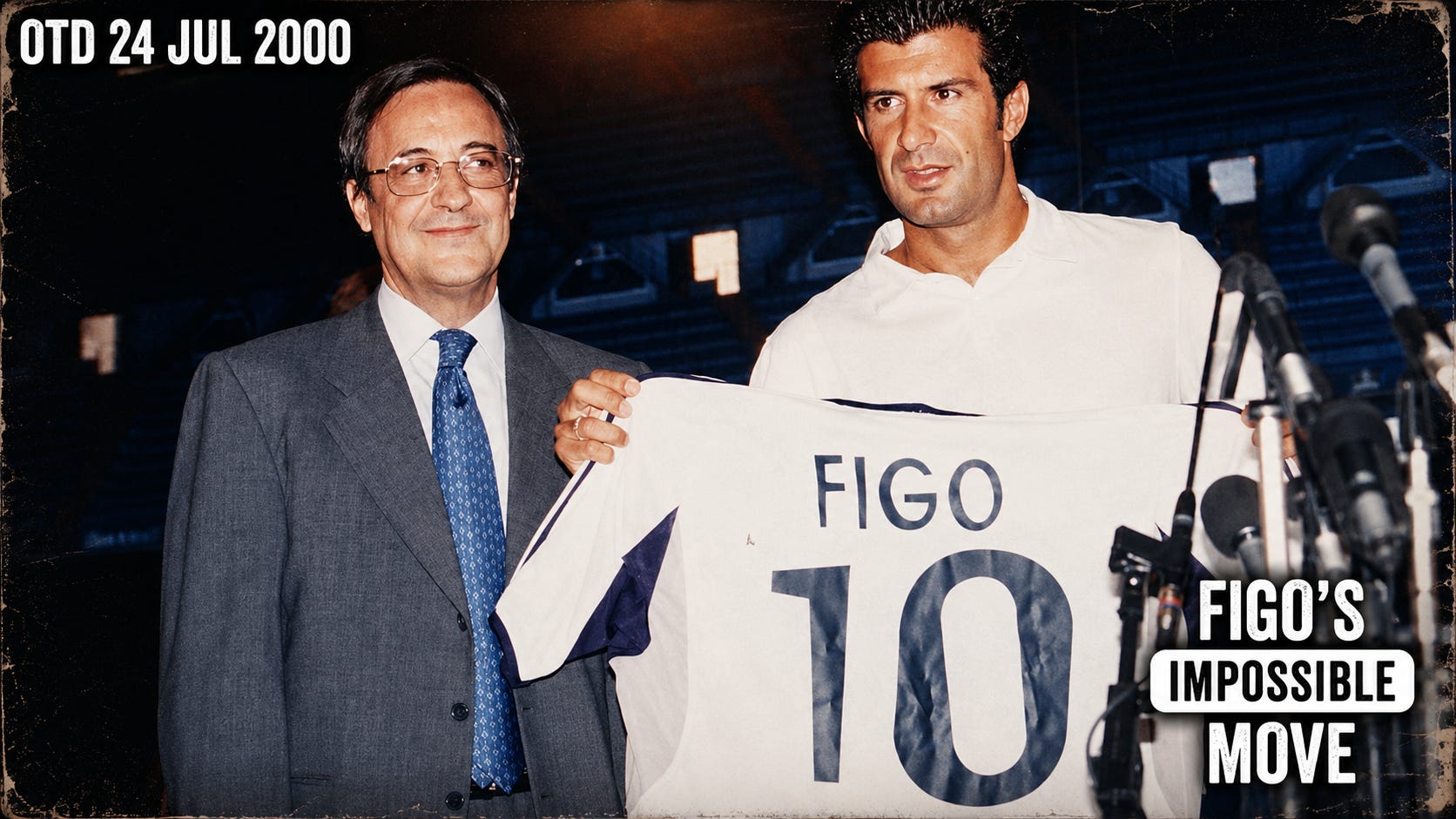
It is July 24, 2000. Madrid. And Luís Figo becomes a Real Madrid player.
Not from Inter. Not from Milan. Not from Manchester United. From Barcelona. Barcelona’s captain, Barcelona’s star, Barcelona’s symbol, walking directly into the shirt Barcelona exists to beat.
To understand the size of it, put a modern name in the role. Imagine Lamine Yamal leaving Barcelona for Real Madrid this summer. Not one day, at 34, at the end. Now, as the number 10, as La Masia’s answer to everything, as the future. That is the emotional category.
Barcelona against Real Madrid was never a local derby. The two clubs are not from the same city. They are separated by geography, language, politics, and the emotional architecture of Spain: Real Madrid attached to the capital, the center, the state, and later, fairly or not, to the international image of Franco’s Spain; Barcelona as més que un club, a vehicle for Catalan identity, memory, and resistance. The history is not a cartoon. Real Madrid were not simply Franco’s team, and Barcelona were not noble resistance in every chapter. But the symbolism became real, and it is the ground Figo walked across.
He had arrived at Barcelona in 1995 from Sporting, already carrying a strange transfer story: conflicting agreements signed with Juventus and Parma, a two-year ban from Italian football, and a landing in Catalonia. There he became elite. Strong, direct, two-footed, explosive, a winger who could beat you and cross and shoot and carry a team’s arrogance. The Cup Winners’ Cup in 1997. La Liga in 1998. La Liga again in 1999. Rivaldo was there too, but Figo was the captain, the one the Camp Nou believed understood the shirt.
Then Real Madrid’s politics arrive. Florentino Pérez is running for president against Lorenzo Sanz, who has just delivered two Champions Leagues in three years. Normally that is unbeatable. So Pérez makes a promise: elect me, and I will bring Figo from Barcelona. If I fail, I will pay the members’ season tickets myself.
It sounds absurd. That is exactly why it works.
Pérez cannot negotiate with Barcelona, who would never sell Figo to Real Madrid at any price. So the only door is the release clause: sixty million euros, ten billion pesetas, a world record. Behind the scenes it turns into something close to spy fiction. Paulo Futre acts as intermediary. José Veiga, Figo’s agent, sits at the center. A conditional agreement is signed: if Pérez wins, Figo goes to Real Madrid, and if he does not, somebody owes an enormous penalty. Figo later insists he did not fully understand or authorize everything around that agreement. Others tell it differently. There is no clean version, which is part of why the story refuses to die.
Pérez wins. The joke stops being a joke. Barcelona’s new president, Joan Gaspart, cannot stop Madrid from simply paying. Figo, who had denied he was going, is going.
What follows is not disappointment. It is desecration. He returns to the Camp Nou in white and the stadium tries to expel one man using sound alone: whistles, banners, coins, banknotes. Barcelona win that night 2-0, which is revenge without closure. The image everyone remembers comes in November 2002, when Figo goes to take a corner and objects rain down, bottles, lighters, and a pig’s head on the grass.
Sportingly, he was right. The Ballon d’Or in 2000. FIFA World Player of the Year in 2001. La Liga. The Champions League in 2002. He becomes the first Galáctico, and Pérez’s model follows: Zidane in 2001, Ronaldo in 2002, Beckham in 2003. Stars are expensive, attention is worth more.
Barcelona spent the money on Overmars and Petit and did not replace the soul, and the Gaspart years were hard. What eventually rebuilt them was not another Figo. It was Laporta, Rijkaard, Ronaldinho, and then Messi, Xavi, Iniesta, Guardiola, a club rediscovering its idea of itself.
Football keeps telling itself certain moves cannot happen. Then money, law, ego, agents, and ambition gather in one room, and impossible becomes a press conference.
🎙️ THE PODCAST GOES DEEPER. The full episode has Pérez’s election promise, the Futre and Veiga negotiations, and a list of football’s other impossible moves. That’s the 10-minute version.
---
🎧 Listen on Spotify, Apple Podcasts, Amazon Music, Overcast, iHeart, and YouTube.
📩 Got an episode idea? otd@17lawsguy.com
Yesterday: 23 July 1966, Rattín at Wembley and the birth of cards.
Tomorrow: 25 July 1976, Defensor break Peñarol and Nacional’s 44-year hold on the Uruguayan title.