

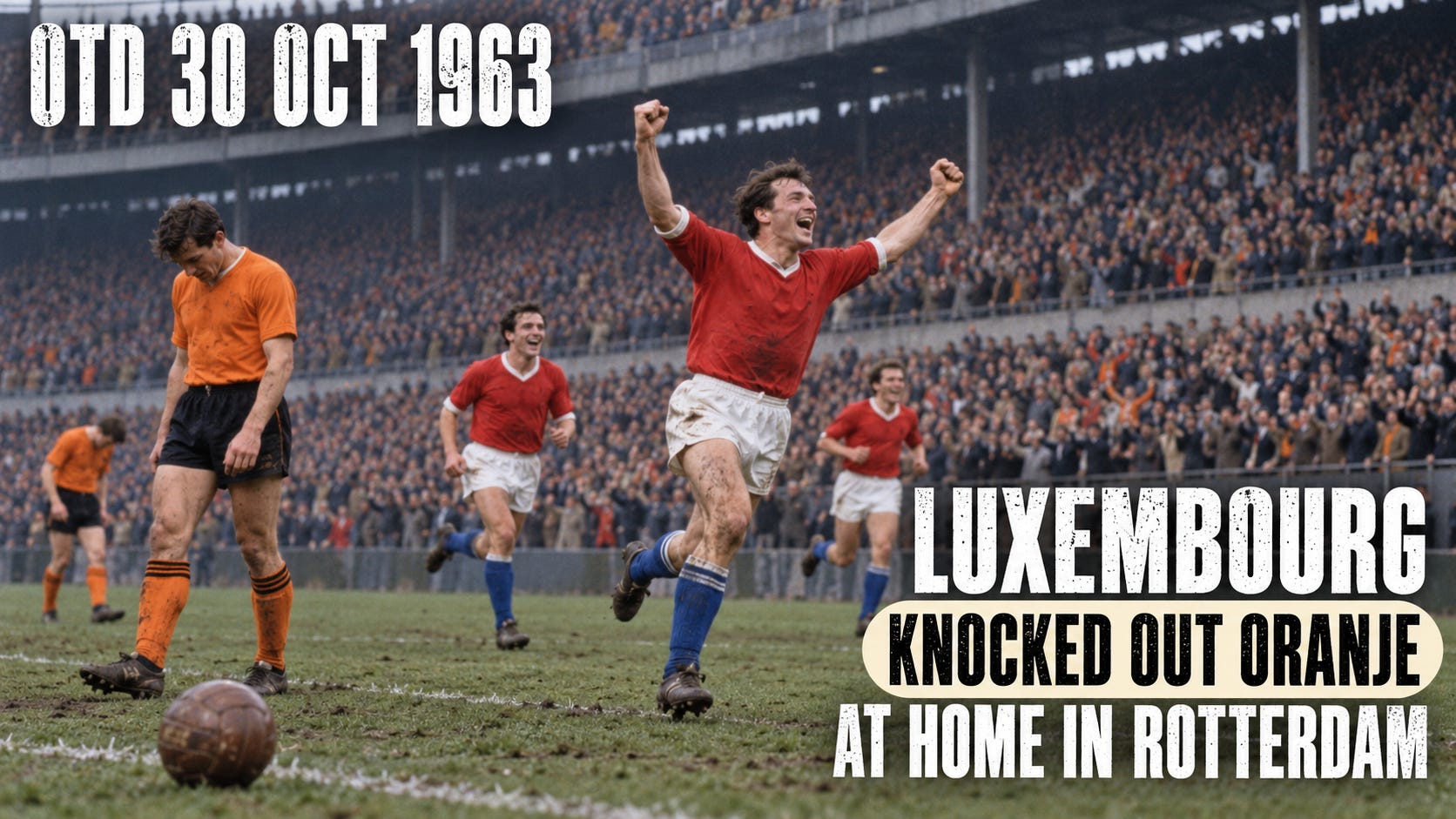
There are football results that sound wrong until one adds the missing detail. Luxembourg eliminated the Netherlands from the European Championship. That happened. Luxembourg did it in Rotterdam. That also happened.
On 30 October 1963, the Netherlands arrived at De Kuip needing to repair a 1-1 first-leg draw. They were in their own country, in a stadium packed largely with their own supporters, and had spent almost a decade building a professional game. Luxembourg, a country with a little over 300,000 people at the time, were officially the home team. They had asked for both legs to be played in the Netherlands because the receipts mattered more than the ceremony of a home gate.
It should have been a practical arrangement. Instead, it became one of the great geographical jokes in European football history. Camille Dimmer, a Luxembourg forward studying engineering in Belgium and playing in that country’s second tier, scored in the 20th minute. Piet Kruiver equalized before halftime. Dimmer scored again in the second half. Luxembourg won 2-1, went through 3-2 on aggregate, and turned De Kuip into the scene of a Dutch national trauma.
The result belongs to an earlier Europe: before the Euro became a summer festival, before qualification groups, before television made every upset immediately global. But it also belongs to the modern game’s most durable truth. A supposedly smaller country can make a competition strange when the format is unforgiving and one excellent night is enough.
How Did We Get Here?
The tournament was not yet called the UEFA European Championship. It was the European Nations’ Cup, a young experiment conceived in the 1950s when UEFA itself was still new. The first edition, won by the Soviet Union in 1960, had attracted only 17 entrants. For the 1962-64 edition, 29 associations entered. That looked like growth, but it did not produce the sprawling qualification architecture we now take for granted.
There were no groups. There was no points table and no route in which a wealthy, well-supported association could recover from an awkward afternoon by beating three other opponents. A preliminary round cut the field to 16, then each round was a home-and-away knockout tie. The four survivors went to a compact final tournament in the host country, Spain. Replays, rather than away goals or penalties, settled level ties. The draw could send a nation from a minor football culture directly into a meeting with an established one, and two bad legs could end everything.
That format made administration part of the football story. Today, an association can plan qualifying windows years ahead, sell a cycle to broadcasters and know that its home fixtures will belong to its own public. Luxembourg had to calculate more modestly. A match in Amsterdam or Rotterdam could produce a gate beyond anything available at home. The price was symbolic: it risked making Luxembourg look like the visiting team in both legs. The reward was real money, a bigger stage and, as it turned out, the chance to make the host nation feel oddly exposed in its own stadium.
The Netherlands and Luxembourg had arrived at this point by very different routes through football history. Dutch organized football had deep roots. The forerunner of the KNVB was created in 1889; the national team played its first official international in 1905; Olympic bronze medals in 1908, 1912 and 1920 gave the country a standing that far exceeded its later mid-century results. Yet Dutch football had also spent years arguing with itself over professionalism. The breakthrough came only in 1954, when the KNVB and the rebel professional association merged. The national Eredivisie followed in 1956-57.
By 1963, therefore, the Netherlands could reasonably believe that it was building toward something. Ajax, Feyenoord and PSV were acquiring the conditions from which Dutch club football would soon explode. The national team had beaten reigning world champions Brazil earlier that year. Elek Schwartz, a Romanian-born coach with a serious European reputation, had an attack containing recognizable club names: Feyenoord’s Coen Moulijn and Kruiver, Ajax players such as Ton Pronk and Sjaak Swart, and the promising Klaas Nuninga. This was not yet the Total Football Netherlands of Rinus Michels and Johan Cruyff, but it was emphatically not a makeshift side.
Luxembourg’s football story was older than the stereotype suggests, but smaller in every material sense. CS Fola was founded in 1906; the Luxembourg Football Federation followed in 1908, organized its first championship in 1910 and joined FIFA that year. The federation became a UEFA founder member in 1954. Its clubs had a domestic championship and cup, and Luxembourg had appeared at the Olympics, but the country did not possess a Dutch-scale professional league or a comparable pool of full-time players. Its best footballers often sought the stronger environments of Belgium, France or Germany.
That made Robert Heinz’s team a blend of local club men and outward-looking careers. Louis Pilot, then still before his celebrated Standard Liège years, was already its intelligent center of gravity. Nico Schmitt was in goal; Fernand Brosius captained; Ady Schmit, Jean Klein, Henri Klein and Jean-Pierre Fiedler supplied a stubborn core. Dimmer was the sharp end. He was fast, direct and, in the phrase that matters most here, unconcerned by the size of the occasion.
The draw gave Luxembourg a bye into the round of 16 while the Netherlands had first removed Switzerland, 4-2 on aggregate. In Amsterdam on 11 September, the Dutch began as though the tie would follow the expected script. Nuninga scored after five minutes. Luxembourg equalized through Paul May before halftime, then defended the 1-1. The Dutch had been warned. Their own federation’s later account puts it plainly: the return should have been the moment when Oranje responded. It was not.
There was a further peculiarity. Luxembourg requested that both matches be staged in the Netherlands because the income would help their federation. The first took place at Amsterdam’s Olympic Stadium before 48,000. The second was assigned to De Kuip in Rotterdam. On paper it was Luxembourg’s home leg; in every practical sense it was the Netherlands’ stadium, Netherlands’ city and Netherlands’ crowd. A modern viewer sees an administrative anomaly. The players saw an opportunity. Luxembourg had removed the travel burden and traded formal home advantage for a financial guarantee. It had also turned the supposed away fixture into a test of Dutch nerve.
Schwartz changed heavily after the Amsterdam draw. On 30 October he selected a side with five Feyenoord players in their own city, including goalkeeper Eddy Pieters Graafland and Kruiver. The crowd expected the error to be corrected. Luxembourg came with almost the same compact logic, but with Dimmer added to the forward line.
The match went wrong early. Dimmer scored after 20 minutes. Kruiver restored the Dutch position at 1-1, but not the tie: Luxembourg still had the emotional advantage of having turned the crowd nervous. Late in the second half Dimmer struck again. The final whistle confirmed the impossible-looking score: Luxembourg 2-1 Netherlands, Luxembourg 3-2 on aggregate.
So What?
For the Netherlands, this was not simply an exit. It was a public humiliation precisely because the stage had been made so accommodating. Both legs had been played at home. The return had drawn roughly 45,000 to De Kuip. The opposition came from a country whose federation had chosen Dutch receipts over its own stadium. Contemporary Dutch coverage was merciless. Sportkroniek described a storm breaking over Dutch football, with its debris falling on Schwartz. The coach’s position did not survive the aftershock. He left in 1964, took over Benfica and reached the European Cup final the following year.
That does not mean the Luxembourg defeat invented the Netherlands’ later football revolution by negative example. History is not so tidy. Ajax, Feyenoord, coaching, youth development and the professional structure were already changing the country. But 1963 exposed the gap between the infrastructure the Netherlands had begun to build and the national authority it imagined it possessed. The country did not reach the 1964 finals, then missed the 1968 European Championship, the 1970 World Cup and the 1972 European Championship. The ascent would come spectacularly with the 1974 World Cup finalists, the 1976 European Championship semi-finalists and, at last, the European champions of 1988.
For Luxembourg, Rotterdam was not a lucky isolated scoreline. It was the first chapter of a run that came within one match of the four-team finals in Spain. Denmark were the next opponents. Luxembourg drew 3-3 at home and 2-2 in Copenhagen, twice refusing to behave like a side that had already had its miracle. The aggregate score was 5-5. Under the rules of the day, there was a replay in Amsterdam. Ole Madsen scored the only goal – in fact he scored all of Denmark’s six goals in this tie – and Denmark went through. Luxembourg had been one match from the European Championship’s final four. Instead, and again a testament to this being a “before” Euro, amateur Denmark in 1964 played a semifinal, and lost 0-3 to Soviet Union.
Luxembourg’s near-miss gives the Netherlands tie its full scale. This was not an early group fixture later rounded off by stronger sides. Luxembourg eliminated a Dutch team in a direct knockout round and then survived two quarter-final legs with Denmark before bowing out after a tie-breaker playoff. If that Amsterdam replay had gone differently, Luxembourg would have gone to Spain as one of only four finalists. There was no round of 16, quarter-final, semi-final and group stage layered into a convenient modern narrative. There was simply a narrow ladder, and Luxembourg climbed almost all of it.
For the players, the consequences were uneven. Dimmer became much more than the scorer of a famous upset. After football and his engineering studies, he entered Luxembourg politics and served as a government minister. Pilot became the country’s greatest football export of the era, winning major honors with Standard Liège and later leading Luxembourg football administration. Schwartz’s Dutch departure did not prevent a distinguished club career, but it attached his name permanently to a result that remains startling even in a national history rich with later glories.
It also explains why the Netherlands versus Luxembourg record still has a sharp edge. The Netherlands subsequently won eight meetings in succession. Johan Cruyff would score freely against Luxembourg; in 1971 the Dutch won 8-0. Modern Dutch football naturally measures itself against Germany, France, Argentina and Brazil, not a tiny neighboring association. Yet the 1963 tie remains a useful corrective. Nations do not inherit status permanently. They earn it in structures, generations and individual games, and they can lose it on an October night at home.
Luxembourg, meanwhile, has not reached a men’s Euro final tournament. That is the endurance of the 1964 story: it remains not merely an old win but the high-water mark of an improbable campaign. The country has nevertheless changed. UEFA notes more than 100 clubs and over 45,000 registered players in a country now a little above 600,000 people. A national youth academy began in 2000-01. Players have increasingly built professional careers abroad, while the national side climbed as high as 83rd in the FIFA rankings in 2017 and reached the UEFA EURO 2024 play-offs. The modern Luxembourg team is no longer content to be treated as a ceremonial opponent.
The European Championship changed around it. In 1968, UEFA adopted qualifying groups, though the quarter-finals remained two-legged. In 1980, the final tournament expanded to eight teams and qualification group winners went straight there. Sixteen finalists arrived in 1996; 24 in 2016. The competition became harder to win but less exposed to the brutal contingency of one tie. That evolution did not end shocks. Albania beat West Germany in 1967. Denmark won the 1992 finals after entering late. Greece won in 2004. Iceland beat England in 2016. But Luxembourg’s 1963 achievement has its own special shape: a tiny association defeated the Netherlands in the Netherlands while nominally hosting them.
It is tempting to turn that into a lesson about rankings, but the FIFA ranking did not yet exist. The better comparison is institutional expectation. Netherlands had the bigger crowds, the professional domestic structure, the famous clubs and the recent win over Brazil. Luxembourg had an intelligent, settled XI, an unusual financial decision and a tie designed to reward nerve. In the older Euro, that was enough to alter history.
That is why it deserves to be remembered as more than an embarrassment on Oranje’s road to greatness. It is a reminder of what the old European Nations’ Cup could do. The format did not protect reputation. It did not provide a safety net. It gave Luxembourg a tie, two Dutch stadiums, one forward with two goals, and a route almost all the way to Spain.
Three Things to Take Away
1. Luxembourg eliminated the Netherlands from the 1964 European Nations’ Cup 3-2 on aggregate. The decisive 2-1 victory took place at Rotterdam’s De Kuip, where Luxembourg were the nominal home team.
2. Camille Dimmer scored twice in Rotterdam. The Netherlands had started professional football in 1954 and the Eredivisie in 1956, but Luxembourg’s smaller football culture, without Dutch professional scale, found the sharper team on the night.
3. Luxembourg then drew twice with Denmark in the quarter-finals before losing a replay in Amsterdam. It came one match from the four-team final tournament in Spain.
On This Day
On 30 October 1963, Luxembourg beat the Netherlands 2-1 at De Kuip in Rotterdam, winning their European Nations’ Cup tie 3-2 on aggregate. Camille Dimmer scored twice. Luxembourg had officially been the home team.
Have a football memory, a correction or a story that belongs here? Write to otd@17lawsguy.com.
Yesterday: The Fog That Opened the Road to Panenka - Czechoslovakia vs. England, 29 October 1975.