

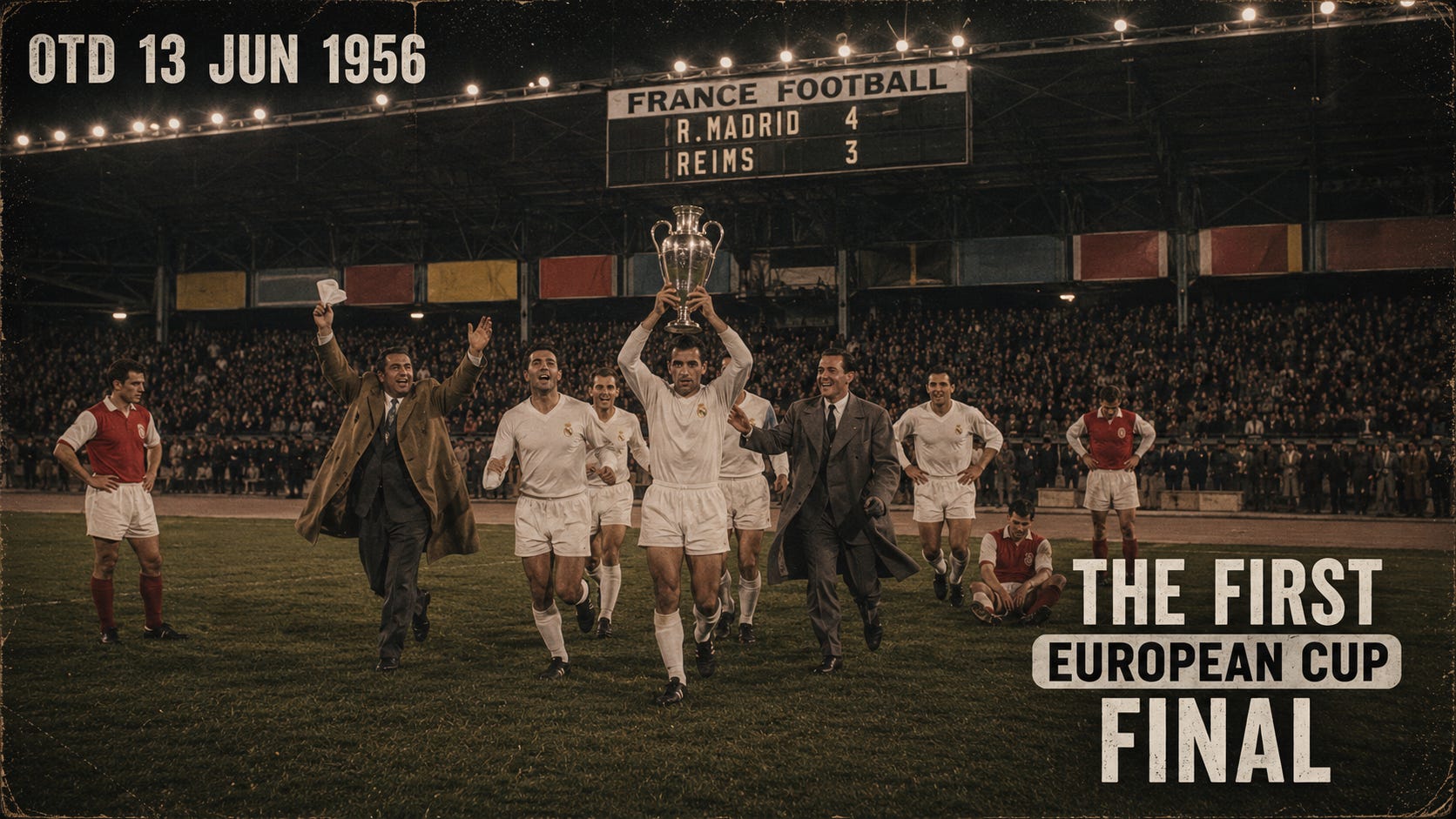
It is 13 June 1956, at the Parc des Princes in Paris. Real Madrid against Stade de Reims, the first European Cup final. After ninety minutes, the score is Real Madrid 4, Stade de Reims 3. Seven goals, two Reims leads, a Madrid comeback, Alfredo Di Stéfano scoring, and Santiago Bernabéu watching the first chapter of the most powerful dynasty European club football has ever seen. This is the beginning of the Real Madrid era. But it is also something larger: the day the European Cup proved it could be more than an idea.
How did we get here? The European Cup did not come from nowhere. Central Europe had already experimented with the idea through the Mitropa Cup from 1927, giving clubs from Austria, Hungary, Czechoslovakia and Italy a serious international stage. There were other attempts too: the Latin Cup, invitation tournaments like the one inside the 1937 Paris International Exposition, floodlit friendlies, prestige matches. But there was still no true European champion, no annual knockout, no shared calendar, no mechanism forcing the champions of Europe’s leagues to answer the same question. Who is actually best?
Then came December 1954, at Molineux: Wolves against Honvéd. Wolves, champions of England, came from 2-0 down to beat Honvéd, the club spine of the Magical Magyars, 3-2 under the floodlights. And the English press reached for the old reflex: champions of the world. That phrase irritated the right man, Gabriel Hanot of L’Équipe, a former France international and organiser who understood that football needs institutions as much as goals. Hanot’s response was, in effect: no, not like this. Not one friendly, at home, in the mud, under your lights, against a team that travelled. If Europe wants a club champion, let Europe build a competition.
He was not alone, with Jacques Ferran central too, and club figures like Bernabéu and Raimundo Saporta at Real Madrid who instantly understood the tournament was about prestige, cities, newspapers, television, and turning a great club into an international institution. In April 1955 the founding meeting took place in Paris. UEFA was only a year old, FIFA and UEFA were wary, and the organizers had to avoid looking like a club rebellion. So the first European Champion Clubs’ Cup was, in a way, born from journalism before governance fully absorbed it.
Sixteen clubs entered, not always strictly the champions. Chelsea, champions of England, were blocked from entering by the Football League, so Scotland’s Hibernian became the first British representative. The opening match was Sporting against Partizan in Lisbon in September 1955, where João Martins scored the first goal in European Cup history in a 3-3 draw. Then the tournament started producing exactly what its creators hoped for: names, stories, upsets. Partizan scored eight against Sporting in Belgrade. Saarbrücken stunned Milan at the San Siro before Milan recovered. Hibernian reached the semi-finals.
And Real Madrid began to reveal what they were becoming, though not at home. In the 1955-56 league season they did not win La Liga. Athletic Bilbao did, and Barcelona also finished above Madrid. In Europe, though, they were something else. They beat Servette 7-0 on aggregate, then survived Partizan after winning 4-0 at home and losing 3-0 in Belgrade, then beat Milan 5-4 over two legs in the semi-final. Three rounds, three different warnings. Madrid were brilliant, but not untouchable.
Reims, the French champions built by Albert Batteux, were the most sophisticated French side of the era, with the small, elusive Raymond Kopa and the great defender Robert Jonquet. They beat AGF, then Vörös Lobogó, then Hibernian to reach the final. So the first final gave the new tournament a perfect pairing: the rising institutional superclub against the technical French champion backed by the tournament’s own founding newspaper. Spain against France. Di Stefano against Kopa. Parc des Princes, with Arthur Ellis of England refereeing and 38,239 watching.
And Reims started as if to steal the whole future. Michel Leblond scored in the 6th minute, Jean Templin in the 10th. Ten minutes in, Real Madrid were two down. That is one of the most important details in the whole story: Madrid’s dynasty did not begin with inevitability. It began with a problem. In the 14th minute Di Stéfano answered, because that is what he did, pulling the match toward him and making panic look unnecessary. In the 30th, Héctor Rial equalized. The final had reset. Then Reims led again, Michel Hidalgo making it 3-2 in the 62nd, and again Madrid answered, Marquitos levelling in the 67th. Then, eleven minutes from time, Rial again. Real Madrid 4, Stade de Reims 3. The first European Cup winner was Real Madrid.
And the dynasty began here, not in theory. Madrid won the European Cup again in 1957, 1958, 1959 and 1960. Five in a row. Di Stéfano scored in all five finals. Kopa, who lost with Reims, joined Madrid and won the Cup with them. Puskás arrived after the Hungarian rupture of 1956. By 1960 and the 7-3 over Eintracht Frankfurt at Hampden, Real Madrid were not merely a team. They were the first European club empire. But the foundation was Paris 1956.
And here is the great what-if. Madrid had not won La Liga that season, so if they had lost this final, they would have been neither Spanish nor European champions, and might not even have entered the next European Cup. A Reims win would not necessarily have erased Madrid’s future, but it could have delayed and complicated it, and changed the early psychology of the competition. Because first winners set the grammar. Madrid’s first win taught Europe that this competition could belong to a club with continental ambition rather than mere domestic excellence, and that became their operating model. Europe was not an add-on. Europe became the point. That is the deepest legacy: the European Cup changed what a great club thinks it is for. A league title became a passport, and the season gained another summit.
That is why 13 June 1956 matters. Newspaper imagination, club ambition, a final in Paris, and one team understanding faster than everyone else what the new world rewarded.
🎙️ THE PODCAST GOES DEEPER. The full episode has more on the pre-history (Mitropa, the Latin Cup, Wolves-Honvéd), the founding politics with UEFA and FIFA, the first tournament’s upsets, the full five-in-a-row run, and the Reims what-if in more detail. That is the 10-minute version.
---
🎧 Listen on Spotify, Apple Podcasts, Amazon Music, Overcast, iHeart, and YouTube.
📩 Got an episode idea? otd@17lawsguy.com
Yesterday: 12 June 1938, The Battle of Bordeaux.
Tomorrow: 14 June 1990, Roger Milla and the corner-flag dance.