

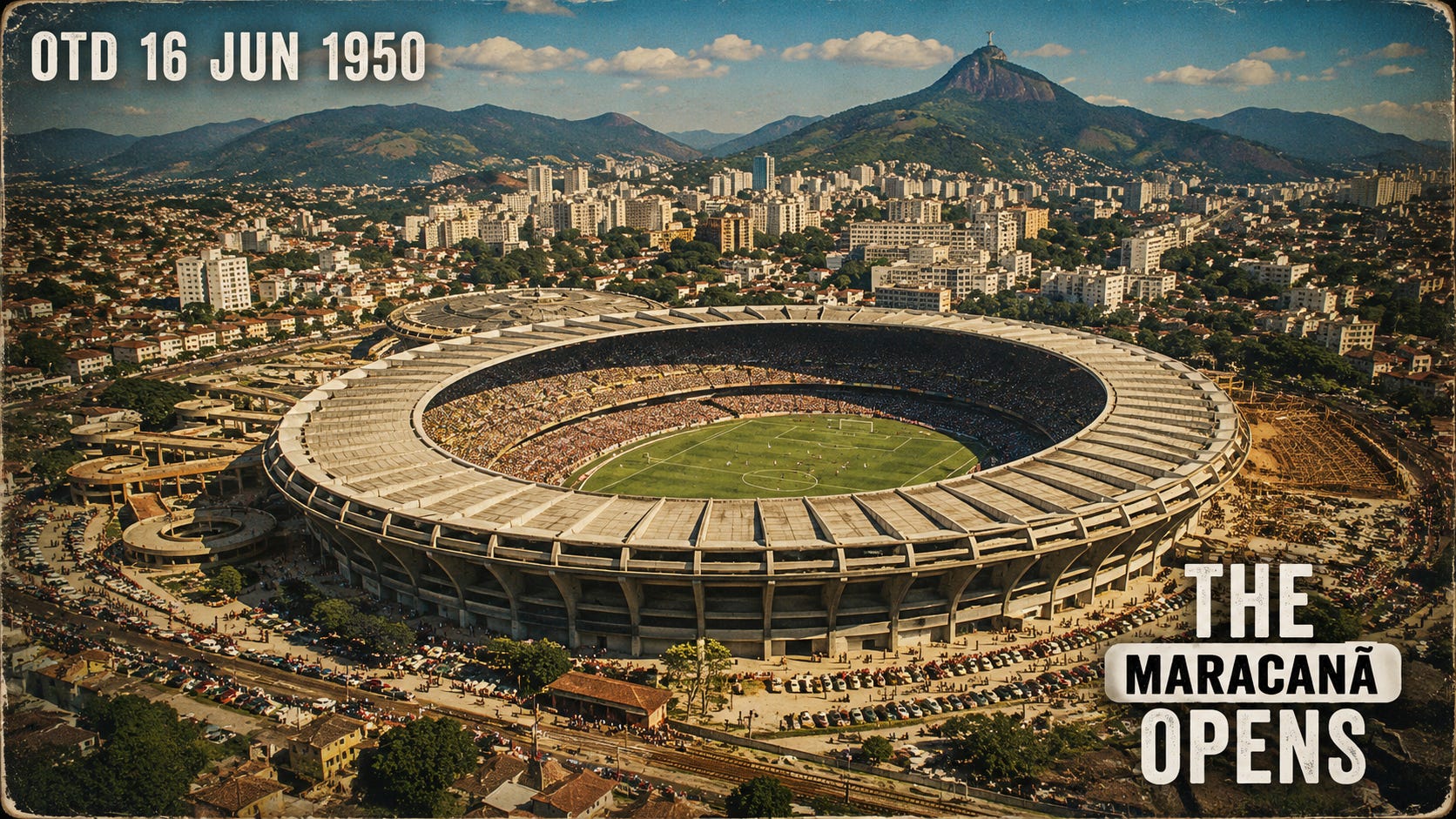
It is 16 June 1950, in Rio de Janeiro, and a new stadium opens. Not quietly, not modestly, but as a declaration: the Maracanã, then officially the Estádio Municipal, a concrete bowl built for the World Cup and for nearly 200,000 people. Today, before the tournament begins, it gets its first match, a Rio selection against a São Paulo selection. The score is almost secondary, because the real result is architectural. Brazil has built the biggest football stage on earth.
How did we get here? Start with the absence. The World Cup had not been played since 1938, the 1942 and 1946 tournaments swallowed by the Second World War. FIFA’s young, fragile global tournament needed resurrecting, and Brazil offered to host, on one condition: not 1949, as discussed, but 1950, to buy time to imagine something enormous. This would be the fourth World Cup, the first after the war, the first in twelve years, and for Brazil it would be more than a tournament. It would be a national exhibition. A formally democratic Brazil, hungry for modernity, reached for the perfect language: football.
But hosting the world meant Rio needed a stadium worthy of the claim, and at first the question was political as much as architectural. Where should it go? The journalist Mário Filho became a great advocate. The chosen site was the old Derby Club, a former horse-racing track in the Maracanã district of Rio’s North Zone, closer to the working, commuting city than to postcard Copacabana. The stadium was meant to be big, public, reachable and democratic by the standards of its time. A team of Brazilian architects designed a vast oval concrete bowl: ramps, terraces, a ring of humanity, built not for intimacy but for mass.
The cornerstone was laid on 2 August 1948, leaving less than two years to build the biggest stadium on the planet. You can guess what happened. The project ran late and over budget, with arguments about cost and priorities, and FIFA grew anxious enough to send the Italian administrator Ottorino Barassi to help push it along. Workers poured concrete, ramps rose, and in the final months thousands raced the calendar. And still, when June 1950 arrived, the stadium was not truly finished: areas were rough, facilities incomplete, toilets inadequate, construction still visible. The Maracanã was playable before it was complete. It would not be fully finished until 1965. But on 16 June 1950, Brazil did not wait.
The first match was Seleção Carioca against Seleção Paulista, the Rio selection against São Paulo’s. The first goal was scored by Didi, then a young Fluminense midfielder not picked for Brazil’s 1950 squad, but destined to become one of the great brains of Brazilian football and the player of the 1958 tournament. São Paulo came back to win 3-1. The largest stadium in the world had begun with a comeback.
The verdict afterward was almost contradictory: the Maracanã was unfinished, and already overwhelming. Brazil had not built a perfect stadium. It had built an unavoidable one. Eight days later the World Cup arrived, Brazil beating Mexico 4-0 in the first competitive match there, Ademir scoring the first competitive goal. Then the stadium grew into the tournament: Brazil 2-0 Yugoslavia, then in the final group stage Brazil 7-1 Sweden and 6-1 Spain. The stadium was not just full. It was convinced. Brazil were not merely winning. They were performing a coronation.
Then 16 July. Brazil against Uruguay, needing only a draw. Official attendance: 173,850. The number that lives in memory: just under 200,000. Brazil led through Friaça. Uruguay equalized through Juan Alberto Schiaffino. Then Alcides Ghiggia scored. Uruguay 2, Brazil 1. The Maracanazo. The silence. The wound that turned the stadium from a monument into a myth, and a story we will tell in its own episode.
And here is the strange thing about the Maracanã. If Brazil had beaten Uruguay, it might be remembered as a triumphal palace. Because Brazil lost, it became something more complicated: a temple with a ghost. From there its history is almost too large for one episode. The Fla-Flu rivalry became a mass ritual there, drawing crowds above 190,000. In 1969, Pelé scored his 1,000th career goal there. In 1989 Brazil beat Uruguay there to win the Copa América, a neat echo of 1950. Then came renovation: the cheap standing geral that made it a people’s stadium disappeared, capacity fell, and for the 2014 World Cup it was rebuilt into a global arena that hosted the final, Germany 1, Argentina 0. In 2016 it staged the Rio Olympic ceremonies. Then, only months later, it fell into disrepair amid management disputes, the most famous stadium in Brazil looking abandoned. Then it returned: Argentina beat Brazil there in the 2021 Copa América final for Messi’s first senior international trophy, and in 2023 Fluminense won their first Libertadores there. Grandeur and neglect, sacred space and political argument, all at once.
That is why 16 June 1950 matters. Today is not only the opening of a stadium. It is the opening of a stage on which Brazil would perform its dreams, its joy, its contradictions, and its most famous silence.
🎙️ THE PODCAST GOES DEEPER. The full episode has more on Brazil’s post-war hosting, the political fight to build it, the rushed construction, the 1950 crowds, the Maracanazo, Pelé’s 1,000th goal, the Fla-Flu era, 2014 and 2016, the post-Olympic decay and rebirth, and how the Maracanã compares to Wembley, the Azteca and the Monumental. That is the 10-minute version.
---
🎧 Listen on Spotify, Apple Podcasts, Amazon Music, Overcast, iHeart, and YouTube.
📩 Got an episode idea? otd@17lawsguy.com
Yesterday: 15 June 1982, Hungary 10, El Salvador 1.
Tomorrow: 17 June 1970, Italy, Germany, and the Game of the Century.