

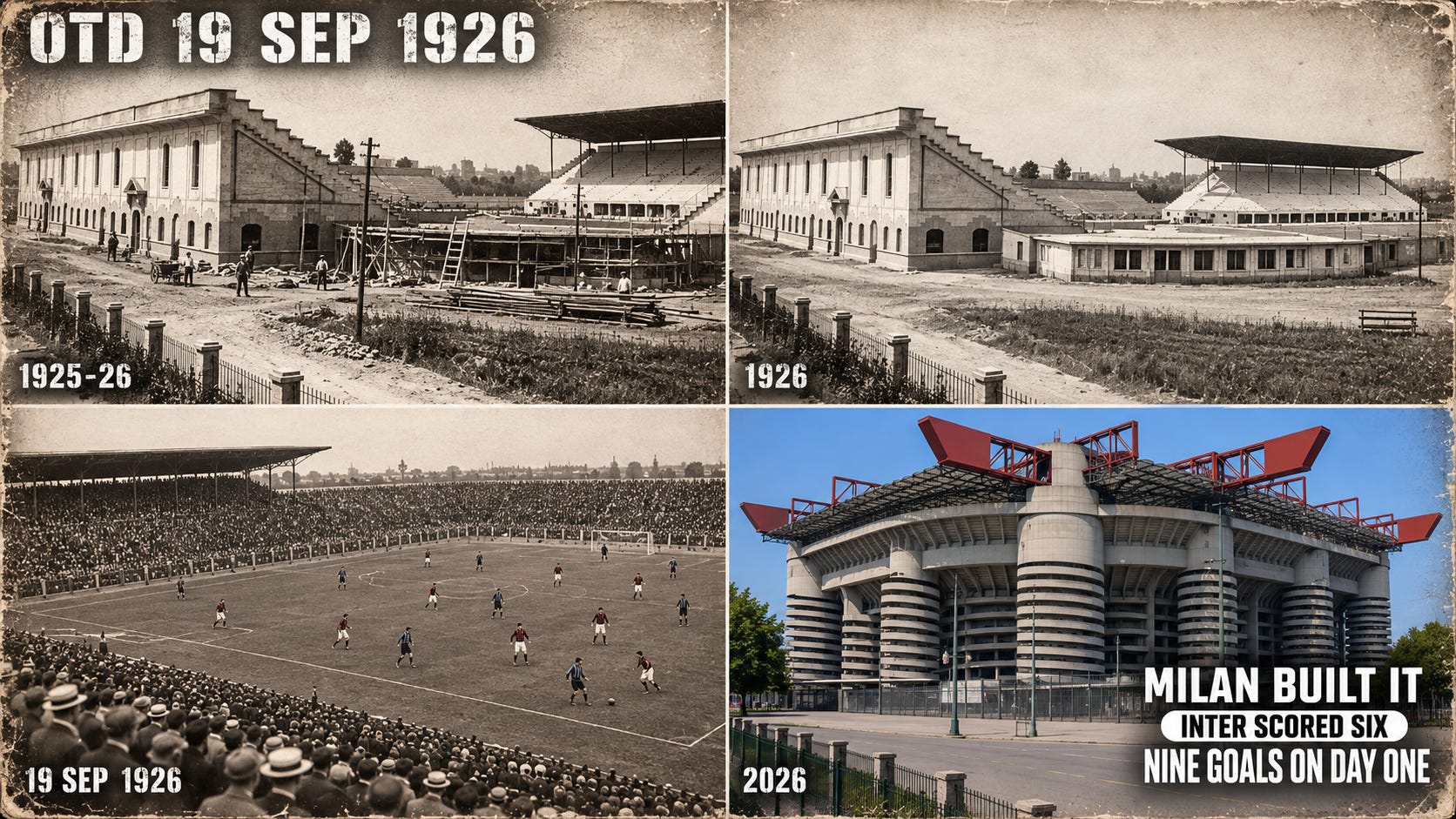
It is September 19, 1926, in the San Siro district of Milan, and a new stadium is opening. It belongs to Milan. It was conceived by Milan’s president, built with Milan’s money, and designed to give Milan a permanent home. So, naturally, Milan invite Inter to play the opening match. Giuseppe Santagostino scores the new stadium’s first goal, for Milan. Then Inter score six. The final score is Milan 3, Inter 6: nine goals in the first match at a ground that will become one of football’s great theatres. Milan built San Siro. Inter opened it by ruining the party.
How did we get here?
Milan had been founded in 1899, but for its first quarter-century “home” was a flexible concept. The club drifted between grounds, the Trotter, Acquabella, Porta Monforte, the Arena Civica, Viale Lombardia, some temporary, some shared, none of them the permanent football home the club’s leadership had begun to imagine. The man who set out to change that was Piero Pirelli, Milan’s president since 1909 and heir to one of the great industrial names of the city, his father having founded the rubber company that grew into an international maker of cables and tyres. The younger Pirelli brought that industrial outlook into football. He wanted infrastructure, permanence, a stadium designed around the club and the match.
In December 1925, construction began on land beside the racecourse in the San Siro district, west of the city centre. The location mattered: the stadium was not squeezed into Milan’s dense core but set beside open land already associated with sport, horses and spectators. And Pirelli did not want another multipurpose civic arena. Many Italian stadiums wrapped an athletics track around the pitch, which pushed the crowd back from the football. San Siro would be different. It would be built specifically for the game, with no running track, four straight stands arranged tightly around the pitch, and spectators close enough to see the tackles, hear the players and feel the match. The design owed something to the English football grounds of the period, functional, rectangular and direct. The architect was Ulisse Stacchini, who had also designed Milan’s imposing central railway station, working with the engineer Alberto Cugini, and roughly 120 workers completed the project in about thirteen months at a reported cost of some five million lire.
The stadium that opened was not the one people recognize today. Capacity was about 35,000, only one stand was partly covered, and there were none of the great cylindrical towers, spiralling pedestrian ramps, or the third tier suspended beneath a red roof. But the fundamental idea was already there: a stadium in which football came first. And on September 19, 1926, Milan opened it with the most obvious opponent possible. Inter. The rivalry was already eighteen years old, because Internazionale had been founded in 1908 after a split within Milan over the recruitment of foreign players, a disagreement that produced two clubs in a single city, and with them one of the game’s enduring rivalries. Now, improbably, that rivalry had one ground, one opening day, and a friendly Derby della Madonnina to introduce it. There was a neat symmetry to it: the club that left in 1908 was being welcomed back to help launch the home of the club it had split from, and it would repay the courtesy by playing the spoiler.
Around 35,000 came. Milan scored first, through Giuseppe Santagostino, known as Pin, after eleven minutes; one of Milan’s leading players of the 1920s and eventually a scorer of more than a hundred goals for the club, his reward is a permanent place in history as the first footballer to score at San Siro. Then the afternoon turned. Anton Powolny equalized, Fulvio Bernardini scored, and Luigi Cevenini, Armando Castellazzi and Leopoldo Conti added to it as Inter scored six consecutive goals, Castellazzi twice. At one point Milan were 6-1 down in the stadium they had just built, before late goals reduced the humiliation to Milan 3, Inter 6. It was only a friendly. But there can be few more fitting beginnings for a shared derby ground: a Milan goal to open it, an Inter avalanche to christen it, and the building starting life with the rivalry that would one day define it.
So what?
The first thing is that San Siro changed what a football stadium could be in Italy. It was privately financed and purpose-built for football, with no athletics track and no attempt to make the match one activity among many. The sightlines, the atmosphere and the physical shape all put football at the centre, an architectural declaration that the sport deserved a permanent home of its own. That was not yet the norm in Italy, where the civic multipurpose arena was the default and clubs borrowed grounds built for other purposes. By insisting on a stadium shaped entirely around the match, Pirelli helped make the dedicated football ground an aspiration other Italian clubs would chase for decades, and a template the country would slowly adopt.
The second thing is that San Siro shows how buildings acquire meanings their creators never intended. Pirelli built it for Milan, and Inter were merely invited for opening day, not original tenants. At first it stayed Milan’s private ground while Inter played most of their home matches at the Arena Civica. But in 1935 Milan sold the stadium to the city, and municipal ownership changed everything: the stands were extended and joined around the corners, the capacity grew, and after the Second World War Inter began using it permanently from 1947. The ground built for one club had officially become home to both. For most shared stadiums, neutrality dilutes the sense of home. At San Siro, sharing did the opposite, because every derby could turn the same concrete into two different worlds, red and black one week, blue and black the next, the same pitch and stands holding a different memory. Even its names carry that doubleness. In 1980 it was officially renamed the Stadio Giuseppe Meazza, after the great pre-war Italian forward who was an Inter icon and, late in his career, also a Milan player. Officially it is the Meazza; to many, especially on the Milan side, it stays San Siro. One building, two names, just as it holds two clubs.
The third thing is that a stadium can become an active participant in history rather than just its setting. San Siro grew into a concrete cathedral: a second tier and the external spiral ramps in the 1950s, then a third tier, eleven cylindrical towers and the vast red roof girders for the 1990 World Cup, the original four stands still buried inside. Its first competitive match had actually brought Milan another defeat, 2-1 to Sampierdarenese two weeks after opening day, and Italy first played there in early 1927, drawing with Czechoslovakia. But the ground kept rising in importance. It staged matches at the 1934 World Cup, including Italy’s semifinal on the road to their first world title, and the opening game of the 1990 World Cup, where holders Argentina were beaten by Cameroon, the ground once again greeting a favourite by hosting an upset. It became one of the homes of European club football too, from Milan’s shock defeat by Saarbrücken in the very first European Cup, through Inter’s 1965 final win over Benfica on their own pitch and Feyenoord’s 1970 victory over Celtic that opened the age of Dutch dominance, to European finals won there by Bayern Munich in 2001 and Real Madrid in 2016. The ramps shape the approach, the steep tiers compress the sound, the shared ownership intensifies the derby, and the sheer scale turns big matches into public spectacles. Stadiums do not score goals, but they shape how those goals are experienced, remembered and mythologized, and the nine scored on opening day were an immediate demonstration of the fact: San Siro did not begin quietly. It began with a derby, a Milan lead, six consecutive Inter goals and an afternoon of civic disorder conducted through football.
Three things to take away
First, San Siro opened on September 19, 1926, with a friendly Milan derby watched by about 35,000 people. Giuseppe Santagostino scored the stadium’s first goal for Milan, but Inter won 6-3 after scoring six in a row.
Second, Piero Pirelli built San Siro as a privately owned, football-only home for Milan. Its greater legacy came later, when it became municipal property, took in Inter, and turned one ground into the shared theatre of two global clubs.
Third, the building outgrew its creator’s intention. A stadium meant for one club became inseparable from a rivalry, carrying two clubs, two names and, eventually, a century of football history.
On this day in 1926, Milan opened its new home, Inter supplied the housewarming disaster, and one of football’s most recognizable stadiums began its long life with nine goals and a lesson its builder never intended to teach.
---
📩 Got an idea to an OTD story? otd@17lawsguy.com
Yesterday: 18 September 1927, five nations begin Europe's first international championship in Prague.
Tomorrow: 20 September 1900, the uncertain beginning of Olympic football.