

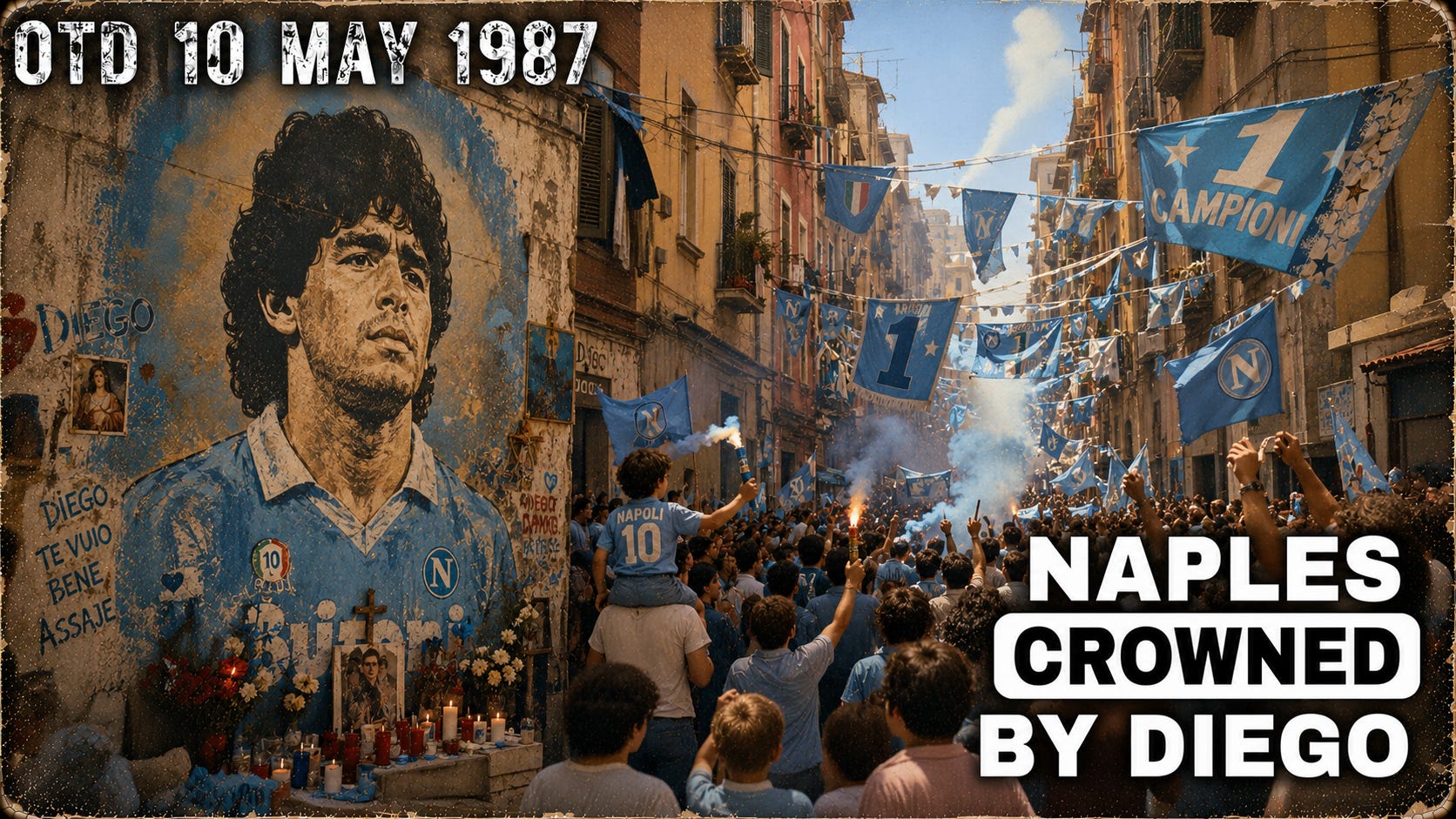
It is 10 May 1987. Naples. Stadio San Paolo. Napoli against Fiorentina.
Napoli only need a draw. Andrea Carnevale scores. Roberto Baggio equalizes for Fiorentina. And when the final whistle goes, 1-1 is enough.
Napoli are champions of Italy for the first time. The Scudetto — literally the little shield, the badge of the Italian champions — is going south, to Naples.
And at the centre of it all is Diego Armando Maradona: twenty-six years old, fresh from winning the World Cup with Argentina, and now giving a city that had been mocked, dismissed and patronized one of the great civic explosions in football history.
This is not just Napoli’s first title. This is Naples crowned by Diego.
Naples is not just another football city. It is noise, theatre, poverty, beauty, chaos, religion, humour, superstition, Vesuvius, the bay, the Spanish Quarter, the old streets, the deep wound of being looked down on by the richer north.
And Napoli, before Maradona, had history, passion and pain — but not the championship. The club had finished second in Serie A in 1968 and 1975. They had won the Coppa Italia in 1962 and 1976. They had known good players, good teams, great crowds. But no Scudetto.
Then, in 1984, they did something that still sounds impossible. They bought Diego Maradona from Barcelona. A world-record transfer. A club with no league title taking the most gifted footballer on earth from one of the grand clubs of Europe. Tens of thousands packed the San Paolo just to see him presented. The image almost explains itself: one man on a football pitch, a city looking at him as if he were not a signing, but an answer.
At first, the miracle did not happen instantly. Napoli finished eighth in 1984-85. Then third in 1985-86. The structure was forming. Corrado Ferlaino as president. Ottavio Bianchi as coach. The team hardened: Claudio Garella in goal, Ciro Ferrara emerging in defense, Giuseppe Bruscolotti carrying the old Napoli authority, Salvatore Bagni, Fernando De Napoli, Bruno Giordano, Andrea Carnevale.
And Maradona arrived into 1986-87 as the best player in the world. His World Cup. Against England, within four minutes, he gave football its most notorious theft and its most beautiful solo goal: Hand of God and Goal of the Century. In the final, West Germany tried to compress him out of the match, and still he found the pass for Burruchaga to win it. Argentina were world champions.
So when 1986-87 began, this was peak Diego. Not just brilliant. Licensed by history.
Napoli started well. Then came 9 November 1986: Juventus away. The symbolic match. Juventus were the north. Juventus were power. Napoli went to Turin, fell behind to Michael Laudrup, then came back. Juventus 1, Napoli 3. Napoli went top.
From that point, the season began to feel possible. Around Christmas, the race was tight. Fiorentina beat Napoli 3-1 in January. But Napoli responded. They beat Juventus again at the San Paolo in March. They beat Milan 2-1 in April, with Maradona scoring one of those goals that seems to come from his private geometry.
By May, Napoli had control. And on 10 May, against Fiorentina, they could finish the job. It was almost too perfect that Roberto Baggio scored Fiorentina’s equalizer. He was still a teenager, still recovering his career after knee problems, and this was his first Serie A goal. One Italian genius beginning while the Argentine genius was ruling.
But the draw was enough. Napoli were champions.
The first title in the club’s history. The first league championship by a mainland southern Italian club. The moment when Naples did not ask permission to belong at the centre of Italian football. It took the centre.
The celebrations became their own mythology. Streets filled. Cars stopped. Flags appeared everywhere. Murals. Horns. Fireworks. People spoke to the dead as if even they needed to know. Outside a cemetery, a banner captured the mood: “You don’t know what you missed.”
That is not just celebration. That is civic release.
And Napoli were not finished. They completed the domestic double by beating Atalanta in the Coppa Italia final. They won the UEFA Cup in 1989. They won Serie A again in 1990.
But the story darkens. Maradona’s life in Naples was never cleanly separable from pressure, fame, addiction, suspicion, exploitation and love. Then came the 1990 World Cup in Italy. Argentina’s semi-final against Italy was played at the San Paolo. The stadium became a fault line. Italy scored first. Argentina equalized. Penalties. Maradona scored Argentina’s last kick. Argentina went through.
A few days later, in Rome, Argentina lost the final 1-0 to West Germany. As the Argentine anthem was whistled, the camera found Maradona’s fury.
Then came the fall. In 1991, Maradona tested positive for cocaine and was banned for fifteen months. He never played for Napoli again.
And yet the bond survived. When Maradona died in 2020, the San Paolo was renamed the Stadio Diego Armando Maradona. That was not a branding exercise. It was an act of memory.
And in recent years, Napoli have risen again. The 2023 title ended a thirty-three-year wait. In 2025, Napoli won again.
But the original myth remains his. Napoli before Diego had pride. Napoli after Diego had proof.
---
🎧 Also available on Apple Podcasts, Amazon Music, Overcast, iHeart, and YouTube.
📩 Got an episode idea? otd@17lawsguy.com
Yesterday: 9 May 1951 — England’s Red vs Argentina.
Tomorrow: 11 May 1976 — Welcome to Watford, Elton John.