

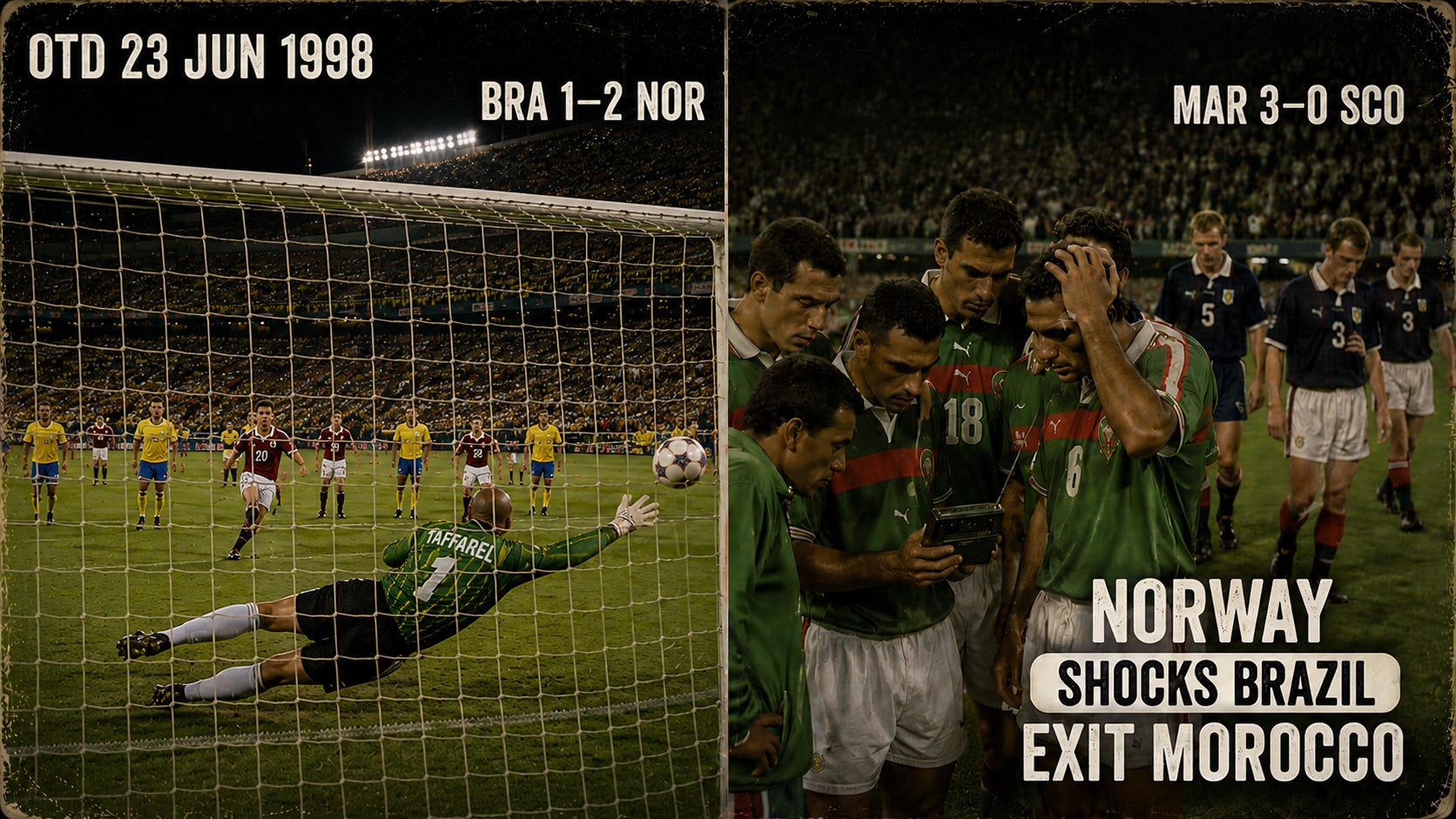
It is 23 June 1998, in Marseille. Brazil against Norway. And with seven minutes left, everything looks settled. Brazil lead 1-0. In the other Group A match, Morocco are beating Scotland and heading through. Norway are going home: unbeaten, respectable, eliminated.
Then, in seven minutes, the whole group turns over.
The temptation is to call what follows a shock, a plucky Nordic upset over the mighty Brazil. But that framing is wrong, and the wrongness is the interesting part. Norway in 1998 were ranked seventh in the world. They had qualified unbeaten, conceding twice in eight matches. Their squad was a Premier League team in disguise: Manchester United and Liverpool players down the spine, a Chelsea striker up front. Their coach, Egil “Drillo” Olsen, was a cold-eyed professor of directness whose long-ball, second-ball, zonal machine was nobody’s idea of a soft draw. This was not a minnow. It was a very good, very awkward side that the romantics simply refused to take seriously.
Brazil were Brazil: reigning world champions, ranked number one, Ronaldo at twenty-one already the most frightening forward on earth. But they were also already qualified, comfortable, and on this particular night, not quite switched on. That combination, a relaxed giant against a focused, organized, underrated opponent, is not the recipe for an upset. It is the recipe for exactly what happened.
What did happen turned on a single disputed moment late on, a decision that television first made look generous and later proved correct, and a penalty struck low and hard past a World Cup-winning goalkeeper. Norway won 2-1. And in another stadium, in another city, Morocco discovered the cruelest arithmetic in football: they had won their own match 3-0 and still gone home, because their fate depended on a game they could not touch.
That is the quiet horror of the group stage. You can do everything right and still be eliminated by ninety minutes happening somewhere else.
For Brazil, the defeat barely registered in the larger story; they marched on to the final, toward their own stranger heartbreak waiting in Paris. For Norway, it remained the summit. Back-to-back World Cups, a place in the last sixteen, and a night when they made the champions panic. Then came the long silence: more than two decades without a major tournament, a golden generation that simply stopped having heirs.
Until now. The midfielder who ran himself into the ground against Brazil that night, Ståle Solbakken, is the coach taking Norway back to the World Cup in 2026, with Erling Haaland and Martin Ødegaard, having finished their group above Italy. In 1998 that last detail would have sounded absurd. History has a way of closing its own loops.
So the win over Brazil was never really a fluke. It was a switched-off giant meeting a side good enough to punish it, on a night when the cost landed on a third team entirely. And it has aged into something better than an upset: the last golden memory of one Norwegian era, and a torch quietly carried into the next.
🎙️ THE PODCAST GOES DEEPER. The full episode has what this post holds back: the two late goals in detail, Tore André Flo’s battle with Júnior Baiano, the disputed penalty and how referee Esfandiar Baharmast was later vindicated, Brazil’s run on to the final, and the long fade and Solbakken-led revival of Norwegian football. That is the 10-minute version.
---
🎧 Listen on Spotify, Apple Podcasts, Amazon Music, Overcast, iHeart, and YouTube.
📩 Got an episode idea? otd@17lawsguy.com
Yesterday: 22 June 1986, the Hand of God and the Goal of the Century.
Tomorrow: 24 June 1990, two World Cup rivalries on one Sunday.