

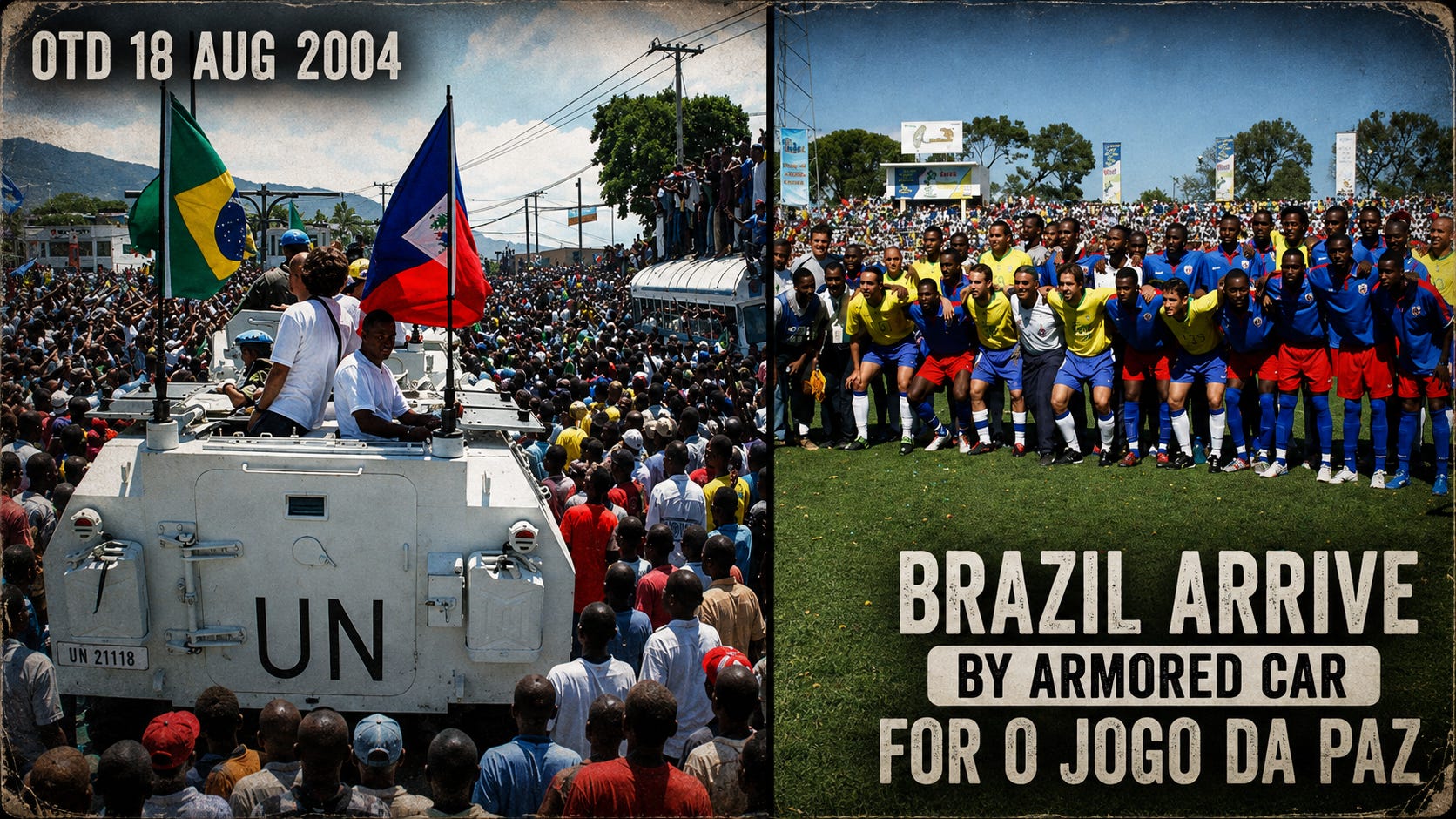
On August 18, 2004, the reigning world champions moved through the streets of Port-au-Prince in United Nations armored vehicles. Ronaldo, Ronaldinho, Roberto Carlos. Tens of thousands of Haitians lined the route, waving Brazilian flags alongside their own, pressing toward a convoy with UN painted down its sides. A few hours later Haiti played Brazil at the Stade Sylvio Cator, lost 6-0, and celebrated almost every goal. Because the score was never the point. This was O Jogo da Paz, the Game of Peace.
Haiti had begun 2004 marking the bicentenary of an astonishing achievement: on the first of January 1804, enslaved people had defeated Napoleon’s forces and founded the world’s first Black republic. Two hundred years later there was little to celebrate. The country was desperately poor, and its politics had turned violent. An armed rebellion that began in February spread until rebels threatened the capital, and on the twenty-ninth President Jean-Bertrand Aristide left the country, later insisting he had effectively been forced out. More than three hundred people had died in the violence around his removal. A new United Nations mission, its military component led by a Brazilian commander, arrived that summer to restore security and help disarm armed groups.
It was Haiti’s interim prime minister, Gérard Latortue, who reportedly floated the idea that a few Brazilian footballers might achieve more than thousands of peacekeepers. There was real logic beneath the joke. Haitians loved Brazilian football, not casually but passionately, adopting the Seleção as a second national team through the eras of Pele, Zico, Romario and Ronaldo. Brazil was already leading the UN military mission; now its most beloved cultural export could arrive alongside the soldiers, and Brazil’s president backed the plan.
One early proposal has become the most misremembered part of the story. Officials publicly discussed trading a gun for a ticket: hand in a weapon, receive admission to watch the world champions. It was a genuine disarmament idea, but it was abandoned before the match, once someone recognized the obvious flaw. If a firearm became the route into the most desirable event in the country, the people most likely to fill the stadium would be the very armed groups causing the violence. So no weapons were exchanged for entry. The match became a broader symbol of reconciliation instead.
The football itself was a party wrapped around a rout. Around fifteen thousand people squeezed into a freshly painted stadium, with thousands more locked outside. Latortue had promised a thousand dollars to the first Haitian to score against Brazil, but nobody told Ronaldinho to keep things polite. Roger opened the scoring. Then, in the thirty-second minute, Ronaldinho produced the moment everyone remembers, dribbling through five Haitians including the goalkeeper before rolling the ball into an empty net. The stadium erupted, not in anger but in appreciation, applauding the man who had just scored against them. Roger added a third before halftime; Ronaldinho completed a hat-trick after the break; Nilmar made it six. Carlos Alberto Parreira, a World Cup winning coach who had seen enormous nights, later said that if anyone ever asked him for the strongest emotion football had given him, this was it.
It would be dishonest to pretend the day did more than it did. It did not disarm Haiti, resolve the political crisis, or heal the country’s institutions. The proof came fast: serious violence returned to Port-au-Prince within six weeks. The UN mission stayed until 2017, and its legacy became deeply controversial, with accusations of excessive force and sexual abuse, and a cholera epidemic introduced by peacekeepers after the catastrophic 2010 earthquake. A football match did not save Haiti, and it is important not to claim that it did.
But that is not the same as claiming it accomplished nothing. For one afternoon it produced something exceptionally rare in that country: a shared national event, in which people from different political worlds occupied the same emotional space. It drew international attention, and it changed how some Haitians encountered a foreign military presence, the same armored vehicles carrying Ronaldo and Ronaldinho rather than only soldiers. It was soft power in its purest form, because Brazil brought something no deployment can manufacture: affection that already existed, and for ninety minutes it used that affection well.
There is a quiet coda. Twenty-two years later, Haiti returned to the World Cup for the first time since 1974, and were drawn against Brazil once more. This time there were no tanks and no peacekeeping mission. They met in Philadelphia because both had qualified for the biggest tournament on earth, and Brazil won 3-0. The result hurt again. But the relationship had changed, and this time Haiti arrived not as a country to be visited, but as a team that had earned its place.
---
🎧 Listen on Spotify, Apple Podcasts, Amazon Music, Overcast, iHeart, and YouTube.
📩 Got an episode idea? otd@17lawsguy.com
Yesterday: 17 August 2005, Messi’s 47-second Argentina debut.
Tomorrow: 19 August 1950, Velez and Huracan, a fight, and all 22 players in a police cell.