

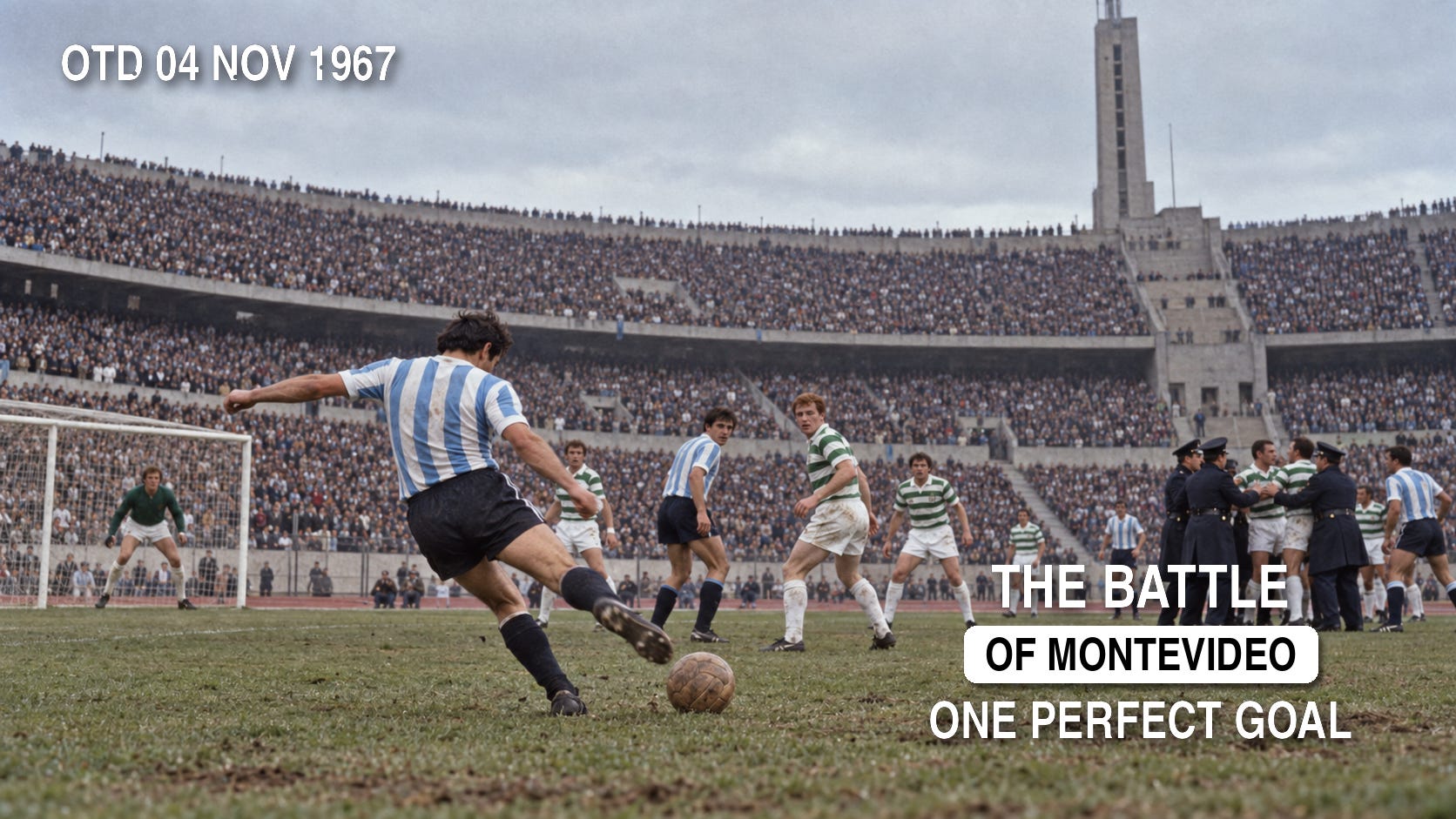
On 04 November 1967, ten minutes into the second half at the Estadio Centenario, Juan Carlos Rulli rolled the ball toward Juan Carlos Cárdenas. The Racing Club forward was roughly 25 yards from goal, left of center, with Celtic goalkeeper John Fallon watching through a forest of bodies.
Cárdenas did not take a settling touch. He swept his left foot through the ball and sent it rising across Fallon into the far upper corner. Fallon barely moved before the net snapped behind him.
It was a goal of startling purity in a match already losing its mind.
Riot police had entered the field. Alfio Basile and Bobby Lennox had been expelled together, even though Lennox appeared to have done nothing that warranted dismissal. Jimmy Johnstone would soon follow them. John Hughes would attack Racing goalkeeper Agustín Cejas. Rulli would be sent off. Bertie Auld would be ordered off and refuse to go.
The deciding match of the 1967 Intercontinental Cup became known as the Battle of Montevideo. Six players received instructions to leave; only five obeyed. Yet the world championship turned on something the chaos could not obscure: one pass, one swing of Cárdenas’s left foot and one perfect goal.
How did we get here?
The Intercontinental Cup began in 1960 with an irresistible proposition. The champions of Europe would face the champions of South America, and the winner could claim to be the best club on earth.
It was not organized by FIFA and it did not include champions from the other continents. UEFA and CONMEBOL created it as a contest between the two established centers of elite club football. In an age before routine live broadcasts and inexpensive international travel, it offered something rare: a meaningful meeting between sides that otherwise occupied separate football worlds.
The first seven editions strengthened the idea that the continents were meeting as equals. Real Madrid won in 1960. Peñarol answered in 1961. Pelé’s Santos took the next two, Internazionale the following two, and Peñarol returned in 1966. Four titles belonged to South America and three to Europe when Celtic and Racing entered. This was not an exhibition attached to a tour. It was a young competition already carrying genuine sporting authority.
Its regulations made the 1967 collision more likely to reach a third act. The opening two matches awarded two points for a win and one for a draw. Aggregate goals did not settle a tie. If each club won once, they were level on points and required a playoff at a neutral venue. A 5-0 victory followed by a 1-0 defeat would have carried no more value than two 1-0 results.
Celtic and Racing arrived as exceptional champions with sharply different journeys to the same claim.
Jock Stein’s Celtic had completed the greatest season in the club’s history. They won the Scottish league, Scottish Cup, League Cup, Glasgow Cup and European Cup. In Lisbon on 25 May, a side assembled entirely from players born within 30 miles of Glasgow recovered from Sandro Mazzola’s early penalty to overwhelm Internazionale 2-1. Tommy Gemmell equalized. Stevie Chalmers supplied the winner. Celtic became the first British club to conquer Europe.
The victory represented more than a trophy. Inter had won the European Cup in 1964 and 1965 through Helenio Herrera’s disciplined, defensive system. Celtic attacked. Their fullbacks advanced, their midfield pressed and their shots accumulated until Inter’s structure broke. The Lisbon Lions became proof that a locally built Scottish club could defeat continental royalty without abandoning adventure.
Racing’s rise was no less dramatic. Juan José Pizzuti had taken charge in 1965 and fashioned a side remembered as El Equipo de José. His players moved between positions, attacked in numbers and defended from the front. Agustín Cejas, Roberto Perfumo, Alfio Basile and Cárdenas were among the talents developed by the club. Experienced international Humberto Maschio supplied intelligence and authority.
Racing went 39 league matches unbeaten across 1965 and 1966. They won the 1966 Argentine championship with 24 victories, 13 draws and one defeat. The following year, they survived the longest championship campaign in Copa Libertadores history. Twenty matches produced 14 wins, four draws and two losses. The final against Nacional also required a third match, staged in Santiago, where Racing won 2-1 on 29 August.
The team’s balance made its movement possible. Perfumo organized the defense with the calm that earned him the nickname El Mariscal. Basile could step forward from the back line. Rulli covered and supplied. Maschio, back in Argentina after a decade in Italy, understood when to slow a match and when to release it. Raffo scored 14 times during the Libertadores campaign. Cárdenas was not a fixed center forward waiting for service; he moved into channels, attacked from distance and gave Pizzuti another route toward goal.
That continental title had been earned through travel, repetition and confrontation. Less than three months later, Racing were asked to cross the Atlantic and begin again.
The first match took place at Hampden Park on 18 October before more than 83,000 spectators. Celtic attacked, Racing disrupted, and the tone hardened quickly. With 21 minutes remaining, Billy McNeill rose to meet a corner and headed the only goal. Celtic had the victory and two points, but no aggregate advantage to protect.
Between the first and second matches, Celtic beat Dundee 5-3 in the Scottish League Cup final. The European champions flew to Argentina carrying another trophy and a belief that footballing superiority would eventually prevail.
The reception in Avellaneda corrected any expectation of normality. Before the return match on 01 November, a missile thrown from the crowd struck Celtic goalkeeper Ronnie Simpson during the warmup. He was unable to start. Fallon, who had watched the European Cup final from the bench, was suddenly told to play in one of the most hostile settings of his career.
Celtic still took the lead. Tommy Gemmell converted a penalty after 21 minutes. Norberto Raffo equalized 12 minutes later, and Cárdenas scored three minutes after halftime. Racing won 2-1. One victory each meant two points each, so the clubs were ordered across the Río de la Plata for a playoff only three days later.
Some Celtic players wanted no part of it. The first two matches had supplied enough evidence of where the contest was heading. Stein and the club’s directors nevertheless chose to continue. The Centenario offered physical separation between the field and stands, including a moat and perimeter barrier, and Uruguay appeared safer than Avellaneda.
Neutral did not mean disinterested. Racing had defeated Nacional in that year’s Libertadores final, and many Uruguayans inside the near 70,000 crowd were ready to support Celtic. Racing brought their own followers across the river during a holiday weekend. Both clubs entered a stadium already divided over a match that had not begun.
The sixth dismissal
Paraguayan referee Rodolfo Pérez Osorio stopped play after 23 minutes and warned the captains through an interpreter. The next serious disorder would bring dismissals. It was an attempt to impose control by threat rather than by identifying and punishing each offense.
Fourteen minutes later, Rulli brought down Johnstone and players converged. John Clark raised his fists. Police came onto the field to separate the groups. Pérez Osorio then dismissed Basile for Racing and Lennox for Celtic.
The symmetry was artificial. Lennox was not responsible for the incident. The referee had apparently decided in advance that Racing’s number 6 and Celtic’s number 8 would pay for their clubs’ next serious violations. Basile and Lennox happened to wear those numbers. Stein tried to keep Lennox on the field, but a police officer carrying a sword helped convince the forward that the order was real.
Halftime arrived at 0-0 with ten players on each side. Three minutes after the restart, Johnstone reacted to another confrontation with Rulli and became Celtic’s second dismissal.
Then football briefly reclaimed the afternoon.
Rulli’s pass found Cárdenas. The left-footed strike traveled beyond Fallon and into Racing history. Cárdenas had also scored the winner in Avellaneda. Across three matches containing only five goals, he supplied two of Racing’s three and both that changed the direction of the series.
Celtic’s response was not a recovery. With 16 minutes left, Hughes attacked Cejas while the goalkeeper was on the ground and was sent off. Rulli followed after striking Clark. Two minutes from the end, Auld received Celtic’s fourth dismissal order.
Auld simply remained. Amid police incursions, arguments and confusion, the referee could not make his decision operational. Racing’s official match record lists five expulsions: Basile and Rulli for Racing; Lennox, Johnstone and Hughes for Celtic. Auld became the sixth player ordered off, but the only one who completed the match anyway.
At the final whistle, nine Racing players and eight Celtic players were still on the field. Racing had won 1-0. Their attempt at a lap of honor was cut short by objects thrown from the stands, and police opened a route toward the tunnel.
The following morning’s language captured the contradiction. La Nación’s front page announced that Racing had beaten Celtic and become world champion. Montevideo newspaper El Día reached for a darker pun: Racing had won the “World War.” Its report also called the match a disgrace, a farce and a fraud. Racing’s achievement and football’s embarrassment occupied the same result.
One gesture resisted the ugliness. Billy McNeill approached Roberto Perfumo, offered his hand and exchanged shirts. Perfumo later treasured the embrace because it restored, for a few seconds, the respect the series had almost eliminated.
So what?
Racing became the first Argentine club to win the Intercontinental Cup and therefore the first to be crowned world champion. Argentina’s senior national side had not yet won the World Cup. For a football culture already convinced of its place among the game’s great powers, Racing supplied the missing international proof.
The title became the summit of the club’s identity. Pizzuti’s side had won Argentina, then South America, then the world in less than a year. Racing would endure a 35-year wait for another domestic championship, suffer relegation and enter bankruptcy proceedings that produced the infamous 1999 declaration that the club had “ceased to exist.” None of that could erase Montevideo. When Racing’s institutional existence appeared most fragile, the first Argentine world championship remained immovable.
Cárdenas became the instant through which that achievement could always be replayed. He stayed with Racing until 1972, spent four years with Puebla and Veracruz in Mexico, then returned in 1976 to finish his career at the club. Long after teammates, tactics and tournament regulations faded from general memory, the left-footed shot remained.
The goal also completed an extraordinary personal sequence. Cárdenas scored seven times in Racing’s 1966 championship season, seven more in the 1967 Libertadores and twice in the three matches against Celtic. He did not merely appear at the end of Racing’s climb. His goals formed a line through Argentina, South America and the world.
The immediate contrast was severe. Racing’s champions were rewarded with bonuses and new cars. Celtic’s board fined every player £250 for the club’s loss of discipline. Documents released decades later revealed an even more personal consequence: Stein had been proposed for a knighthood in the 1968 New Year Honors, but the nomination was withdrawn after Montevideo.
Celtic recovered on the field. They continued winning in Scotland and returned to the European Cup final in 1970, losing to Feyenoord after extra time. The Lisbon Lions retained their heroic place in club history. Montevideo became the dark reverse of Lisbon: the same great side, five months later, pulled into a contest it could neither control nor transcend.
The Battle of Montevideo did not destroy the Intercontinental Cup by itself. It did, however, expose the competition’s structural danger. The title mattered enormously, yet responsibility was divided between two confederations. The home-and-away format imported local hostility into a contest carrying global prestige. Long travel, incompatible calendars, uneven refereeing expectations and weak disciplinary authority turned every grievance into a continental one.
The next two editions deepened the damage. Manchester United’s 1968 meetings with Estudiantes were bitter. Estudiantes against AC Milan in 1969 became so violent that Argentine authorities arrested three Estudiantes players after the return match. European champions increasingly declined to participate. Bayern Munich’s withdrawal allowed European runner-up Atlético Madrid to contest and win the 1974 edition.
The competition found a more durable structure in 1980. A sponsor, Toyota, helped move it to Japan as a single match on neutral ground. The Toyota Cup preserved the European versus South American duel while removing the two hostile home legs and the emergency playoff that had trapped Celtic and Racing.
FIFA’s first Club World Championship in 2000 widened the idea to all six confederations. The competition returned permanently in 2005 and absorbed the old Intercontinental tradition. FIFA formally recognized the winners from 1960 through 2004 as club world champions in 2017. Racing’s claim was no longer merely cultural or promotional. It received world football’s retrospective institutional seal.
The concept has expanded again. The 32-club Club World Cup launched in 2025, while an annual FIFA Intercontinental Cup restored the old name for a tournament involving champions from every confederation. The modern production is separated from Montevideo by security planning, global broadcasting, formal disciplinary systems and carefully controlled venues. The central sales pitch, however, remains the same one offered in 1960: gather champions from different football worlds and decide which club stands above them all.
The lesson of 1967 is not that passion made the old competition authentic and regulation made the new one sterile. Racing’s goal was authentic. McNeill’s handshake was authentic. The punches, arbitrary dismissal and police interventions were failures of football administration, not proof that the prize mattered more.
Three things to take away
The title was decided by points, not aggregate goals. Celtic’s 1-0 win and Racing’s 2-1 win gave each club two points. That required a neutral playoff. The goals happened to total 2-2, but goal difference and away goals had no role.
Six dismissals does not mean six players left. Basile, Lennox, Johnstone, Hughes and Rulli departed. Auld was also ordered off but stayed on the field, leaving Racing with nine active players and Celtic with eight when the match ended.
Montevideo helped reveal why a world club championship needed stronger machinery. The Intercontinental Cup eventually became a neutral-site event in Japan, then fed into FIFA’s global tournament. The modern competition’s plumbing grew partly from the old competition’s failures.
On This Day...
Before the match, Racing’s chaplain Norberto Chindemi encouraged the players to carry small holy cards of Don Bosco. Club lore says Cárdenas slipped his into his shin guard.
On 04 November 1967, while police, players and officials lost control around him, that guarded left leg struck the cleanest ball of the afternoon. The Battle of Montevideo gave Racing the world. One perfect goal made certain the battle would never be the whole story.
---
(This story was first published as a podcast episode on 04 Nov 2025.)
Questions, corrections or story ideas: otd@17lawsguy.com
Yesterday: 03 November 1971, The Shootout That Should Never Have Happened.