

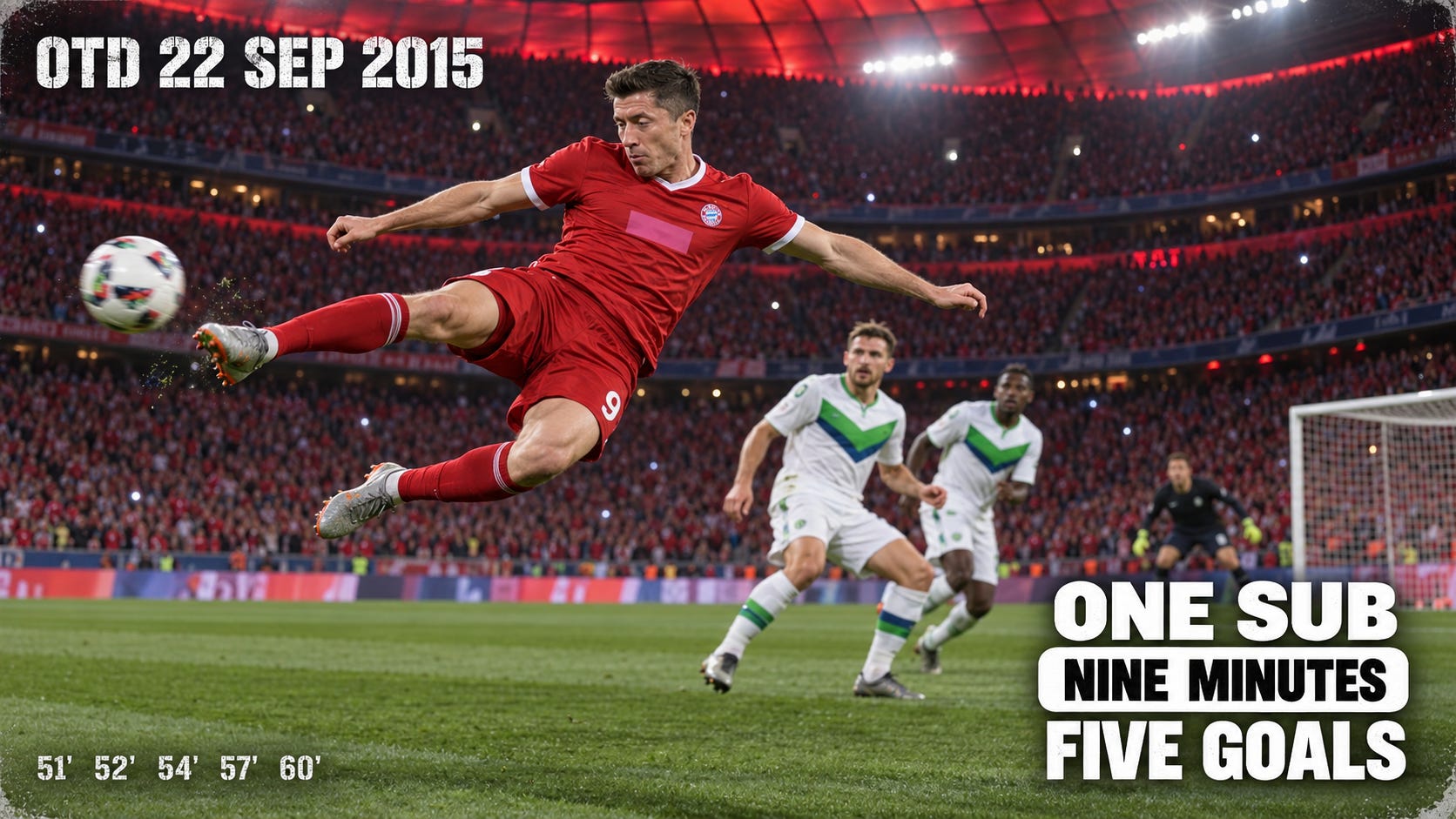
It is September 22, 2015, at the Allianz Arena, and Bayern Munich go in at half-time trailing Wolfsburg 1-0. Pep Guardiola needs to change the game, so he sends on Robert Lewandowski. Six minutes later Lewandowski scores. A minute after that, he scores again. Then a third, a fourth, a fifth. Five goals in eight minutes and fifty-nine seconds. One substitute has turned a serious contest between Germany’s champions and cup holders into something that looks like a computer game. This is the story of the most devastating substitution football has ever seen.
How did we get here?
Bayern against Wolfsburg was not meant to be a mismatch. Bayern were the defending Bundesliga champions, into the third and final season of Guardiola’s reign, with five wins from five and three straight clean sheets. But Wolfsburg had finished second the previous season and won the German Cup for the first time, and they had become genuinely awkward opponents for Bayern, beating them 4-1 in January 2015 and then defeating them on penalties in the German Supercup that August. They were not coming to Munich merely to survive. They were one of the very few German teams with recent proof that Bayern could be beaten.
The two clubs also embodied very different Bundesliga journeys. Bayern had not even been chosen for the league’s inaugural season in 1963, entering only in 1965 and losing their first Bundesliga match to local rivals 1860 Munich, with a young Franz Beckenbauer, Sepp Maier and Gerd Müller still assembling what would become a dynasty. Fifty years later, Bayern were the dynasty, the reference point against which every other German club measured itself. Yet it was Wolfsburg who struck first. In the 26th minute Julian Draxler found Daniel Caligiuri on the right, and Caligiuri drove into the area and beat Manuel Neuer with a fierce shot at the near post. Wolfsburg nearly made it two when Neuer raced far outside his box and lost the ball, but Josuha Guilavogui’s effort from inside his own half struck the post. At the interval Bayern had dominated possession without controlling the match. They were losing, and Wolfsburg’s plan was working again.
Guardiola made two changes. Javi Martínez came on to firm up the structure behind the ball, and Robert Lewandowski replaced Thiago Alcântara to give Bayern a recognized centre-forward. Lewandowski had not even been fully fit; he had started on the bench partly because of an ankle problem, and Bayern did not know whether he could change the game. They were about to discover that he could consume it.
In the 51st minute Thomas Müller forced his way into the area, the ball broke loose among several defenders, and Lewandowski stabbed it in. One-all. Wolfsburg had barely restarted before he collected the ball outside the box and drove a low shot beyond Diego Benaglio. Two-one. Just over three minutes after his first goal he completed his hat-trick, his first attempt hitting the post, his second blocked, the third rebound finally converted: three goals in three minutes and twenty-two seconds, the fastest hat-trick in Bundesliga history. And he had only just begun. Douglas Costa crossed from the left and Lewandowski met it with a controlled volley for the fourth. Then, on the hour, Mario Götze delivered from the right, and Lewandowski twisted and launched himself at the ball, striking an airborne volley from the edge of the area that flew past Benaglio. Five-one. On the touchline Guardiola put both hands on his head and stared, mouth open, the coach who could seemingly explain every movement of a football match with no explanation for what he had just watched.
Lewandowski had scored five times in eight minutes and fifty-nine seconds, and Bayern had gone from a goal down to 5-1 up without anyone else scoring. There was nearly a sixth, cleared off the line by Ricardo Rodríguez. Afterward Guardiola admitted he had never experienced anything like it, as player or coach; Philipp Lahm joked that Lewandowski deserved criticism for missing the chances that might have made it seven; and Wolfsburg’s coach Dieter Hecking could only call him world-class and the collapse inexplicable. Except even that undersold it, because this was not simply five goals. It was five goals from a man who had not been on the pitch when the second half kicked off.
So what?
The first thing is that this was the substitute taken to its logical extreme, and the substitute is a surprisingly recent idea. The English Football League did not allow them until 1965, when Keith Peacock came on for the injured Mike Rose and became the first, a change introduced only to cover injuries. That rule did far more than provide cover. It eventually created a new kind of footballer and a new form of tactical intervention, in which the player from the bench could become the story. László Kiss showed it at the 1982 World Cup, scoring three times in seven minutes against El Salvador to become the first substitute with a World Cup hat-trick. Ole Gunnar Solskjær came on at Nottingham Forest in 1999 and scored four in the last nineteen minutes, then months later scored the stoppage-time Champions League winner. Others changed history with a single touch, Götze with Germany’s 2014 World Cup final winner, Éder with Portugal’s decider at Euro 2016. But Lewandowski’s belonged in its own category. Those substitutions produced a decisive moment. His produced an entire avalanche, five goals, the first time any Bundesliga substitute had scored five.
The second thing is who it happened to. This was not a semi-professional side in an early cup round. Wolfsburg were the reigning German Cup holders and league runners-up, a team that had beaten Bayern twice in the previous eight months, and for forty-five minutes they had again looked capable of frustrating Guardiola’s champions. Nine minutes later the contest had simply ceased to exist. The records fell almost as fast as the goals: three in three minutes and twenty-two seconds, four in five minutes and forty-two seconds, five in eight minutes and fifty-nine seconds, and Guinness World Records would later hand Lewandowski four certificates for the feat: the fastest hat-trick, the fastest four goals, the fastest five, and the most goals by a substitute in a Bundesliga match. It is worth pausing on how strange that cluster is, because records like these are usually set in blowouts against overmatched opposition, accumulated slowly over ninety minutes, not detonated in nine against the team that had finished second in the country. It also marked a turning point in his Bayern career. He had joined from Borussia Dortmund in 2014 and scored a fine but not yet overwhelming seventeen league goals in his first season. After Wolfsburg the goals never stopped: two against Mainz four days later, a Champions League hat-trick against Dinamo Zagreb, two more against his old club Dortmund, ten in three matches. He finished the season with thirty league goals and went on to score more than three hundred in the Bundesliga, break Gerd Müller’s single-season record with forty-one, and establish himself as one of the greatest centre-forwards the game has seen. Even inside that career, these nine minutes stand alone.
The third thing is what the night says about tactics and their limits. In 1965 the man on the bench was an emergency replacement, allowed only because someone had been hurt. By 2015 the bench was an arsenal, and Guardiola could read the first half, change Bayern’s shape and send one of the world’s finest strikers at a tiring defence. That is what tactics can do: identify the problem and create the opportunity. But tactics only explain why Lewandowski entered the match. They explain nothing about what happened next. A coach can diagnose. A substitution can open the door. Only the player can produce the miracle, and no tactical plan has ever accounted for five goals in nine minutes. That is not a knock on Guardiola; it is the honest limit of what any manager controls. He built the loaded gun. He did not, and could not, guarantee it would fire like that. That is the humbling and the beauty of it: the best-laid plan in the world still needs someone capable of turning a good chance into something no one will ever forget.
Three things to take away
First, Wolfsburg were beating Bayern 1-0 at half-time, and had recently beaten them in both the Bundesliga and the German Supercup. This was a real contest, not a formality.
Second, Robert Lewandowski came off the bench and scored five goals in eight minutes and fifty-nine seconds, including the fastest hat-trick in Bundesliga history and four world records in one spell.
Third, football resisted substitutes for decades, then made the bench a weapon. Keith Peacock in 1965 was the emergency beginning; Lewandowski in 2015 was the logical extreme.
On September 22, 2015, Pep Guardiola made a substitution. Nine minutes later the match was over and four world records had been born.
---
📩 Got an idea to an OTD story? otd@17lawsguy.com
Yesterday: 21 September 1949, England’s first loss on home soil to a foreign nation.
Tomorrow: 23 September 1973, Argentina assemble a secret squad, the Selección Fantasma.
A game that will forever remain etched in my brain truly. Wonderful job capturing its very essence!