

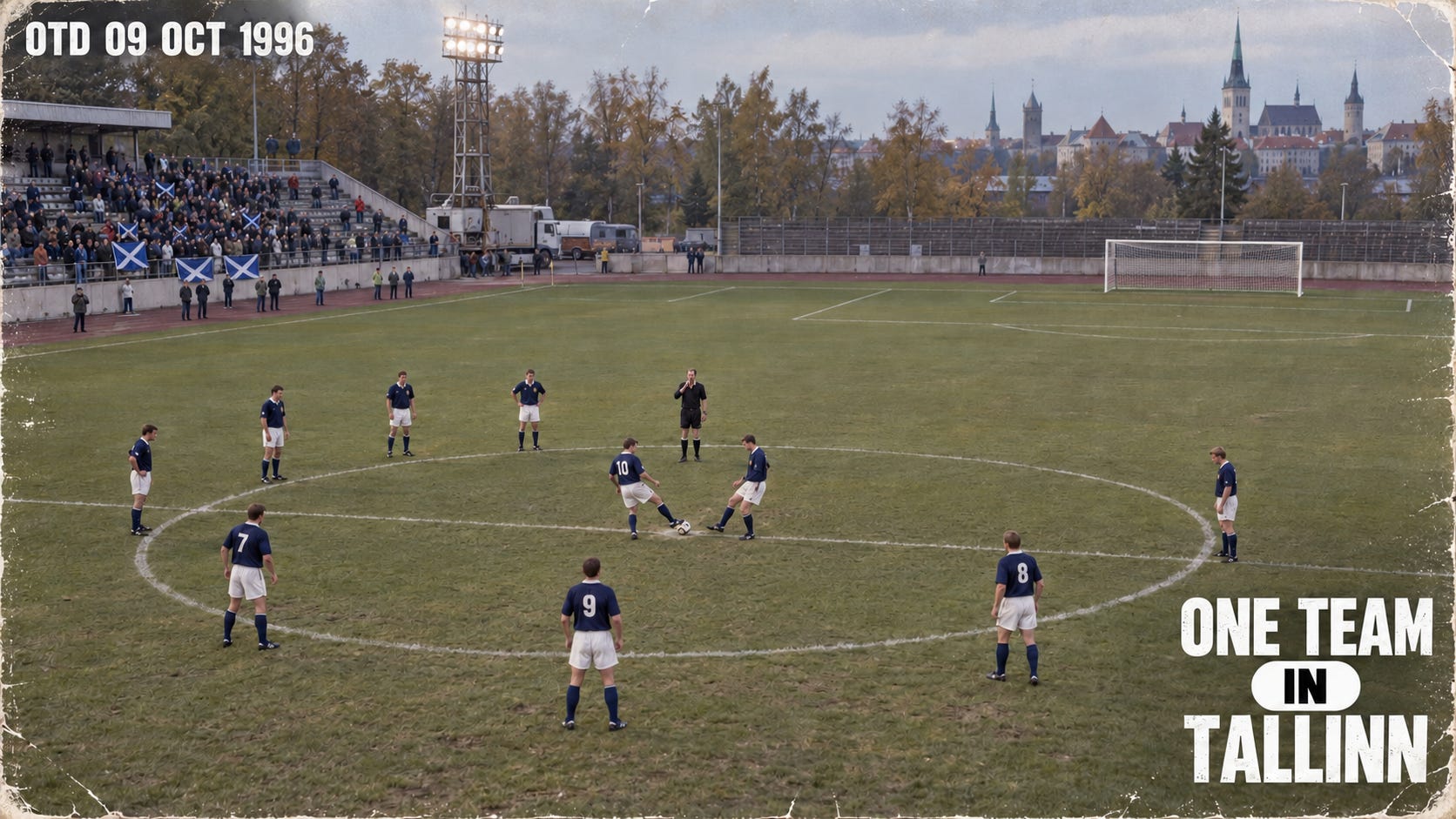
It is 09 October 1996, shortly before three in the afternoon, and the most conspicuous thing inside Tallinn’s Kadriorg Stadium is the team that is missing.
Scotland are present. Andy Goram is in goal. John Collins stands over the ball. Billy Dodds is beside him. Craig Brown’s players are in full kit, the Yugoslav referee Miroslav Radoman has checked his watch, and several hundred travelling supporters are singing the line that will name the afternoon: “One team in Tallinn. There’s only one team in Tallinn.”
No Estonian player occupies the other half. No goalkeeper guards the empty goal. Radoman blows his whistle. Dodds nudges the ball to Collins. Almost immediately, the whistle sounds again.
It is remembered as international football’s three-second match: kick-off, one short pass and abandonment. Scotland have obeyed FIFA’s order; Estonia the original timetable. Both believe the rules are on their side.
The 1998 World Cup campaign’s shortest action will require four months, a committee decision and a journey to Monaco to resolve.
How did we get here?
Estonia’s football story had already been interrupted once by forces much larger than sport. On 14 December 1921, nine representatives of three Tallinn clubs—Kalev, Tallinn Football Club and Sport—created the Estonian Football Association, with judge Gustav Laanekõrb as chairman. Estonia already had twenty-nine clubs, a domestic championship and a national team. FIFA membership followed in 1923; Paris 1924 brought an Olympic appearance.
In July 1928, Kadriorg hosted the first Baltic Cup, created by three young states using football to make themselves visible on the European map. Estonia beat Lithuania 6-0, lost the decider 1-0 to Latvia, then won the cup in 1929, 1931 and 1938. Sweden against Estonia in June 1933 was also the first match ever played in World Cup qualifying.
Then came Soviet occupation. The independent association was dissolved, its national team disappeared and some of the men who had built the pre-war game were killed. An Estonian SSR championship continued, but there was no sovereign team and very little presence in the Soviet elite. Tallinna Kalev managed two seasons in the Soviet top flight before relegation in 1961; from 1969 to 1982, Estonia had no club anywhere in the Soviet league pyramid.
The recovery began before the state itself returned. In 1980, a match between teams from Estonian television and radio drew a crowd that became an anti-Soviet demonstration. Youth coach Roman Ubakivi understood that football could again become a rallying point. His Lõvid—Lions—team travelled successfully to Scandinavian youth tournaments and supplied much of the generation that would form the restored national side post-Cold War.
On 3 December 1988, before political independence, the Estonian Football Association was re-established. Siim Markus led the first phase. Peeter Küttis and former player Arvu Sild were among the restorers; Sild became vice-president, while Küttis joined the board and succeeded Markus as president in 1994. Aivar Pohlak, a teacher, writer and youth coach, founded Flora Tallinn in 1990 around players emerging from Ubakivi’s work. Uno Piir took charge of the national team, with Pohlak later his assistant. They were rebuilding a federation, league, clubs and national team while the country rebuilt the state.
The first symbolic return came through the old regional route. Estonia played Latvia and Lithuania in the revived Baltic Cup in November 1991, three months after independence. FIFA did not count the games as full internationals, and Estonia lost both, but the competition suppressed with the countries had returned with them. On 3 June 1992 came the first official international: 1-1 with Slovenia at Kadriorg. Twenty-year-old Mart Poom was in goal; Martin Reim and Marko Kristal were already there.
The independent Meistriliiga opened in 1992. Norma Tallinn won the first championship and retained it in 1992-93; Flora followed, although its first title came after leaders Tevalte were controversially disqualified. By 1996, FC Lantana—not Flora—were champions. Europe exposed the gap: Flora’s first UEFA tie ended in a 6-0 aggregate defeat by Odense (OB) from Denmark. No Estonian club reached a UEFA group stage until Flora entered the Conference League in 2021.
The national team learned just as publicly. Estonia went almost three years without a victory between October 1993 and October 1996 and sank to 135th in FIFA’s rankings. Scotland had visited Tallinn during qualification for the 1994 World Cup and won 3-0. By 1996, however, the picture was beginning to change. The Icelandic coach Teitur Þórðarson became the first foreign manager of the restored side, simultaneously taking charge of Flora. Poom had experience in England, Reim was developing into the team’s metronome, and Flora supplied much of the squad.
On 05 October 1996, Estonia beat Belarus 1-0 at Kadriorg. It was the country’s first competitive victory since returning to international football and its first win of any kind for nearly three years. Scotland, meanwhile, won 2-0 in Latvia through goals by Darren Jackson and Kevin Gallacher. Four days later the sides were due to meet in Tallinn in European qualifying Group Four, which also contained Austria, Sweden, Latvia and Belarus.
Scotland had missed the 1994 World Cup after five consecutive appearances, then narrowly failed to escape its Euro ’96 group. France mattered enormously. Scotland had drawn in Austria before beating Latvia; Sweden were favourites, Austria dangerous, and Estonia had just shown that points at Kadriorg were no longer ceremonial.
The scheduled kick-off was 6.45pm. That made floodlights decisive.
Kadriorg was an old, intimate arena rather than a modern television stadium. The Estonian association had hired temporary floodlighting from Finland, sitting mounted on lorries around the pitch. The problem was the lights’ low position at Kadriorg. At Scotland’s evening training, Brown asked to see full power and worried about high balls disappearing into darkness or glare. FIFA commissioner Jean-Marie Gantenbein tested the lighting, initially considered it broadly acceptable, yet remained uncertain about parts of the field.
The complaint was not invented after defeat or used to avoid playing. Scotland raised it before the match, and the FIFA commissioner agreed that the lighting did not meet the required standard. At roughly nine the following morning, on match day, FIFA’s emergency machinery moved the kick-off forward to 3pm, while there was still daylight.
That solved one problem by creating several others.
Thousands of tickets had been sold for an evening fixture. Supporters would be at work. Security, television and stadium arrangements had been built around 6.45. The Estonian association estimated its losses at about £170,000, including roughly £100,000 in television revenue, refunds and the cost of the very temporary lighting that FIFA now judged inadequate.
More immediately, Estonia said some of its players were around eighty kilometres from Tallinn and could not be recalled, fed, briefed and prepared properly on a few hours’ notice. The association objected that a World Cup qualifier could not simply be brought forward by almost four hours on the morning of the game. Þórðarson’s team would honor the time originally agreed.
FIFA’s reply was that the new time was final.
Scotland could say that FIFA had ordered a 3pm kick-off and Estonia had failed to attend. Estonia could say FIFA’s own late decision made normal fulfilment commercially and practically impossible. One side had an order, the other a grievance, and neither could settle the argument.
Scotland arrived at the stadium around 1pm. Senior Estonian football officials were there, but the team was not. Brown suspected Estonia might appear late as a protest and the match would eventually proceed. Instead, the deadline approached with the home dressing room empty.
The Scottish players walked out. The Tartan Army converted administrative absurdity into comedy. “One team in Tallinn” rolled around the ground. The Scots lined up as if opponents might materialize. Radoman’s task was not to decide the competition points. A referee applies the Laws, records what happens and reports an abandonment; the competition authority decides whether the result becomes a forfeit, a replay or something else.
Radoman performed the necessary ritual. Dodds rolled the ball to Collins; the referee stopped proceedings; Tosh McKinlay punched the air. A supporter later ran on and scored into the undefended goal, the afternoon’s closest thing to a shot.
The Scotland party believed it had done what FIFA required and would receive the conventional 3-0 default. The match delegate reportedly reinforced that expectation. Estonia’s bus arrived near the original evening time, by which point the opponents, referee and supposed match had gone.
Even the paperwork became philosophical. Had a match started? If it had, had Gary McAllister now served the suspension that had ruled him out specifically against Estonia? Had the eleven Scots earned caps for one pass against nobody? The eventual answer to the last question was no, although the players were allowed to keep their shirts.
The answer to everything else belonged to FIFA.
So what?
On 07 November, FIFA’s World Cup organizing committee ordered the fixture to be played again, preferably in Estonia and before 16 March. Scotland were furious. The Scottish FA sought clarification not only about the regulations but also about the process. The committee’s chairman, Guillermo Cañedo of Mexico, was ill; vice-chairman Lennart Johansson had previously expressed the view that the match should be replayed. Johansson was also Swedish, a former president of the Swedish association, and Sweden were Scotland’s direct rivals in Group Four.
That did not prove improper influence. It did make the appearance of impartiality unusually important. Scottish chief executive Jim Farry chose his words carefully: “Everybody knows that football is a game of opinions,” he said. “Some of us have opinions but, because of our position, we cannot voice them.” He then questioned whether the necessary “ethic of responsibility” had been followed by everyone involved. It was an accusation delivered without quite becoming one.
The ruling gave neither side what it wanted. Estonia avoided a 3-0 defeat but lost home advantage. Winter made Tallinn impractical; Estonia proposed Cyprus, Scotland objected, and FIFA selected Monaco for 11 February 1997. FIFA met Scotland’s replay costs because the Scots had already travelled once.
McAllister’s case made the sporting consequence immediate. FIFA treated the Tallinn non-match as void, so his suspension had not been served. He therefore missed Scotland’s next scheduled qualifier, at home to Sweden on 10 November. Scotland won 1-0 anyway, thanks to John McGinlay, but Brown had been deprived of his captain and most influential midfielder in a match more difficult than the one he was originally due to miss.
Supporters had paid for transport, accommodation and tickets, then watched one pass. Some pursued FIFA for reimbursement. Before France ’98, the Scottish FA guaranteed those travellers tickets for all three group matches: a reward, not a refund.
The replay in Monaco finally took place on 11 February 1997. It was nominally Estonia’s home match, staged before 3,766 people in one of Europe’s richest enclaves. Collins, then an AS Monaco player, had the peculiar experience of playing an away international in his club stadium.
This time Estonia appeared, and Poom made sure their presence mattered. Scotland created the better chances. Duncan Ferguson had a header cleared, Tom Boyd struck the bar and Poom produced the saves required for a 0-0 draw. The goalkeeper who had been part of Estonia’s rebirth in 1992 now denied Scotland the victory it had expected to receive by regulation four months earlier.
For Ferguson, it was his seventh and final Scotland appearance. For Poom, it advertised the authority that would take him to Derby County, Sunderland and Arsenal. Estonia finished fifth, but Þórðarson’s tenure moved them towards respectability. The national side later reached the Euro 2012 play-offs, Tallinn staged the 2018 UEFA Super Cup and Flora entered a UEFA group phase in 2021. Estonia did not become a power; it did travel far from 1996’s borrowed infrastructure and improvised institutions.
Scotland survived the lost points. They beat Estonia 2-0 at Kilmarnock, finished second behind Austria and qualified automatically for France ’98 as Europe’s best runner-up, one comparison point ahead of Italy. The Monaco draw did not ultimately cost them, but nobody knew that when FIFA reallocated the competitive risk.
The Laws of the Game explain only part of such an episode. Today, Law Three says a match may not start or continue if either team has fewer than seven players. Law Seven says an abandoned match is replayed unless competition rules or the organisers determine otherwise. That final phrase is the hinge. The referee can establish that football cannot proceed; the referee does not normally award the table points.
Competition regulations supply the sanction. Modern UEFA rules normally impose forfeiture when an association refuses to play or causes a match not to take place. Yet responsibility is not always physical absence. Estonia were missing, but FIFA had created the emergency; the committee judged a replay fairer.
Two months later, virus-hit Middlesbrough failed to travel to Blackburn believing they had sufficient guidance to postpone. The Premier League fined them, deducted three points and ordered a replay. Middlesbrough were relegated by two. Again, the question was who had authority to excuse the absence.
Juventus-Napoli in 2020 produced the legal version. Napoli did not travel after local health authorities intervened during Covid-19. Juventus initially received a 3-0 win and Napoli lost a point; Italy’s highest sports tribunal overturned both sanctions and the match was played.
Brazil-Argentina in 2021 lasted minutes before health officials entered over quarantine breaches. FIFA ordered a replay, but after both teams qualified, the dispute was resolved without one.
There is also the darker example: Chile against the Soviet Union in the 1973 World Cup play-off. The Soviets refused to enter Santiago’s Estadio Nacional after it had been used for detention and torture following the coup. Chile kicked off against an empty half and walked the ball into an empty net before the spectacle stopped. That was not a floodlight dispute but state violence pressing directly into football. The visual rhyme with Tallinn should not disguise the moral gulf between them.
A fixture is not merely two teams and a ball. It is an agreement among laws, competition rules, broadcasters, police, public authorities, stadium operators, travel plans and supporters. Most days the plumbing is invisible. A no-show exposes every pipe.
Tallinn shows why automatic punishment is both attractive and dangerous. Without deadlines, teams could manipulate schedules. Without discretion, a governing body can punish a team for an emergency it did not cause. FIFA chose discretion but handled the hours before kick-off so poorly that every later option looked unfair.
Scotland followed the instruction and lost the expected reward. Estonia protected its original arrangement and lost the right to play at home. McAllister’s suspension migrated to a harder fixture. Supporters paid for institutional confusion. Radoman, who had no power to repair any of it, supplied the two whistles that made the dispute official.
That is why “One Team in Tallinn” endures. The chant is funny. The scene is irresistible. But beneath it lies a serious question: when football cannot be played, who gets to decide why?
Three things to take away
The famous match was a procedure, not a contest. Scotland kicked off, Collins received Dodds’s pass and Radoman abandoned proceedings. No caps were awarded and FIFA, not the referee, decided what came next.
Estonia’s absence did not produce an automatic forfeit. FIFA had changed the kick-off from 6.45pm to 3pm only hours beforehand because of inadequate lighting. Its organizing committee then judged a neutral-venue replay fairer than a 3-0 award.
The consequences reached far beyond one comic afternoon. McAllister’s suspension moved to the Sweden match, supporters sought compensation, Estonia lost home advantage, and Scotland had to earn a 0-0 draw in Monaco before qualifying for France ’98 as Europe’s best runner-up.
On This Day...
On 09 October 1996, Scotland walked into an empty half of Kadriorg Stadium. Billy Dodds touched the ball to John Collins. Miroslav Radoman blew his whistle, and a World Cup qualifier ended before it had properly begun. Estonia arrived for the time printed on the original schedule. Scotland expected three points. FIFA gave them another match.
---
Questions, corrections or story ideas: otd@17lawsguy.com
Yesterday: 08 October 1989, The Night Costa Rica Qualified Without Playing