

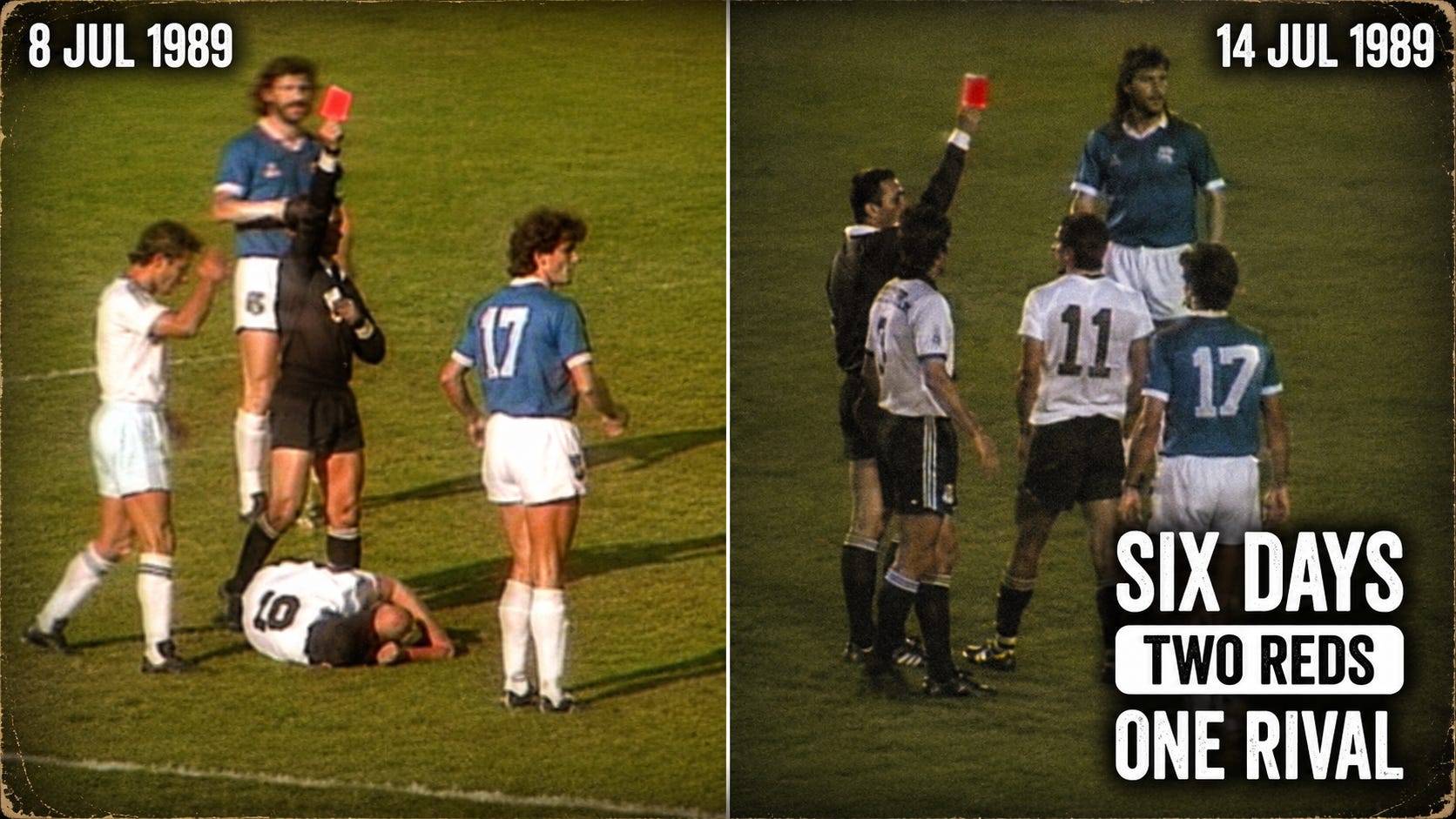
It is July 14, 1989. Rio de Janeiro. The Maracanã. Copa América, Uruguay against Argentina.
And Oscar Ruggeri is sent off.
Which is already a story. But here is the detail that turns it into history: Ruggeri had also been sent off against Uruguay six days earlier. Same tournament. Same opponent. Same rivalry. Two Argentina-Uruguay matches, two Ruggeri red cards, six days apart.
Argentina against Uruguay is one of football’s oldest international rivalries outside Britain. Buenos Aires and Montevideo stare at each other across the Río de la Plata, sharing migration, language, tango, pride, and enough resentment to build a century of matches. They met in the 1928 Olympic final, where Uruguay won a replay. They met in the first World Cup final in 1930, where Uruguay came back to win 4-2 and Buenos Aires raged at the result. When these teams play, it is never just two teams. It is memory.
Into that memory walks Oscar Ruggeri. El Cabezón, the Big Head. A tall, aggressive, aerially dominant centre-back who came through Boca Juniors alongside Maradona, then in 1985 did the almost unthinkable: he left Boca for River Plate. Boca fans treated it as treason. Ruggeri later said barras tried to set fire to his house with his parents inside. At River he won the league, the Copa Libertadores, and the Intercontinental Cup, and once, in a Superclásico at La Bombonera, he scored an equalizer and celebrated with everything he had in front of the Boca end.
He does not lower the temperature. He lives in it.
By 1989 he is a world champion, part of Bilardo’s structure around Maradona, and Argentina arrive at the Copa América in Brazil as a hard, compact, often unpleasant team. On July 8, in the group in Goiânia, Ruggeri fouls Enzo Francescoli in the sixteenth minute, collects a second yellow, and walks. Ten-man Argentina win anyway: Maradona releases Caniggia, who scores from a narrow angle. 1-0.
Both teams reach the final group in Rio. Ruggeri serves his suspension. And on July 14, against Uruguay again, he starts.
Uruguay are sharper. Maradona nearly produces something absurd, chipping Javier Zeoli from near halfway and hitting the crossbar. Then, in the thirty-eighth minute, Roberto Sensini plays a poor back pass, Rubén Sosa reads it, rounds Pumpido, and scores. Now the match is exactly what Uruguay want: Argentina chasing, Uruguay waiting, and Ruggeri defending space he hates to defend.
Sixty-fourth minute. Ruggeri brings down Sosa. Cynical foul. Red card. Again. Against Uruguay. Again.
There was no secret plan, and none was needed. Uruguay had Francescoli to draw defenders out, Sosa to run behind them, transition speed, a lead to protect, and six days of fresh memory. They had the conditions. Ruggeri supplied the combustion. Sosa chips Pumpido in the eighty-first minute, Uruguay win 2-0, and Argentina’s tournament curdles: third place, without a single goal in the final group. Brazil lift the title two days later, beating Uruguay 1-0 at the Maracanã.
Here is the thing about Ruggeri, though. The double red is a strange stain on an enormous career. World Cup winner in 1986. Finalist in 1990. Copa América champion in 1991 and 1993, so the man who lost his head twice against Uruguay also helped end Argentina’s long continental drought. Ninety-seven caps. South American Footballer of the Year in 1991. Good enough for Boca, River, and Real Madrid.
Football remembers the red cards because they are cinematic. Careers are larger than their cinematic moments. But same national opponent, same tournament, same six-day window, same player walking twice: nobody has made it more Ruggeri than Ruggeri.
🎙️ THE PODCAST GOES DEEPER. The full episode has the 1928 and 1930 Uruguay-Argentina finals, Ruggeri’s Boca-to-River betrayal, and how rare the six-day double really is. That’s the 10-minute version.
---
🎧 Listen on Spotify, Apple Podcasts, Amazon Music, Overcast, iHeart, and YouTube.
📩 Got an episode idea? otd@17lawsguy.com
Yesterday: 13 July 1930, the first World Cup match and Lucien Laurent’s goal number one.
Tomorrow: 15 July 1930, Argentina against France, and the referee who blew for full-time six minutes early.