

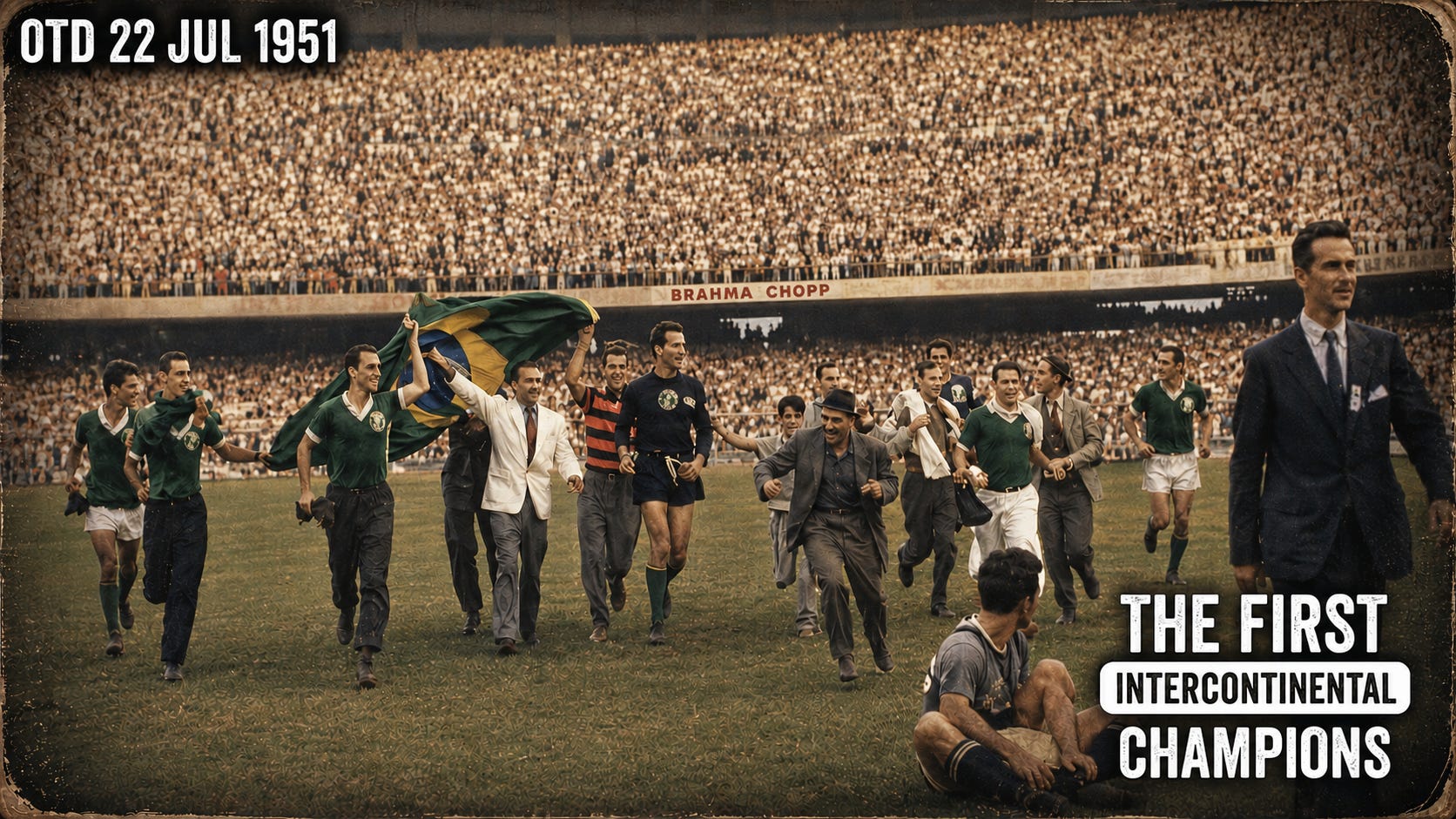
It is July 22, 1951. The Maracanã. Palmeiras against Juventus, the second leg of the Copa Rio final. Officially, the Torneio Internacional de Clubes Campeões: an international tournament of champion clubs, from South America and from Europe. Before the European Cup. Before the Copa Libertadores. Before the Intercontinental Cup. And on this day, Palmeiras draw 2-2, win the tie, and become champions of the first serious intercontinental club tournament in football history.
The idea was born from a wound. One year earlier, Brazil had built the Maracanã, expected a coronation, and watched Uruguay win the decisive match instead. The Maracanazo left silence and a question: how do you bring people back, and how do you make Brazil feel like the center of football again? One answer: bring the world back. Not national teams this time. Clubs.
That was a real leap, because in 1951 the club world was not organized. No European Cup. No Libertadores. No regular meeting of continents. There were predecessors, the Mitropa Cup in Central Europe, the Copa Latina, the South American Championship of Champions in 1948, but a structured competition gathering major clubs from two continents in one place, with a title at stake, was new. The CBD, predecessor of today’s CBF, organized it. Mário Filho, the great journalist whose name would later be attached to the Maracanã itself, shaped the Brazilian imagination of the event. Stanley Rous, later FIFA president, is credited in Brazilian reports with proposing a tournament of champions from FIFA countries. Ottorino Barassi, the Italian administrator famous for hiding the Jules Rimet Trophy during the Second World War, worked the European side. And Rimet himself approved the model while making clear the competition was the CBD’s responsibility. Not fully official by today’s institutional categories; far too serious to dismiss as a summer friendly.
The dream was sixteen champion clubs. Travel, money, calendars, and refusals shrank it to eight: Vasco da Gama and Palmeiras for the host country, which had no national championship yet; Nacional of Uruguay; Sporting of Portugal; Juventus, Italy’s 1950 champions, invited after Milan chose the Latin Cup instead; Nice of France; Austria Wien; and Red Star Belgrade. Two groups, Maracanã and Pacaembu. And the key fact of the São Paulo group: Juventus beat Palmeiras 4-0.
So Palmeiras’ road to the title runs through the memory of being crushed. They eliminate Vasco, the Rio giant and 1948 champion of champions, in the semi-final, 2-1 and 0-0. Then the final. First leg, July 18, Pacaembu: Palmeiras 1-0, Rodrigues. Second leg, July 22, Maracanã, about 100,000 people. Juventus have Giampiero Boniperti and the Danish stars Karl Aage Præst and John Hansen. Præst scores in the eighteenth minute. Rodrigues equalizes early in the second half. Then Boniperti: 2-1 Juventus, a scoreline that invokes too many memories of the year before. Then the 78th minute. Liminha. Two-two. Relief, and the trophy.
The team that lost 4-0 to Juventus in the group has beaten Juventus when it mattered. The Brazilian press calls them champions of the world, champions of champions, Brazil restored. You do not have to accept every old headline to understand the emotion: a year after the Maracanazo, a Brazilian club beat a major European club at the Maracanã and brought home an international title. And for Palmeiras, formerly Palestra Itália until wartime politics forced the name change in 1942, beating an Italian giant carried symbolism in every direction.
The Copa Rio did not become a permanent institution; the machinery was too fragile, and the 1952 edition carried less weight. But as an idea it was seismic: proof that club football wanted a world before the world had institutions. The European Cup follows in 1955, the Libertadores in 1960, then the Intercontinental Cup and, much later, FIFA’s Club World Cup. The safest historical sentence in 2026 is also the strongest one: Palmeiras won the first major intercontinental club tournament between South American and European clubs.
That is already huge.
🎙️ THE PODCAST GOES DEEPER. The full episode has the post-Maracanazo origins, Barassi and Rous behind the scenes, and the recognition debate handled precisely. That’s the 10-minute version.
---
🎧 Listen on Spotify, Apple Podcasts, Amazon Music, Overcast, iHeart, and YouTube.
📩 Got an episode idea? otd@17lawsguy.com
Yesterday: 21 July 1991, Argentina’s Copa América without Maradona.
The Barassi cameo is my favorite part of this story: the same man who hid the Jules Rimet trophy in a shoebox under his bed during World War 2 was out there recruiting European clubs for a tournament in Brazil. Football’s great fixer, always exactly where the plot needed him.