

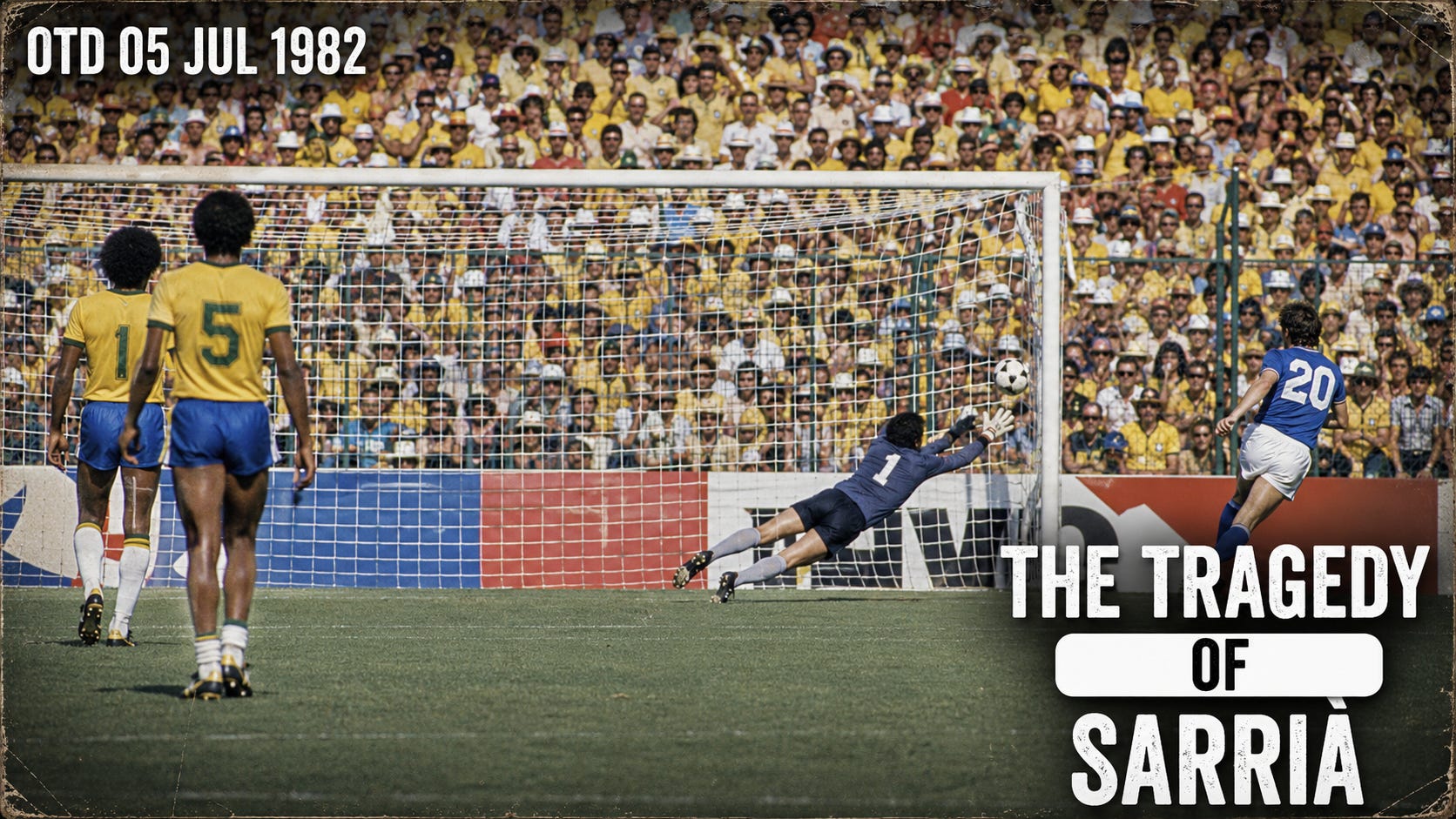
It is 5 July 1982, at the Estadi de Sarria in Barcelona. Italy against Brazil, a World Cup second-round group decider. The math is brutally simple: Brazil need only a draw, Italy have to win. Across ninety minutes, Paolo Rossi, silent and doubted all tournament, scores three times. Italy 3, Brazil 2. And one of the most beloved teams in the sport’s history goes home.
The two sides arrived as opposites. Brazil were the beautiful team, the keepers of an idea, with Zico, Socrates, Falcao, Cerezo, and Eder playing football that felt like joy set to rhythm. Italy had scraped out of the first group stage with three colorless draws, unloved and untrusted, and their center forward, Rossi, had just returned from a two-year ban in the Totonero betting scandal. He looked rusty. He had not scored. The whole country argued about whether coach Enzo Bearzot should even keep picking him.
What followed is one of football’s great swings of fate. Rossi headed Italy in front early. Socrates leveled with a shot from the narrowest angle. Then Rossi pounced on a loose Cerezo pass across defense and drove it low for 2-1. When Falcao struck a beautiful equalizer for 2-2, Brazil, on that scoreline, were through. All they had to do was hold. But this Brazil did not know how to hold, and kept pouring forward as if only beauty could protect them. On seventy-four minutes an Italian corner was half-cleared, fell to Rossi in the six-yard box, and he turned it in for his hat-trick. Late on came the last, defining image: Dino Zoff, forty years old, clamping an Oscar header on the goal line, not near it but on it, to send Italy through.
The consequences ran in both directions. Rossi was reborn. He scored twice against Poland in the semifinal and again in the final against West Germany, Italy won 3-1, Zoff lifted the trophy, and the man his own country had doubted took the Golden Boot and the Golden Ball. It is one of the greatest redemption arcs the game has produced.
Brazil, strangely, became immortal by losing. They did not win the World Cup. They did not even reach the semifinal. Yet they are remembered as one of the most beautiful teams ever assembled, invoked every time football asks whether beauty needs a trophy to be true. In Brazil the match became the Tragedia do Sarria, and something shifted in the national game after it. Had this side won, its passing and movement might have become the blueprint. Instead the lesson many drew was the opposite one: be stronger, faster, more pragmatic. Brazil won the World Cup that way in 1994, and with more flair but the same steel in 2002. Success validated the change. But the argument never really ends, because every time Brazil look less like Brazil, someone remembers 1982.
That is the ache at the center of this match. Italy did not win because beauty was false, or because defense was somehow nobler. They won because tournament football is ruthless, a draw was enough for Brazil, and Brazil played as if that safety net did not exist. Rossi punished them three times.
🎙️ THE PODCAST GOES DEEPER. The full episode has Rossi’s road back from the Totonero ban, the goal-by-goal at Sarria, and how the defeat reshaped Brazilian football. That’s the 10-minute version.
---
🎧 Listen on Spotify, Apple Podcasts, Amazon Music, Overcast, iHeart, and YouTube.
📩 Got an episode idea? otd@17lawsguy.com
Yesterday: 4 July 1954, Das Wunder von Bern.
I did an article on why Italy managed to win in 1982.Rossi is one part of this magnificent story. It was also due to their coach, their defensive displays(Claudio Gentile especially) and their midfield (Bruno Conti and Marco Tardelli in particular)!