

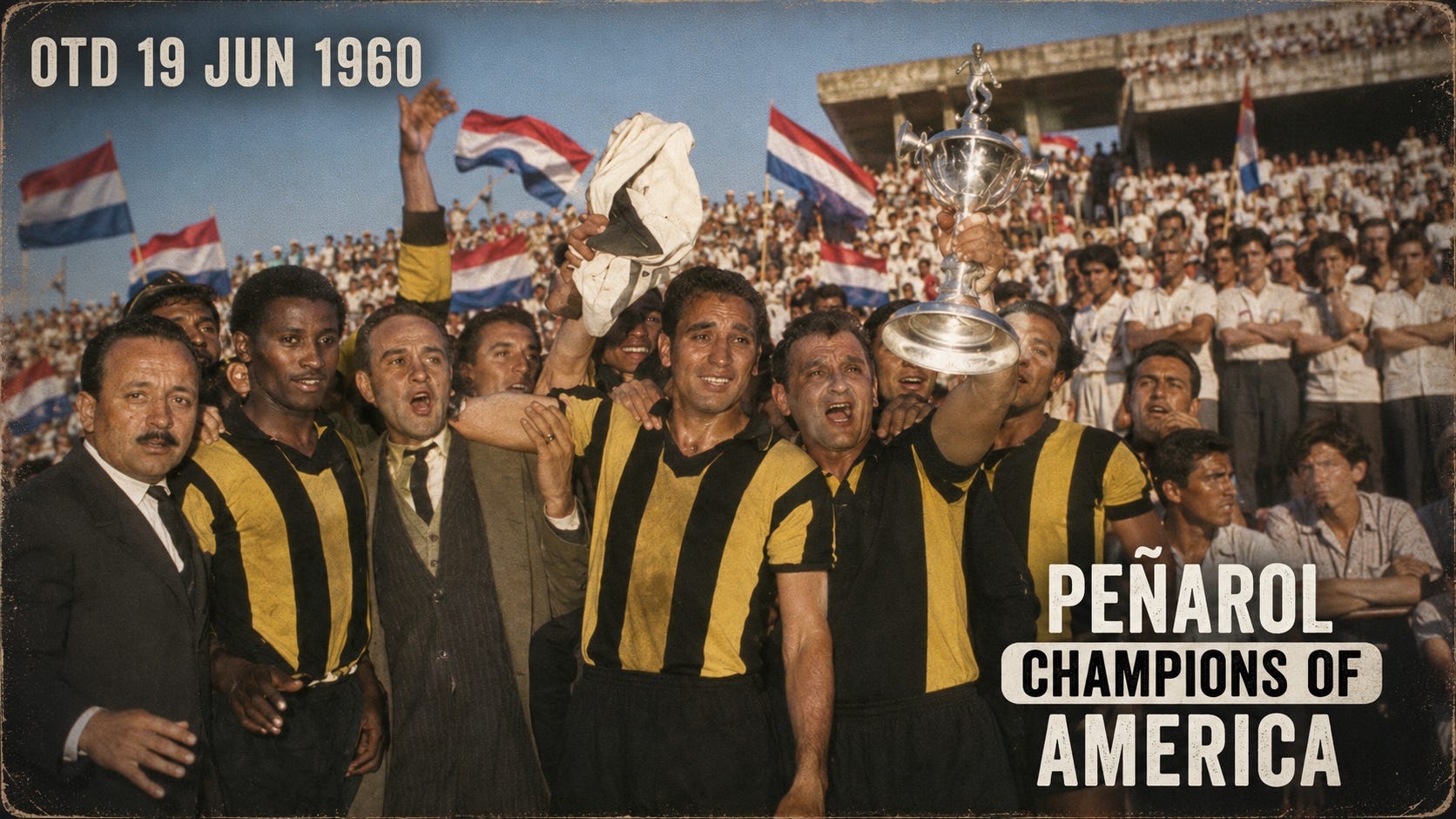
It is 19 June 1960, in Asunción, Paraguay, at Puerto Sajonia. Olimpia against Peñarol, the second leg of the final of a new South American club tournament. Not yet called the Copa Libertadores. Its official name is the Copa de Campeones de América, the Cup of Champions of America. And today Peñarol draw 1-1 with Olimpia, win the final on points, and become the first champions of South America. Like Real Madrid in Europe, they immediately teach a new continental competition what a dynasty can look like.
How did we get here? Peñarol trace their origins to 1891 and the Central Uruguay Railway Cricket Club, founded by workers of the British-owned railway in Villa Peñarol outside Montevideo. The black and yellow, the industrial identity, the railway inheritance, all of it matters. By 1960 they were one of the great institutions of the Río de la Plata, with crowds, history, a fierce rivalry with Nacional, and a squad built for something larger: Néstor Gonçalves the captain, Luis Cubilla, Carlos Borges, and Alberto Spencer, the Ecuadorian forward who would become the greatest scorer in Libertadores history. Their opponents Olimpia, founded in 1902, were the oldest major club in Paraguay, Paraguayan champions five years running. So the first final was no novelty. It was two old giants meeting at the birth of something new.
But the tournament had a long prehistory. South America had been thinking internationally for decades: the South American Championship for nations from 1916, the Copa Aldao for clubs, and in 1948 the South American Championship of Champions in Santiago, won by Vasco da Gama. That 1948 tournament proved the idea could work, but its format was too heavy, one city, one long round-robin, weeks away from home. A brilliant rehearsal, not yet a sustainable annual competition.
Which raises an obvious question: if South America was far less devastated by the Second World War than Europe, why did Europe get its European Cup running in 1955 while South America waited until 1960? The answer is not a lack of football. It is logistics, politics and structure. South America was vast, travel was expensive, domestic calendars were complicated, and some countries did not yet have neat national champions in the European sense (Brazil still lived largely through powerful state competitions). And CONMEBOL needed its associations and clubs to agree it was worth the cost. Then Europe forced the issue. The European Cup began in 1955, Real Madrid made it glamorous, and by 1960 Madrid had won five in a row. South America did not need Europe to tell it how good its football was, but the European Cup showed what an annual champions’ tournament could do for prestige, money and mythology. The question sharpened: if Europe has a champion, who represents South America?
The answer had to be a South American champions’ cup. The idea took shape at CONMEBOL meetings in 1958 and 1959, and in 1960 it began, with only seven teams: Peñarol, Jorge Wilstermann, San Lorenzo, Bahia, Universidad de Chile, Millonarios and Olimpia. So it began as an experiment still convincing people. But Peñarol made it look serious from the first night, 19 April 1960: Peñarol 7, Jorge Wilstermann 1, with Carlos Borges scoring the tournament’s first goal and Spencer scoring four. They beat San Lorenzo in a playoff semi-final, and reached the final against Olimpia. In the first leg at the Centenario, Spencer scored late for a 1-0 win. Then today, the second leg in Asunción: Olimpia led through Hipólito Recalde, the final came alive, and then, six minutes from time, Luis Cubilla scored. Olimpia 1, Peñarol 1. Peñarol were champions. The first champions. The Copa de Campeones de América belonged to Montevideo.
Why did it last when the 1948 experiment had not? Because it found a repeatable structure, home-and-away ties, national champions, continental prestige, and a prize beyond the trophy: the Intercontinental Cup, a chance to face the champion of Europe. That was decisive. The Libertadores was not only a continental title. It was a passport to argue with Europe. In 1960, Peñarol faced Real Madrid and lost 5-1 in Madrid. That hurt, but it showed the scale of the new world. Peñarol did not retreat. They won South America again in 1961 and beat Benfica to become world champions. And in 1966 they won the Libertadores again, met Real Madrid again, and this time beat them 2-0 in Montevideo and 2-0 at the Bernabéu. The arc is beautiful: in 1960 Madrid taught Peñarol the cost of global ambition; in 1966 Peñarol returned the lesson.
And the dynasty was real. Peñarol won the first two editions, were knocked off by Pelé’s Santos in 1962, and returned as champions in 1966, three Libertadores in the first seven editions and two Intercontinental Cups. Around them grew names that became Libertadores language, above all Spencer, the competition’s all-time top scorer with 54 goals. And Cubilla gave one of the great twists: he scored the goal that denied Olimpia in 1960, then later coached Olimpia to Libertadores glory. That is the Libertadores, a competition where enemies return as architects.
Then, in 1965, it took the name that gave it a soul: Copa Libertadores de América, after the liberators of South America. That was not just branding. Europe had the European Cup, clean and institutional. South America chose Libertadores, historic, political, emotional. And it fits, because the competition became more than administration. It became altitude, heat, smoke, rhythm, survival, and nights when a club could become immortal. Where does it rank today? Financially, it is not the Champions League, which lives in a different commercial universe. But culturally, the Libertadores is still one of football’s great sacred competitions, arguably the only continental club cup outside Europe that can stand in the same sentence without sounding ridiculous. Not as rich, not as polished, but in atmosphere, danger and historical weight, unique.
That is why 19 June 1960 matters. Peñarol did not just win a final. They gave South America’s new club championship its first model of greatness.
🎙️ THE PODCAST GOES DEEPER. The full episode has more on the 1948 Santiago tournament, why Europe moved first, the seven-team first edition, Peñarol’s route and squad, the Intercontinental Cup rivalry with Real Madrid, the 1965 renaming, and the dynasties that followed. That is the 10-minute version.
---
🎧 Listen on Spotify, Apple Podcasts, Amazon Music, Overcast, iHeart, and YouTube.
📩 Got an episode idea? otd@17lawsguy.com
Yesterday: 18 June 2002, South Korea, Italy, and Byron Moreno.
Tomorrow: 20 June 1976, Antonín Panenka and the penalty that became a name.