

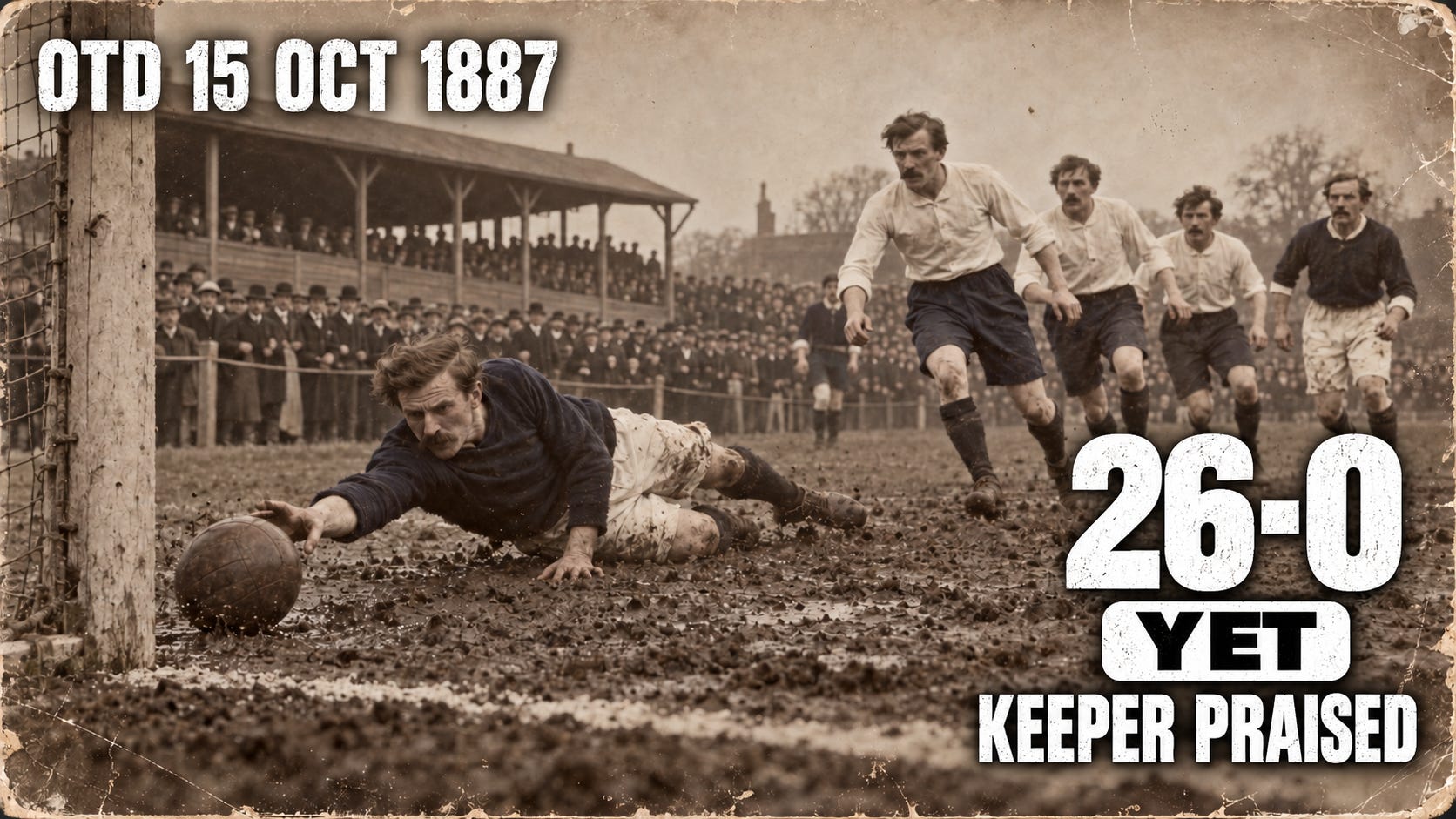
On October 15, 1887, Charles Bunyan stood in Hyde’s goal at Deepdale and conceded 26 times. He still left the field with praise.
Years later, Bunyan told the journalist J. J. Catton that Preston North End might have scored 40 without him. It sounds like the gallows humor of a goalkeeper trying to reclaim the worst afternoon of his career. The contemporary reports suggest something more remarkable. Bunyan really had played well. He saved repeatedly while one of the most advanced football sides in England attacked a club only two years old. The goalkeeper was not the explanation for 26‑0. He was the reason it stopped there.
The result remains the largest winning margin in FA Cup history and in senior English League or Cup football. Yet the number alone hides the more important story. Preston were building the first great professional machine. Hyde were ambitious enough to test themselves against it. The FA Cup had opened its door to both, but had not yet created a staircase between them.
One year before the Football League began, football’s playing standards, economics and competition structures were developing at different speeds. For one afternoon at Deepdale, the gaps became visible every time the ball crossed Bunyan’s line.
How did we get here?
The FA Cup began with an idea from Charles Alcock in 1871. The Football Association secretary proposed a Challenge Cup open to all member clubs, creating a national knockout competition from a sport still organized through schools, old boys’ clubs, military teams and local fixtures. Railways made travel possible. The draw supplied uncertainty. The cup supplied a reason for clubs from different football worlds to meet.
Wanderers beat Royal Engineers 1‑0 at the Oval in March 1872 to win the first final. The early competition belonged largely to the amateur establishment. Wanderers won five of the first seven editions; Oxford University and Royal Engineers took the other two. The FA Cup reflected the culture that had written association football’s rules.
Then the game’s center of gravity moved north. Industrial towns had Saturday half-holidays, paying crowds, civic rivalries and businessmen who understood that better players produced better gates. Clubs began finding work for talented footballers, paying expenses that were wages in everything but name, and recruiting Scottish players admired for their passing combinations.
No club exposed the contradiction more dramatically than Preston North End. William Sudell did not wait for professionalism to become respectable. He recruited players, especially from Scotland, arranged employment and paid them. When London amateur club Upton Park protested after an FA Cup tie in January 1884, the FA expelled Preston. Sudell’s response was not a narrow denial. Preston, he said, were all professionals, and other northern clubs were doing the same.
The dispute threatened to split English football. Northern and Midland clubs discussed a rival British Football Association. The FA legalized professionalism on July 20, 1885, although registration rules and a six-mile residency restriction tried to control it. The law had caught up with Preston, but the rest of the football system had not.
There was still no national league, no table and no guaranteed program of meaningful fixtures. The FA Cup was the only national prize. A powerful club could arrange prestigious friendlies and enter regional cups, but its claim to be England’s best still ran through the knockout draw.
By 1887, Preston had turned professionalism into repeatable performance. They had eliminated holders Blackburn Rovers in the previous FA Cup, reached the semifinal and won the Lancashire Senior Cup by beating Bolton Wanderers 3‑0. Their squad already contained much of the side that would soon become the Invincibles: Nick Ross, John Goodall, Jimmy Ross, Fred Dewhurst, George Drummond and Sam Thomson.
Hyde Football Club represented another point on the sport’s curve. Founded in 1885, Hyde were only two years old, but they were not an accidental collection of local players waiting to be embarrassed. The club wanted strong opposition. It had already played Blackburn Rovers and lost 8‑0. Before the 1887‑88 season, Hyde recruited players including Bowers from Derby County and Bunyan and Gregory from Spital. Three thousand spectators watched Bolton Wanderers visit in September. Hyde lost 8‑1, then recovered a week later to beat Gorton Villa 4‑1.
The FA Cup entry was another statement of ambition. It was also dangerous.
The 1887‑88 competition attracted 149 clubs and was the last edition without qualifying rounds. Early ties were regional, but the draw did not separate clubs by strength. A new local club could be paired immediately with the country’s most sophisticated professional operation.
The competition had already produced severe mismatches. Royal Engineers beat Hitchin 5‑0 in the inaugural edition. Wanderers raised the record to 16‑0 against Farningham in 1874. Outside the FA Cup, Witton had beaten Liverpool Stanley 23‑0 in the Lancashire Cup in 1882.
When Preston drew Hyde, North End reportedly offered the visitors compensation to withdraw. Hyde refused. Preston then announced its intention to attack the wider English record. A Manchester newspaper doubted they could reach even half of 23.
Hyde had entered the Cup to discover where it stood. The answer arrived without mercy.
The match
About 2,000 spectators came to Deepdale in fine weather. Kickoff was at 3:30. Preston were close to full strength, although regular goalkeeper James Trainer was ineligible and Addison replaced him. Bethell Robinson was ill, so Goodall dropped into the half-back line. The man who would lead the scoring in the Football League’s first season was positioned farther from goal and still scored once.
Dewhurst opened the scoring after two minutes, heading in a corner from Jimmy Ross. Bunyan made several saves before Drummond converted Thomson’s cross in the twelfth minute. Jimmy Ross added the third.
Then Hyde lost Bowers to a sprained arm. Substitutes were not permitted, so Hyde played roughly half an hour of the first half with ten men. By the time the visitors made Addison do anything, Preston were already 4‑0 ahead.
The score reached 12‑0 at halftime.
Preston then allowed Hyde reserve Knowles to replace Bowers. The gesture was informal, outside the laws and decades ahead of authorized substitutions. It is often described as the first recorded replacement in the FA Cup. Mercy changed the personnel, not the direction of the match.
Hyde began the second half by attacking down the right. Preston regained possession and Thomson scored the thirteenth. Hyde then produced its only shot of the afternoon. It went wide. From Addison’s goal kick, Preston advanced again and Thomson made it 14‑0.
The final half hour brought another eleven goals. The surviving contemporary breakdown credits Jimmy Ross with seven, Gordon and Thomson with five each, Dewhurst with three and Drummond with two. Graham, Russell, Nick Ross and Goodall scored once apiece. Some later summaries give Jimmy Ross eight, but the contemporary sequence totals 26 with seven.
Goodall scored the last.
The Times devoted one restrained sentence to the result: Hyde had sustained a most overwhelming defeat. That description was accurate and almost comically inadequate. Bunyan had retrieved the ball 26 times, made enough saves to earn respect and acquired a record that would follow him for life.
So what?
For Preston, 26‑0 was not the peak. It was evidence that the peak was approaching.
North End continued through the FA Cup and reached the final against West Bromwich Albion at the Oval. Preston were so confident that they reportedly asked to be photographed with the trophy before kickoff. FA president Major Francis Marindin suggested that they win it first. West Bromwich Albion did, 2‑1. It was Preston’s only defeat of the season.
The response became one of football’s foundational campaigns. The Football League began in 1888‑89, turning a collection of matches into a season with regular fixtures and a table. Preston won the inaugural championship without losing. They also won the FA Cup without conceding a goal. The first Double belonged to the Invincibles.
The team that scored 26 against Hyde had not found one freak afternoon. It had revealed what organized professionalism could do before English competition had learned how to contain the gap.
Hyde’s consequence was not extinction. The club finished the 1887‑88 season with 27 victories from 44 matches and met Newton Heath, the future Manchester United, in what local coverage called an unofficial championship of Manchester. Hyde did not enter the FA Cup again until 1906, but the club continued through the Lancashire Combination, a merger with Hyde St George’s and a move to Ewen Fields. The original organization folded during the First World War; the postwar Hyde United inherited the town’s football lineage.
Bunyan’s life provides the strongest answer to the idea that Hyde should be remembered only as victims. He was eighteen when he faced Preston. He went on to play for Derby County, Chesterfield, Walsall and New Brompton, and his career lasted about two decades. In 1909 he moved to Belgium to coach football and cricket at Racing Club de Bruxelles while assisting with the Belgian national side. He then coached Örgryte in Sweden and prepared Sweden for the 1912 Olympic tournament before returning to Belgium, where his clubs included Standard Liège and Anderlecht.
The goalkeeper attached to English football’s most lopsided score became part of the game’s early international transfer of knowledge. His sons extended the connection. Maurice Bunyan became a prolific striker in Belgium and represented Great Britain at the 1920 Olympics. Charles Jr. also played and coached on the continent. The family story reached far beyond a muddy goalmouth in Preston.
The FA Cup changed too. The 1887‑88 edition was the last without qualifying. In 1888‑89, 22 clubs received exemption to the first round proper while the remaining entrants competed through four qualifying rounds for ten places in the last 32. The arrangement was not yet the modern hierarchy. Several Football League clubs still had to qualify. It was nevertheless the beginning of a filter.
Exemption was based on standing and invitation, not simply membership in the new League. Bolton Wanderers, Everton, Notts County and Stoke all entered qualifying even though they were founder members of the League. The reform therefore did not draw a clean line between professional and amateur, or between national and local. It acknowledged that a competition attracting more clubs needed stages. Stronger entrants were increasingly protected from the earliest rounds, while developing clubs were given matches through which they could earn access to them.
The new League added another sorting mechanism. Divisions, scheduled competition, regional qualifying and later entry for stronger clubs gradually made an immediate Preston against Hyde collision less likely. The Cup never removed inequality because its appeal depends on clubs from different levels being able to meet. It changed the route. A smaller club usually had to survive opponents nearer its own strength before reaching a giant.
Large scores continued. Nottingham Forest’s 14‑0 victory at Clapton in 1891 remains the FA Cup’s record away win. Preston beat Reading 18‑0 in 1894, still the competition’s second-largest margin. Tottenham Hotspur beat Crewe Alexandra 13‑2 in 1960. Bournemouth beat Margate 11‑0 in 1971, with Ted MacDougall scoring an FA Cup record nine goals. Manchester City beat Exeter City 10‑1 in January 2026. None came close to 26.
The wider world supplies larger numbers, but each needs a category. Two years before Preston against Hyde, Arbroath beat Bon Accord 36‑0 in the Scottish Cup while Dundee Harp beat Aberdeen Rovers 35‑0 on the same afternoon. Those were competitive goals against opponents trying to defend. FC Infonet equaled 36‑0 against Virtsu in the 2015 Estonian Cup.
Australia’s 31‑0 victory over American Samoa in 2001 remains the recognized senior international benchmark. Vanuatu beat Micronesia 46‑0 at the 2015 Pacific Games, but Micronesia were not FIFA members and the tournament used under-23 teams. AS Adema’s 149‑0 victory over SO l’Emyrne in Madagascar in 2002 consisted entirely of deliberate own goals in a refereeing protest. It was an act of organized resistance, not attacking superiority.
Preston’s score survives every distinction that matters to the FA Cup. It was a senior competitive match. Hyde tried to defend. Bunyan played well. Preston kept scoring.
That combination explains the record’s endurance. A protest score can be larger without representing superiority. A youth or non-FIFA match can produce a greater number without occupying the same category. A preliminary tie can still bring together clubs of radically different ability, but the strongest clubs now enter much later. Preston against Hyde belongs to a brief period when a national cup was open enough to admit almost everyone and unstructured enough to place almost anyone directly in front of the best.
The Cup’s structural answer was not to lock Hyde out. It was to stop asking Hyde to begin at Deepdale.
Three things to take away
The record remains 26‑0. Preston North End’s victory over Hyde is still the largest winning margin in FA Cup history and in senior English League or Cup football.
Hyde were an ambitious club, not a punchline. They were two years old, recovered to win most of their matches that season and helped create a football lineage that survives through Hyde United. Bunyan went on to a long playing and coaching career across England, Belgium and Sweden.
The score exposed a structural problem. One year before the Football League, and in the final FA Cup without qualifying rounds, a professional powerhouse could be drawn immediately against a developing local club. Qualifying began the following season and made such collisions rarer.
On This Day...
On October 15, 1887, the goals kept coming at Deepdale until the count reached 26. Preston’s players walked toward immortality. Hyde walked away with the record defeat. In the middle of it stood an eighteen-year-old goalkeeper whose work was measured not by what he conceded, but by the goals he somehow prevented.
Questions, corrections or story ideas: otd@17lawsguy.com
Yesterday: October 14, 1964, The Day Japan Stunned Argentina at the Olympic Games.