

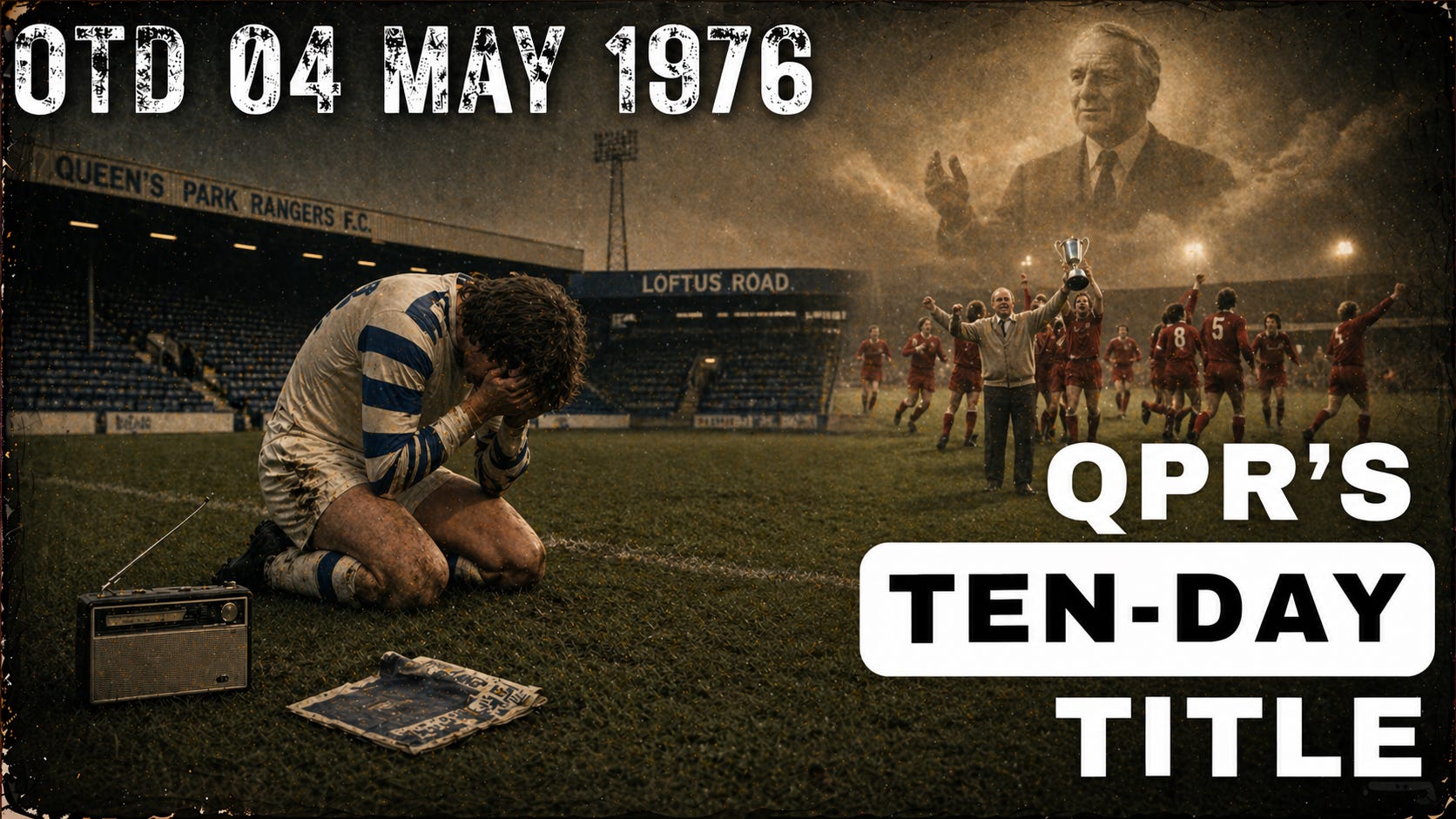
It is 4 May 1976. Molineux. Wolves against Liverpool.
At BBC in west London, Queens Park Rangers are waiting for history to make up its mind.
QPR have already finished their season. They are top of the First Division. One point ahead of Liverpool. Forty-two matches played. Nothing left to do. Nothing left to control.
Liverpool still have one match to play. Away to Wolves.
And for most of the night, the impossible is happening. Steve Kindon has put Wolves 1-0 up. Liverpool are behind. The clock is moving. QPR, as things stand, are champions of England.
Not “nearly champions.” Not “good story.” Champions.
Then, with a quarter of an hour left, Liverpool do what great teams do before everyone else has fully realized they are great. Kevin Keegan scores. John Toshack scores. Ray Kennedy scores.
Wolves 1, Liverpool 3. QPR’s dream dies in the last fifteen minutes of the league season.
Liverpool are champions by one point.
And Bob Paisley, the reluctant successor to Bill Shankly, has his first trophy as Liverpool manager. It will not be his last.
QPR were not a fairy tale fluke. Nine years earlier, a third-division QPR side had come back from 2-0 down to win the first one-match League Cup final at Wembley. By 1973 they were back in the First Division. Then came Dave Sexton — the manager who gave them shape. The team played with a freedom that looked almost continental by English standards: Phil Parkes in goal, Frank McLintock and David Webb at the back, Gerry Francis as captain and pulse, Don Masson supplying craft, Don Givens supplying goals, Dave Thomas supplying width. And Stan Bowles. Loose socks. Low centre of gravity. Gambling-shop charisma. The ball tied to his instep.
Sexton made the talent function. And in 1975-76, it all came together.
The opening day of the season set the tone: QPR 2 Liverpool 0 at Loftus Road. Gerry Francis scored a goal-of-the-season-quality goal. By December, QPR were first and Liverpool second.
After the new year, QPR went on a run that still looks extraordinary: eleven wins and one draw from twelve matches. They were not hanging around waiting for Liverpool to fail. They were taking the league by the collar.
Their final match was a 2-0 win over Leeds on 24 April. Bowles scored. The crowd invaded the pitch. Their league season was over. They were top, one point ahead of Liverpool.
And there they stayed for ten days.
Ten days is a strange kind of football purgatory. Long enough to imagine the trophy. Long enough to replay every missed chance. Long enough to convince yourself that Wolves away, under the lights, with Wolves fighting for survival, might just be the kind of match that breaks Liverpool.
On the night, both ends of the table were on the line. Wolves needed a win to stay up. Liverpool needed a point to be champions on goal average.
Wolves led 1-0 at half-time. They led for most of the second half.
Then, in the 76th minute: Toshack to Keegan, 1-1.
85th minute: Kennedy to Toshack, 2-1.
89th minute: Keegan to Kennedy, 3-1.
From panic to procession in thirteen minutes. The final whistle confirmed two verdicts at once: Liverpool were champions. Wolves were relegated. And QPR — the best QPR side there has ever been — had finished second by a single point.
For QPR, this was the high-water mark. Unbeaten at Loftus Road in the league. More league wins than Liverpool. Football people remembered as liberated, expressive, and slightly dangerous. They became the ten-day champions: the team that had the title in its hands while waiting for somebody else to drop it.
They never got that close again. Relegated by 1979. Later flashes — the 1982 FA Cup final, European nights, the strange pain of beating Partizan Belgrade 6-2 at Highbury in 1984 and still going out after losing 4-0 in Belgrade. Very QPR, that. Brilliant. Fragile. Almost there.
For Liverpool, the meaning is the opposite.
This was not a summit. It was a launch.
Fifteen days after Molineux, Liverpool won the UEFA Cup. The following season, the league again — and then the European Cup in Rome. In 1978, the European Cup again. By the time Paisley stepped down in 1983, he had won six league titles, three European Cups, a UEFA Cup, and three League Cups. No manager before him had won three European Cups.
And every dynasty has hinge moments. For Liverpool, 4 May 1976 is one of them. The night the post-Shankly question was answered. The moment they stepped from continuity into empire.
Perhaps that is why QPR’s pain feels so sharp.
Because they were not beaten by an ordinary champion.
They were beaten by the beginning of an age.
---
🎧 Also available on Apple Podcasts, Amazon Music, Overcast, iHeart, and YouTube.
📩 Got an episode idea? otd@17lawsguy.com
Yesterday: 3 May 1949 — El Dorado Begins in Colombia.
Tomorrow: 5 May 1918 — the first final of the Coupe de France, played while the Great War was still raging.