

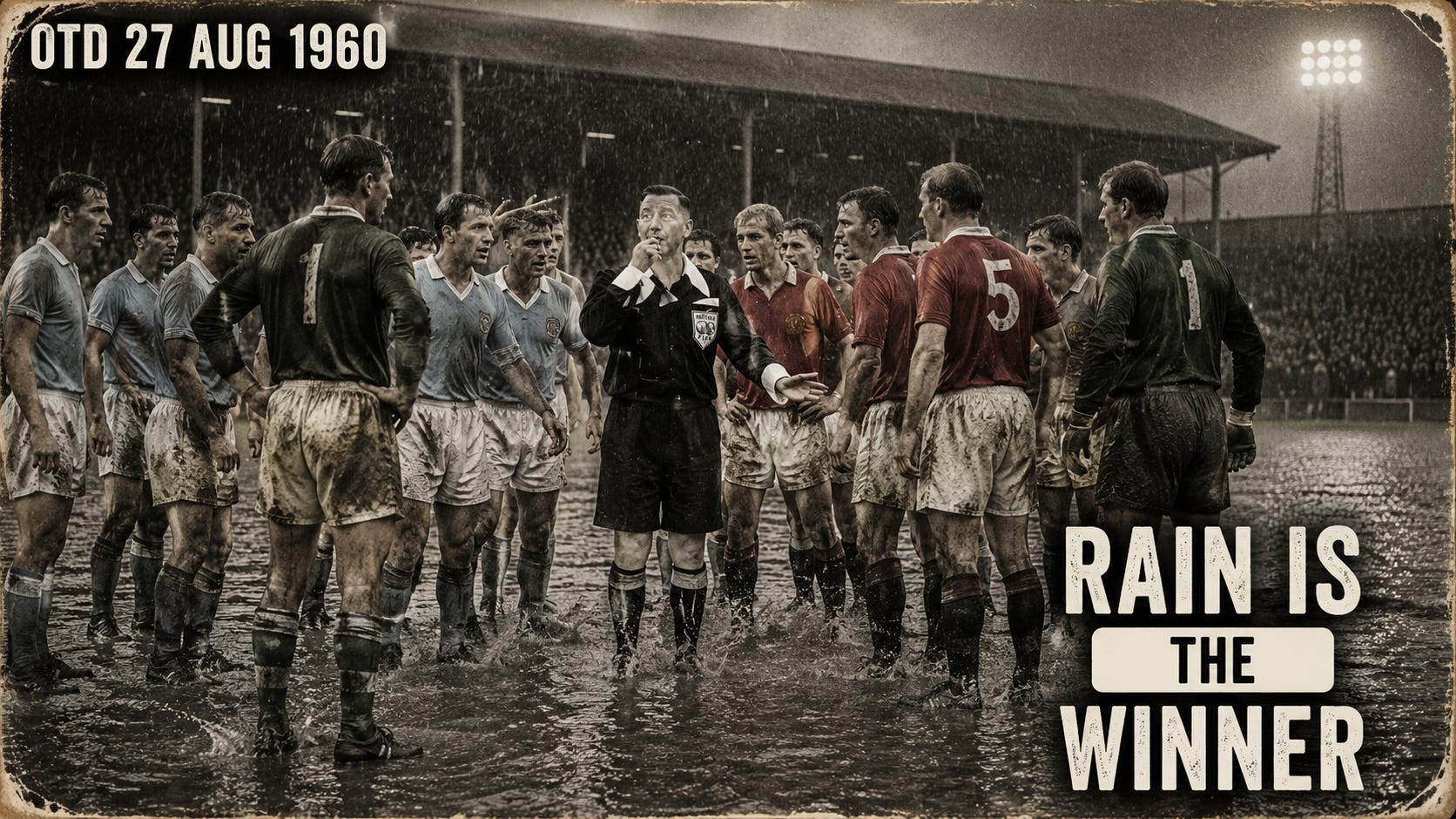
It is August 27, 1960, and 51,927 people have come to Maine Road for an unusually early Manchester derby. They will not see one finished. Two minutes in, Denis Law puts Manchester City ahead. Manchester United answer through Dennis Viollet and Alex Dawson and lead 2-1 at the break. Then the sky takes over. A thunderstorm rolls across Manchester, the floodlights come on in the middle of the afternoon, and the rain simply does not stop.
The referee that day is not just any official. Arthur Ellis had taken charge of the first European Cup final in 1956, and only seven weeks earlier he had refereed the first European Championship final between the Soviet Union and Yugoslavia. He had worked three World Cups, run the line for Brazil against Uruguay at the Maracanã in 1950, and handled the notorious Battle of Berne in 1954. If anyone could keep a game upright in a storm, it was him.
He tries. With the pitch worsening, Ellis sends the clubs back out, because for a few more minutes football is still just about possible. In the 54th minute Joe Hayes makes it 2-2. Two minutes later, Ellis stops play, and the crowd turns. Boos, whistles, slow handclaps. He has to be escorted from the field by police. Ten minutes on, he goes back out to inspect the surface and finds several inches of standing water sitting on the grass. The ball cannot behave. Neither can the players. Ellis abandons the match, with an explanation that needs no footnotes: he cannot control the weather.
Four goals. Fifty-six minutes. All of it gone.
Here is the part that matters. Ellis was not reaching for some special waterlogged-pitch regulation. He was using one of the oldest powers a referee has. The original Laws of 1863 did not even contain a referee. The referee entered the Laws in 1881, at first only to settle disputes between the two umpires, and by 1886 he could explicitly stop a match if spectators interfered. As the game grew, that authority widened, and by the great rewrite of 1938, Law V handed the referee discretion to suspend or terminate a match on account of what it called the elements. Weather, crowd, other causes: the judgment was his. Stop it temporarily and it might restart with a dropped ball. Terminate it, and the referee simply reports what happened, leaving the competition to decide what follows.
In 1960 the Football League’s answer was blunt. The 2-2 ceased to exist. No point apiece, no goals for Law, Hayes, Viollet or Dawson. The fixture would be replayed from the very first minute. Weather had erased almost an hour of football.
None of this was new. On Christmas Day 1937, fog grew so thick at Stamford Bridge that Chelsea against Charlton was abandoned, and the Charlton goalkeeper Sam Bartram stayed at his post long after the whistle, peering into the murk, until a policeman came to tell him everyone else had gone home. And the strangest chapter of all was still only months away. In January 1961, Luton Town led Manchester City 2-0 in an FA Cup tie, then trailed 6-2 as Denis Law scored all six, before rain turned Kenilworth Road into a lake and the match was abandoned after 69 minutes. Every one of Law’s six goals vanished. Four days later the clubs began again, Law scored once more, and Luton won 3-1. If anyone ever had reason to hate the full-replay rule, it was him.
Law provides the perfect counterpoint too. In April 1974, back at City, he scored his famous backheel against United at Old Trafford. City led 1-0, United supporters invaded the pitch, and the match was abandoned late. This time the Football League let the result stand. The same club, the same derby, the same idea of an abandoned game, and a completely different consequence.
That is still how it works. Today, Law 5 lets the referee stop, suspend or abandon a match when the field, its surroundings or the weather will not allow play to continue. Law 7 then says an abandoned match is replayed unless the competition rules decide otherwise. Drainage, undersoil heating, weather radar and safety teams have transformed the game, and matches are now often postponed before anyone travels. But the questions have barely changed. Is the field safe? Can the ball move? Can the players play? If not, someone has to call a halt.
As for the derby itself, the answer took more than six months. On March 4, 1961, back at Maine Road and before another crowd above 50,000, the fixture finally went the distance. Alex Dawson and Bobby Charlton scored, David Wagstaffe and Mark Pearson replied, and United won 3-1. The match that had stood at 2-2 in August finally entered the record books in March. More than 51,000 people had turned up that first afternoon and gone home with four goals, a thunderstorm, floodlights in August, a police escort for one of the world’s most famous referees, and no result at all.
---
🎧 Listen on Spotify, Apple Podcasts, Amazon Music, Overcast, iHeart, and YouTube.
📩 Got an episode idea? otd@17lawsguy.com
Yesterday: 26 August 2005, Australia launches a league built to last.