

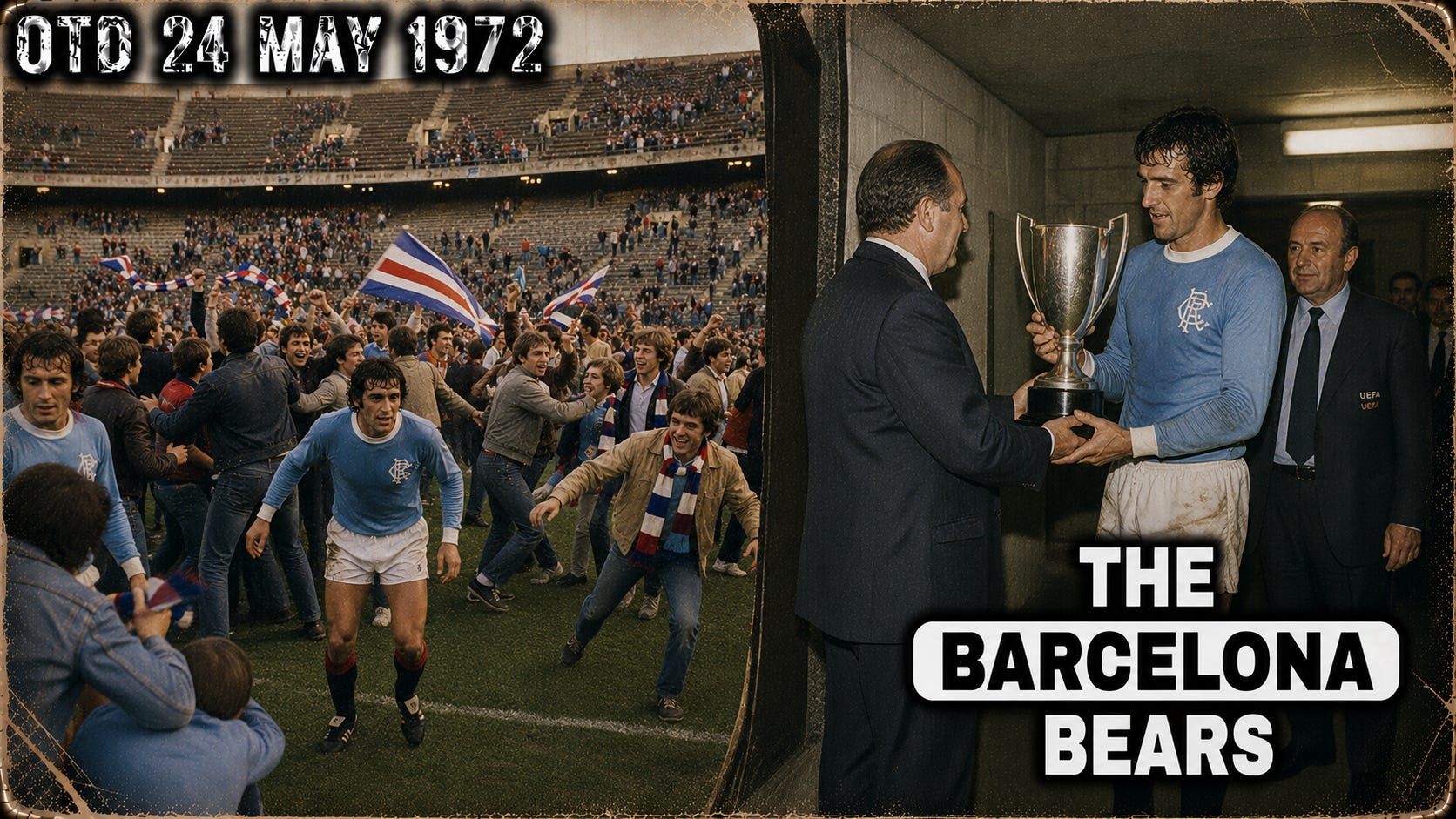
It is 24 May 1972. Barcelona. Camp Nou. Rangers against Dynamo Moscow. European Cup Winners’ Cup final.
And already, the title of the competition is a little awkward. Because Rangers are here even though they did not win the Scottish Cup. Celtic did. But Celtic also won the league, which sent them to the European Cup, so Rangers — beaten finalists in the Scottish Cup — took Scotland’s place in the Cup Winners’ Cup.
Now they beat Dynamo Moscow 3-2. Colin Stein scores. Willie Johnston scores twice. Rangers survive a late Soviet fightback.
Then the pitch is invaded, the trophy is handed over indoors, and Rangers become European champions in the strangest possible way: Cup Winners’ Cup winners, without having been cup winners at all.
The European Cup Winners’ Cup is one of those competitions modern football has almost forgotten, but in the 1960s and 1970s it mattered. A lot. The European Cup was for national champions only. The Fairs Cup had only become the UEFA Cup in 1971. So by 1972, the Cup Winners’ Cup sat in a powerful place: a clean idea, every country sending its domestic cup winner, knockout football, national trophies turned into continental drama.
For Rangers, this was a wounded moment. Celtic were still inside the nine-in-a-row era. They had won the European Cup in 1967. Rangers had lost European finals in 1961 and 1967. Then, in January 1971, the Ibrox disaster killed sixty-six people after an Old Firm match. The club was grieving, under pressure, and still chasing a European trophy that had eluded it twice.
Willie Waddell was the manager. John Greig was the captain. Peter McCloy in goal. Sandy Jardine, Dave Smith, Derek Johnstone, Alex MacDonald, Tommy McLean, Colin Stein, Willie Johnston — this was the side that would become known as the Barcelona Bears.
The run began against Rennes: 1-1 in France, 1-0 at Ibrox. Then Sporting CP — a tie that became almost comic. Rangers won 3-2 at Ibrox, Sporting won 3-2 in Lisbon, both sides scored in extra time to make it 6-6 on aggregate, and Rangers had more away goals. But the referee ordered penalties, and Sporting won the shootout. Then UEFA corrected the error and Rangers advanced.
Quarter-final: Torino. 1-1 in Italy, 1-0 at Ibrox. Then the semi-final: Bayern Munich. Maier, Beckenbauer, Müller, Breitner, Hoeness — the side about to become the foundation of Germany’s European and world-champion generation. Rangers drew 1-1 in Munich, then won 2-0 at Ibrox.
They were going to Barcelona.
Dynamo Moscow’s road was historic too. They beat Olympiacos, Eskişehirspor, Red Star Belgrade and Dynamo Berlin to become the first Soviet club to reach a European final. In 1972 — Cold War Europe, state sport — that carried more than a club crest.
Rangers started fast. Colin Stein made it 1-0. Before half-time, Dave Smith clipped in a high ball and Willie Johnston headed in. 2-0. Early in the second half, Johnston scored again. 3-0.
For a moment, it looked finished. It was not. Vladimir Eshtrekov pulled one back. Dynamo pushed. McCloy made saves. Jardine cleared off the line. Then Aleksandr Makhovikov made it 3-2 near the end. Now Rangers were hanging on.
And then chaos. Some Rangers supporters invaded the pitch before the match was properly over, thinking the final whistle had gone. The game was delayed. Spanish police under Franco’s regime reacted brutally. The players had to finish in a strange, charged atmosphere.
Rangers survived. Final whistle. Rangers 3, Dynamo Moscow 2.
But because of the chaos, there was no proper trophy presentation on the pitch. John Greig received the cup inside the stadium buildings. That is perfect, in its own way. Even Rangers’ greatest European night could not be simple.
Rangers had won the one European trophy that still defines their continental history — after losing the first Cup Winners’ Cup final to Fiorentina in 1961 and again to Bayern in 1967. And they had earned it: Rennes, Sporting, Torino, Bayern Munich, Dynamo Moscow.
But the aftermath was immediate. Because of the pitch invasion, UEFA banned Rangers from European competition for two years, later reduced to one. So they could not defend the trophy they had won. There was one strange consolation: an unofficial European Super Cup against Cruyff’s Ajax tied to Rangers’ centenary. Ajax won 6-3 on aggregate.
The Barcelona Bears became club mythology. Greig remained “Mr Rangers.” Jardine became one of the great Scottish full-backs of the era. Johnston became forever linked to Barcelona.
And the Cup Winners’ Cup itself looks different through this story. For a long time it stayed prestigious — Milan, Chelsea, Dynamo Kyiv, Barcelona four times, Aberdeen, Everton, Ajax, Lazio. But its logic depended on domestic cup winners being major clubs. Once the Champions League expanded and took multiple clubs per country, the best teams chased Champions League money, and the Cup Winners’ Cup thinned. In 1999, after Lazio beat Mallorca, UEFA shut it down and folded cup winners into the UEFA Cup.
The competition vanished. But 1972 remains one of its purest contradictions: a tournament for cup winners, won by a team that had not won its cup.
🎙️ The full episode (linked above) has more — including the full chaotic Sporting CP penalty saga (episode 3 has the whole story), the Ibrox disaster context, the unofficial Ajax Super Cup, and the slow death of the Cup Winners’ Cup. The whole arc is in the audio.
---
🎧 Also available on Apple Podcasts, Amazon Music, Overcast, iHeart, and YouTube.
📩 Got an episode idea? otd@17lawsguy.com
Yesterday: 23 May 1992 — Hannover’s Impossible Cup.
Tomorrow: 25 May 2005 — the Miracle of Istanbul.