

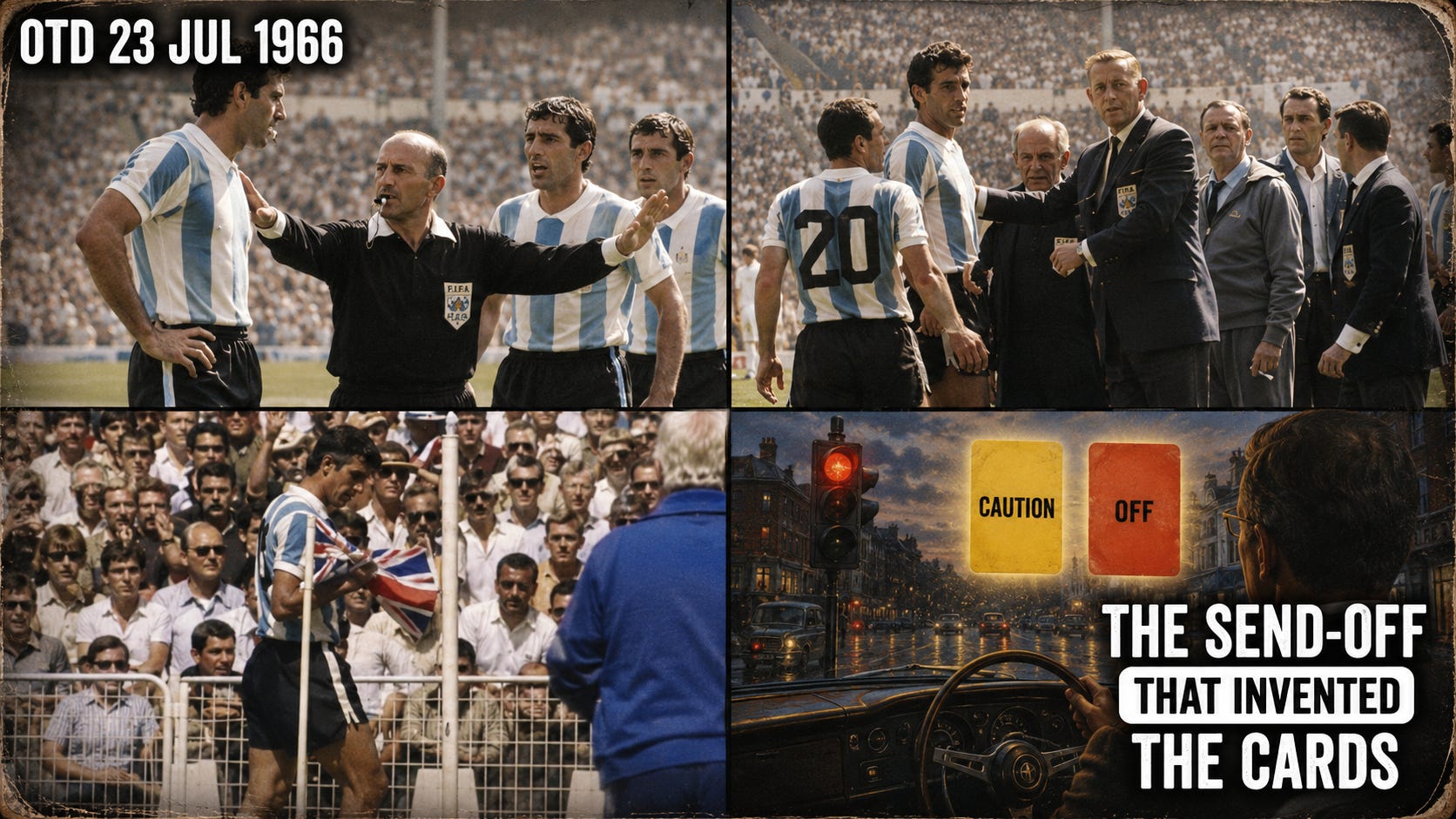
It is July 23, 1966. Wembley. England against Argentina, a World Cup quarter-final in front of more than ninety thousand people. England win 1-0, Geoff Hurst scores, and almost nobody remembers the goal.
What survives is a man standing still.
Antonio Ubaldo Rattín is Argentina’s captain. El Rata. Boca Juniors, tall, powerful, a defensive midfielder before that role had all its modern language, a Nations Cup winner in 1964 and a symbol of La Bombonera. Argentina have not come to England as tourists. They beat Spain, drew with West Germany, beat Switzerland. They are organized, proud, hard, experienced.
The referee is Rudolf Kreitlein of West Germany, and the afternoon is tight from the start. Five players are cautioned. And here is the thing that matters most: there are no cards. Referees can caution. Referees can dismiss. That power sits in the Laws already. But the communication is verbal, gestural, improvised. A player might not know he has been booked. Neither might his manager, or the crowd.
Thirty-fifth minute. Rattín is sent off. The official reason becomes famous: violence of the tongue. Which is strange in any match, and stranger here, because Kreitlein does not speak Spanish and Rattín does not speak German. Rattín says he is asking for an interpreter. He points at his captain’s armband. He wants to speak as captain. Kreitlein wants him gone.
Rattín refuses.
He stands there. He argues. He waits. Ken Aston, the tournament’s English refereeing supervisor, walks onto the field to help move him, which does not calm anybody, because across South America there is already a suspicion that European refereeing protects European teams. It takes about eight minutes. Rattín sits down on the red carpet laid for the Queen. On his way out he tweaks the Union Jack corner flag, something he later says he regretted.
Then football resumes. Argentina, down to ten, hold until the seventy-eighth minute, when Martin Peters crosses and Hurst heads in. England reach the semi-final. Alf Ramsey stops George Cohen swapping shirts, then calls the Argentines animals, and the word travels. In Argentina the match becomes el robo del siglo, the theft of the century, and the phrase has never really gone away. This summer, Argentina knocked England out of the World Cup semi-final with a 2-1 comeback: Enzo Fernández, Lautaro Martínez, two assists from Messi. Different century, same voltage.
But the lasting consequence is quieter, and it belongs to Aston. He leaves Wembley with two problems. One player dismissed who would not go. And Jack Charlton, who learns from the newspapers afterward that he had been cautioned, because he never clearly understood it on the pitch.
Driving home through London, Aston stops at a traffic light.
Yellow means Caution. Red means Stop. Lightbulb moment.
The colors are not the genius. The genius is that they need no translation. Spanish, German, Portuguese, Japanese: a card is a sentence with no words. They arrive at the 1970 World Cup, and a referee reaching into his pocket becomes one of the most recognizable images in sport.
Rattín died earlier this month, aged 89, and that changes the weight of telling this story. Outside England he was never the man who would not leave Wembley. He was fourteen years at Boca, hundreds of matches, titles, the captaincy, a statue outside La Bombonera. He coached. He went into politics. He was a captain who believed he had the right to speak, inside a system that had no clear way to tell him the conversation was over.
Football fixed the signal. It never fixed disagreement. Cards do not make referees right. They make a decision visible, and they turn authority into a color.
🎙️ THE PODCAST GOES DEEPER. The full episode has the violence of the tongue ruling, Jack Charlton finding out from the newspapers, and Ken Aston’s traffic light. That’s the 10-minute version.
---
🎧 Listen on Spotify, Apple Podcasts, Amazon Music, Overcast, iHeart, and YouTube.
📩 Got an episode idea? otd@17lawsguy.com
Yesterday: 22 July 1951, Palmeiras and the Copa Rio.
Tomorrow: 24 July 2000, Luís Figo leaves Barcelona for Real Madrid, and the impossible move.