

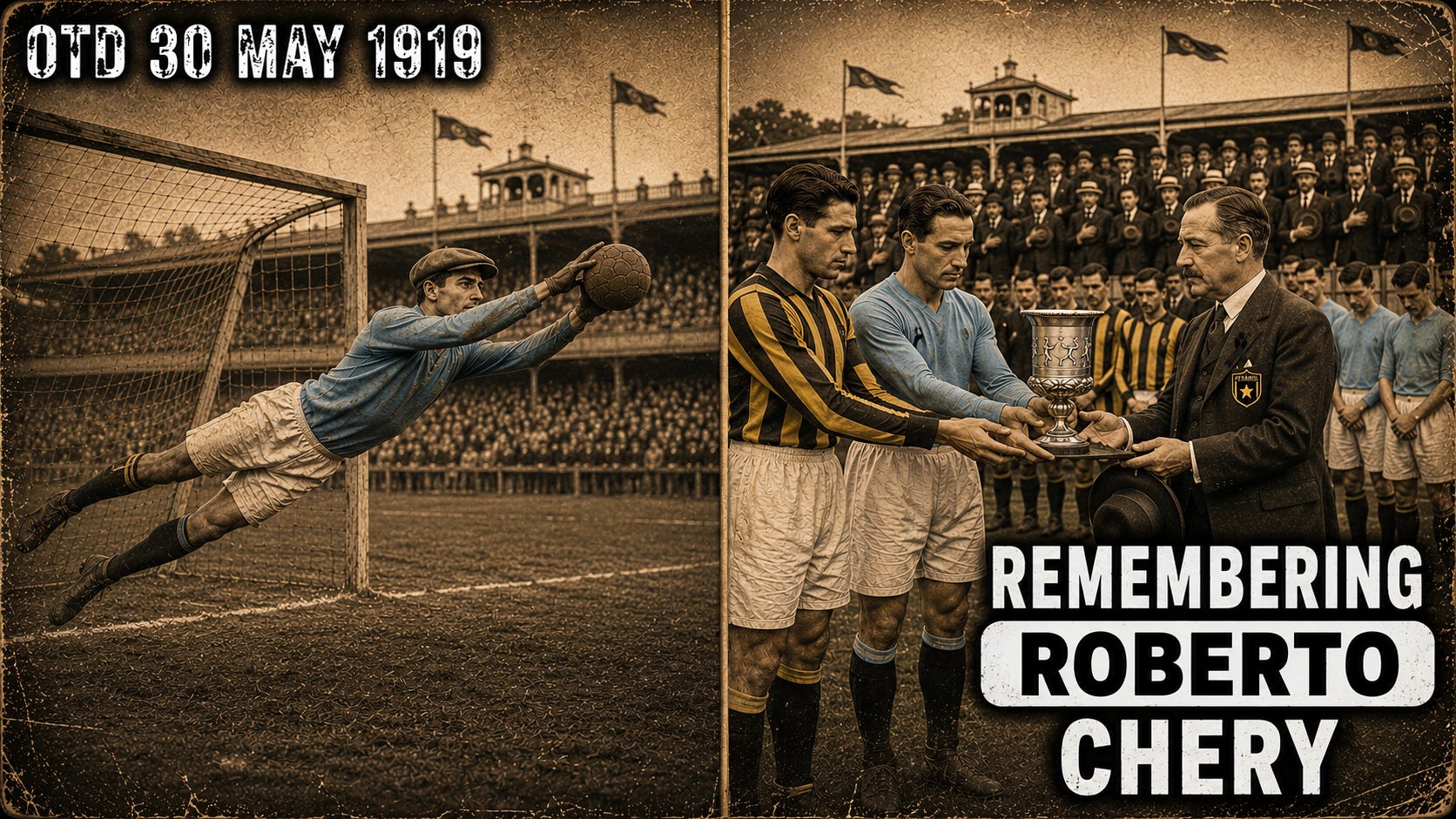
It is 30 May 1919, in Rio de Janeiro. A 23-year-old goalkeeper for Peñarol, Roberto Chery, passes. Thirteen days earlier, he had made his debut for Uruguay. One match. One cap. One save. And then an injury that became something far worse.
This is a story from the heroic age of South American football — when the game was amateur in name but already national, emotional, and fiercely competitive. It is also a story about a rule that feels unthinkable now: no substitutes. No bench to save you. No medical protocol. If you were hurt, the match went on — and so did you.
By the 1910s, South American football was young but not small. And in 1916, during a tournament marking Argentina’s independence centenary, the continent created the South American Championship — and, alongside it, CONMEBOL, the oldest continental confederation in world football. Uruguay won that first championship, then again in 1917. By 1919 they were the defending kings of the young continent.
The 1919 tournament, delayed a year by the Spanish flu pandemic, was played in Rio. Uruguay travelled with names that would echo through history, like Isabelino Gradín, Ángel Romano, the Scarone brothers. And from Peñarol, the reigning Uruguayan champions, came a goalkeeper named Roberto Chery — from Montevideo’s Barrio Sur, tall and thin, nicknamed El Poeta, the Poet, because he liked to write verses.
He was not Uruguay’s first choice. That was the veteran Cayetano Saporiti, who played the opening win over Argentina. But the Rio heat had not treated Saporiti kindly, so for the second match, against Chile, coach Severino Castillo told Chery he would start. He could barely believe it. On 17 May 1919, he came out smiling, wearing his cap.
Uruguay won 2-0, but did not play especially well, and Chile created danger. In one of those moments, Chery made the save that became the story of his life: he threw himself across the goal, made a brilliant stop, and landed heavily. The details are imperfect, as they often are from this age, but what remains consistent is the cost. He had aggravated a hernia. And in 1919, that could be fatal.
There was no stretcher protocol. No replacement goalkeeper. No medical timeout. Under the rules and customs of that football world, the injured player and his team were trapped inside the match. Chery carried on as far as he could. Uruguay won. For a moment, it looked like a painful day rather than a fatal one.
It was not. The pain did not leave him. By 26 May he woke in severe pain; the next day he was hospitalized in Rio — all while the tournament continued. Brazil and Uruguay drew 2-2, forcing a playoff. That playoff, on 29 May, became the longest match in the competition’s history: 90 minutes goalless, extra time goalless, then a further two periods of 15 minutes, during which - in the 122nd minute - Arthur Friedenreich scored the matchwinner. After 150 minutes, Brazil were South American champions for the first time.
The celebration was immediately shadowed. The next day, 30 May, Chery was operated on. For a moment it seemed he might come through. Then peritonitis set in, and that evening he died. He was 23 — the only footballer remembered as having died from injuries suffered while defending Uruguay.
And then grief did something extraordinary. Brazil and Uruguay had been scheduled to meet again, but Uruguay were too devastated to play. So Argentina stepped in. On 1 June, at Laranjeiras, Brazil played Argentina in Copa Roberto Chery — and they did not simply play a match. Brazil wore Peñarol’s black and yellow, honouring Chery’s club. Argentina wore Uruguay’s sky blue, honouring Chery’s country. The match finished 3-3. The trophy went to Peñarol. The proceeds went to his family.
Think about that image. Brazil, just crowned champions after beating Uruguay in the longest match the competition had known, wearing the colors of a Uruguayan club. Argentina, Uruguay’s great rival across the Río de la Plata, wearing the Celeste. It remains one of the most beautiful gestures in the history of South American football.
His death did not change the laws — substitutions were decades away, and football kept romanticizing playing on through pain. But Chery’s story endures as a warning from the pre-substitution age: that the heroic era was heroic partly because it demanded too much of bodies with too little protection. He is remembered not for a trophy, but for a save, a single cap, and a death that turned rivals into mourners.
🎙️ THE PODCAST GOES DEEPER. The full episode has what this post compresses: CONMEBOL’s founding in full; Uruguay’s golden generation; the conflicting contemporary accounts of the save itself; the 150-minute final in detail; Chery’s funeral and the ship that carried him home to Montevideo; and how football was — and wasn’t — changed by his death. That’s the 10-minute version.
---
🎧 Listen on Spotify, Apple Podcasts, Amazon Music, Overcast, iHeart, and YouTube.
📩 Got an episode idea? otd@17lawsguy.com
Yesterday: 29 May 1958 — The First Star Above a Crest.
Tomorrow: 31 May 1961 — Béla Guttmann, Benfica, and the end of Real Madrid’s reign.