

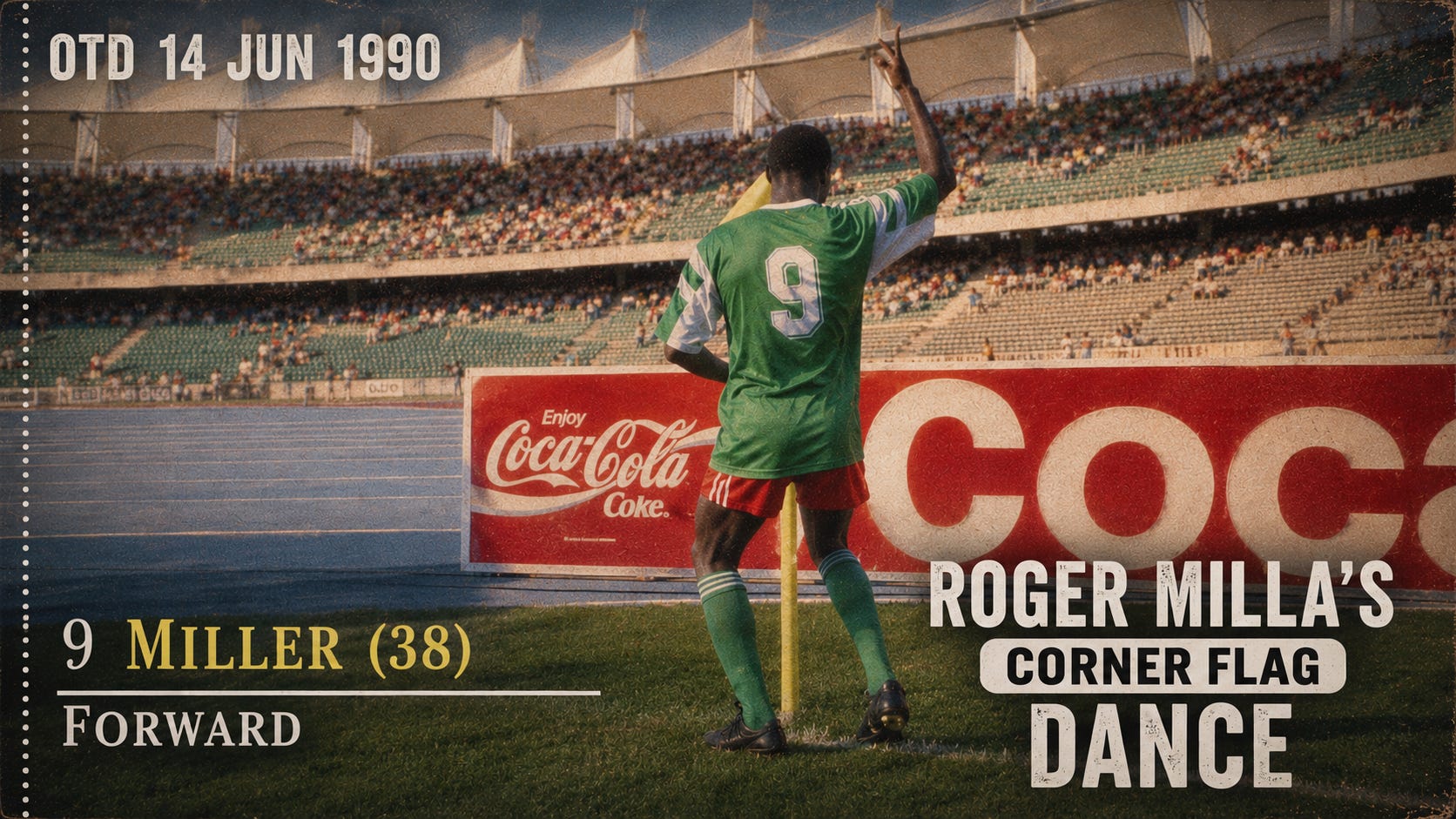
It is 14 June 1990, at the Stadio San Nicola in Bari. Cameroon against Romania. And a 38-year-old substitute is about to change the visual language of football. His name is Roger Milla, and today, after scoring, he does something simple. He runs to the corner flag, lifts one arm, shakes his hips, and dances. Not wildly, not for long, just enough. And suddenly the goal celebration becomes more than a release. It becomes a signature.
How did we get here? To understand Cameroon in 1990, start with African football’s long World Cup climb. Egypt literally missed the boat in 1930 but became the continent’s first representative in 1934, then Africa largely vanished from the tournament until 1970. Tunisia gave Africa its first World Cup win in 1978. Algeria shocked West Germany in 1982, then were squeezed out by the notorious West Germany-Austria non-aggression result in Gijon. Morocco reached the second round in 1986. So by 1990 serious observers knew African football had talent, even if much of the wider football world still treated it as exotic and naive.
Cameroon had already challenged that. At Spain 1982 they did not lose a match, drawing all three group games, including against eventual champions Italy, and going out only on goals scored. Then they became a continental power, winning the Africa Cup of Nations in 1984 and 1988. This was not a novelty side. It was the best sub-Saharan African team of its era. But the 1990 build-up was chaos. The coach was Valery Nepomniachtchi, a Russian originally sent for youth development, who spoke little French and inherited a squad full of strong personalities, political interference and federation intrigue. Cameroon still qualified, then crashed out of the 1990 AFCON group stage, and arrived in Italy amid stories of missing equipment, late buses and disciplinary disputes.
And then there was Roger Milla. By 1990 he was Cameroonian football royalty, African Footballer of the Year back in 1976, a veteran of the 1982 World Cup. But he was now 38, playing for Saint-Pierroise on Réunion, out in the Indian Ocean, closer to semi-retirement than stardom. Then he played well in a testimonial, and back home people asked the obvious question: why is Roger Milla not in the squad? And when the president of Cameroon, Paul Biya, wanted something, the national-team structure listened. The story became legend: presidential pressure, public demand, and a veteran summoned from the beach into the world’s biggest tournament. Milla arrived late, not fit enough to start, and some teammates were skeptical. Thomas N’Kono helped persuade the group that the old man could still help.
Then Italy 1990 began, and Cameroon stunned the holders Argentina 1-0 in the opening match, finishing with nine men. But that was not yet Milla’s day. Against Romania, four days later in Bari, the match was still waiting for him. Cameroon and Romania were locked at 0-0, Romania carrying Gheorghe Hagi and a strong side, and Cameroon needing a spark. Around the hour, Nepomniachtchi sent for the old man.
For a while, nothing magical happened. Then, in the 76th minute, a huge dropping ball came toward the Romanian defense. Ion Andone misjudged it and let it bounce. That was the mistake. Milla sensed it instantly, used his body to roll the defender, entered the box, and finished low with his left foot. Cameroon 1, Romania 0. The finish was cold. The celebration was warm. Milla ran away from goal, toward the corner flag, raised one arm, and wiggled his hips in a burst of joy. It looked spontaneous because it was. People later tried to identify it as makossa, the Cameroonian dance style, but Milla said no, it was just something that came to him, God’s dance, he later called it. That is exactly why it worked. It was not a routine yet. It was a man rediscovering youth in front of the world.
Then he did it again. In the 86th minute, after a half-cleared free-kick, Milla looped around the defenders, took the ball into the area, and smashed it in at the near post. Cameroon 2, Romania 0. Back to the corner flag, back to the hips, back to history. Romania pulled one back almost immediately, but Cameroon won 2-1 and were through to the knockout stage. A 38-year-old late call-up from Reunion was now the most joyful man in the World Cup.
And Cameroon kept going. They topped a group that contained Argentina, Romania and the Soviet Union. In the round of 16 Milla scored twice more against Colombia, including a famous theft of the ball from the sweeper-keeper René Higuita, and Cameroon became the first African team ever to reach a World Cup quarter-final. There, against England in Naples, they led 2-1 and were 25 minutes from a semi-final before Gary Lineker’s two penalties ended the dream, 3-2. But the world did not forget them. Italia 90 is remembered for atmosphere and drama, for Gazza’s tears and Schillaci’s eyes, and for Cameroon’s joy, and Milla’s dance.
And Milla kept rewriting age. In 1990 he became the oldest goalscorer in World Cup history. Then in 1994 he returned at 42 and scored against Russia, breaking his own record, which still stands. He is not just the old man who had one magical summer. He is the old man who came back and made the record older.
Milla did not invent celebrating goals. Marco Tardelli’s scream in the 1982 final came first. But Milla gave the World Cup one of its first repeatable, personal, globally copied celebrations. The celebration was not just raw emotion, it was identity. You saw the dance and instantly knew it was Roger Milla. After him, the celebration increasingly became part of the footballer’s language: Bebeto rocking the baby in 1994, Klinsmann’s mock dive, Mbappé’s folded arms, Cristiano Ronaldo turning Siuuu into a global call-and-response. As we enjoy the 2026 World Cup, we may yet see Messi point to the sky or CR7 launch the Siuuu, and nobody will think it strange that a goal celebration carries choreography, memory, brand and crowd participation all at once. Because today, the celebration is part of the goal.
That is why 14 June 1990 matters. Not only because Cameroon beat Romania, and not only because Milla scored twice, but because football joy got a new shape.
🎙️ THE PODCAST GOES DEEPER. The full episode has more on Africa’s World Cup history, Cameroon’s chaotic 1990 build-up, the N’Kono and Bell goalkeeper drama before the opener against Argentina, the Colombia match and the Higuita moment, the England quarter-final, and a lineage of modern goal celebrations. That is the 10-minute version.
---
🎧 Listen on Spotify, Apple Podcasts, Amazon Music, Overcast, iHeart, and YouTube.
📩 Got an episode idea? otd@17lawsguy.com
Yesterday: 13 June 1956, Madrid, Reims, and the First European Cup Final.
Tomorrow: 15 June 1982, Hungary 10, El Salvador 1.
Great detail about the live tv graphic misspelling Roger Milla's last name as "Miller". As he got famous after his corner flag dancing, the Italian tv producers got it right. :-)