

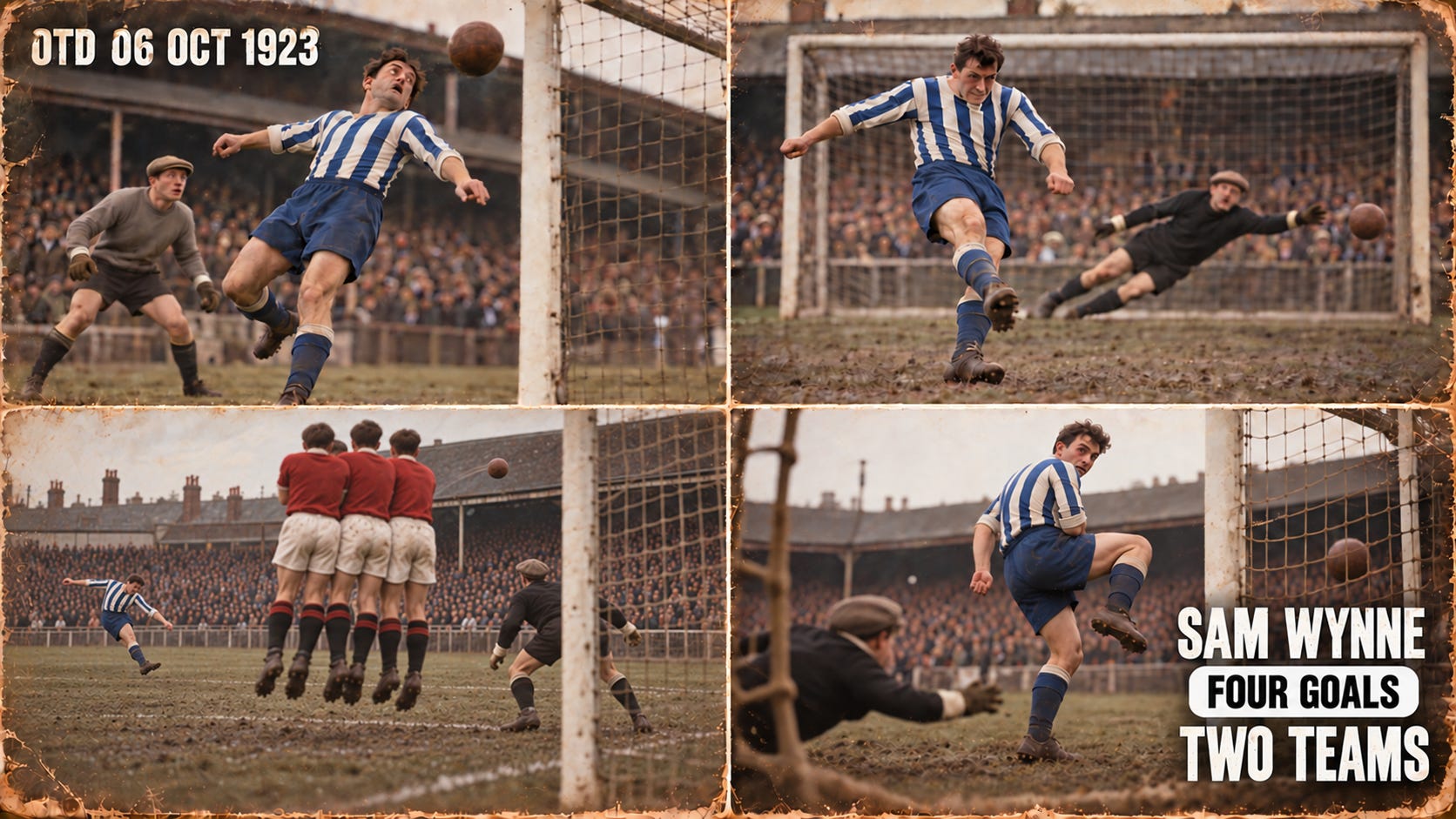
On October 6, 1923, Sam Wynne headed a corner over his own goalkeeper to put Manchester United ahead. Nineteen minutes later he walked the length of the pitch to take a penalty and beat United's goalkeeper at the other end. Before half time was over he had scored again, a clean free kick struck low past the same goalkeeper. In the second half a corner found his knee and rebounded into his own net a second time. Four goals, one player, two goalkeepers beaten from open play that he never meant to beat and two beaten from dead balls he meant to beat perfectly. Oldham won 3-2. Wynne had become the first documented Football League player to score twice for his own team and twice for the opposition in the same match.
How did we get here?
Boundary Park sits barely nine miles from Old Trafford, but the clubs that met there that Saturday bore almost no resemblance to the ones those grounds house now. Manchester United were not yet football’s great global institution, and Oldham were not yet the perennial underdogs of English football folklore. In the years immediately before the First World War, Oldham had actually come closer to winning the English championship than United had, finishing second in the First Division in 1914-15, one point behind Everton. The war then suspended the Football League for four seasons, and when it resumed in 1919 Oldham’s momentum was gone: fifteenth, then seventeenth, then nineteenth, then, by the winter of 1922, fighting relegation outright.
Their response was to bring back David Ashworth, the manager who had first taken charge of Oldham in 1906 and helped establish them as a serious Football League club before leaving for Liverpool, where he won the 1921-22 league championship. Halfway through the following season, with Liverpool chasing another title, Ashworth walked away from the defending champions and returned to a club sitting near the bottom of the table. Even Liverpool’s own official history concedes that nobody has satisfactorily explained why. He could not save them. Oldham were relegated at the end of 1922-23, and Liverpool retained the championship without him, now managed by director Matt McQueen.
Manchester United had fallen into the Second Division a year earlier still, finishing fourth in 1922-23 and opening the new campaign with three straight wins before a run of a draw, three defeats and another draw left their promotion push wobbling by the time they made the short trip to Boundary Park. Oldham’s own start had been worse, one win from eight. This was the clubs’ first meeting outside the top division, two recently relegated sides each trying to arrest a slide, watched by 12,250 people on a heavy October pitch.
Football itself looked different that autumn. There were no substitutes; whatever eleven men started, finished. Goalkeepers could still be legally charged while holding the ball. The offside law required three defenders between an attacker and the goal line rather than two, which rewarded teams for stepping forward together and suppressed scoring across the board; when the law changed in 1925, scoring in the top division jumped from 2.58 goals a match to 3.69 the following season. Goals were precious enough in 1923 that a defender who could also strike a dead ball was worth a great deal, and Sam Wynne, born in Neston on the Wirral on April 26, 1897, a war veteran who had come up through Neston Colliery football before Connah’s Quay, Shotton United and Oldham in 1921, was exactly that kind of defender: five foot nine, thirteen stone, reliable in the air, trusted with every penalty and free kick Oldham won, and still, somehow, without a single competitive goal to his name.
Two ends, one man
Seven minutes in, United winger Frank McPherson swung a corner into the Oldham area. Wynne rose to head it clear, over his own crossbar, the obvious and correct defensive choice. Instead the ball looped beyond goalkeeper Bert Gray and in. Oldham 0, United 1, and the cruelty of the own goal revealed itself immediately: it is almost always scored by a man trying to protect his own net, not neglect it.
Later in the half, Oldham’s Bert Watson went down under a challenge from United’s Charlie Radford and referee A. E. Fogg pointed to the spot. Wynne left his position and walked forward. He struck it low and hard past Jack Mew. 1-1, and Wynne’s first competitive goal in Oldham colors had arrived by scoring at both ends inside the same half hour. Oldham then won a free kick just outside the United box, and Wynne beat Mew again, clean and direct. Billy Howson pushed Oldham 3-1 ahead, collecting a weak clearance from Mew. Howson’s single goal is the only reason the scoresheet does not read as a man playing the whole match by himself.
Then United won a second corner, Joe Spence delivering it this time, and the ball struck Wynne’s knee inside the box and rolled in a second time. 3-2. Four of the five goals in the match had now gone in off the same player, two headed and kneed past his own goalkeeper under genuine defensive pressure, two struck cleanly and deliberately from twelve yards and twenty. There were no further goals. Oldham Athletic had beaten Manchester United 3-2, with Wynne responsible for two goals at each end.
So what?
Scoring at both ends is uncommon but not unique. What makes Wynne’s afternoon extraordinary is its symmetry: two deliberate goals for Oldham, two inadvertent goals for United, all by a full-back who had never previously scored in a competitive match. Whether he was the first footballer anywhere to score two own goals in a single competitive match cannot honestly be established. The Football League alone had existed since 1888, association football for sixty years before that, and early reporting of own goals was inconsistent enough across Britain, Europe and South America that no claim to an absolute first survives close scrutiny. What can be said is narrower and more secure: Wynne became the first documented Football League player to score twice for his own team and twice for the opposition in the same match, a feat the competition would not see repeated for more than half a century.
It finally recurred on March 20, 1976, when Aston Villa’s Chris Nicholl somehow matched it against Leicester City at Filbert Street, an own goal, an equalizer, a second own goal that he later called possibly the best header he ever hit, and a last-gasp equalizer from a corner to make it 2-2. Unlike Wynne, Nicholl scored every goal in the match himself, and he asked the referee, officiating his own final game in the Football League, whether he could keep the ball as a souvenir. The referee said no; he was keeping it for himself. Between Wynne and Nicholl, and after him, came a long and oddly specific lineage: Kevin Bond scoring an own goal and an equalizer for Norwich twice in five days in 1980; Tony Adams doing it for England against the Netherlands in 1988 and for Arsenal the year after; Jamie Carragher becoming the first player to score two own goals in a single Premier League match when Liverpool lost 3-2 at home to Manchester United on September 11, 1999; Stoke’s Jonathan Walters heading into his own net twice against Chelsea in 2013 and then missing a penalty at the right end for good measure; New Zealand’s Meikayla Moore scoring a perfect own-goal hat trick, one with each foot and one off her head, against the United States in 2022. Set pieces caused nearly all of it. A cross arrives, the defender has half a second to decide whether to intervene, and any imperfect contact can beat his own goalkeeper just as easily as it clears the danger. Wynne’s two own goals both came from corners; his two real goals both came from dead balls at the other end. The same part of the game that punished him also paid him.
The other half of the story is what became of the two clubs he briefly made equals. United took revenge seven days later at Old Trafford, winning 2-0, but their promotion push never recovered, and they finished fourteenth, five points and six places behind an Oldham side that climbed to seventh. It would not stay that way. Manchester United are now one of the wealthiest and most recognized sporting institutions on earth. Oldham Athletic, in April 2022, were relegated out of the Football League altogether after 115 consecutive years in it. They returned through the National League play-offs in 2025 after a three-year absence and now play in League Two. The gulf that did not yet exist on an October afternoon in 1923 remains one of the widest in English football, but Oldham’s story now carries a note of recovery rather than permanent exile.
Wynne stayed at Boundary Park until December 1926, making 145 league appearances and scoring nine official goals, before Bury paid a reported club record fee of around £2,500 for him after their own full-back broke his leg against Derby County. He settled in immediately. On April 30, 1927, four days after his thirtieth birthday, Bury traveled to Sheffield United. Five minutes before half time, with an offside free kick given his way, Wynne placed the ball, straightened up to take his run, and collapsed. He was carried from the field and died before the interval ended. His father-in-law had watched him arrive at the ground that morning and later said he looked like a man with another ten years of football left in him. The inquest found pneumonia that nobody had known he was carrying, complicated by what one examining doctor called an athlete’s heart, and ruled that the exertion of a professional football match was the worst thing he could have done in that condition. A rearranged fixture raised £680 for his family, and donations brought the total fund to roughly £1,400. His widow, Hannah, later won a Workmen’s Compensation claim after Bury contested it, a judge ruling that although disease had killed him, his work as a professional footballer had materially contributed to his death. He left a son born eight weeks after he died, and a daughter, Gwendoline. That same spring, within weeks of Sam’s death, his brother John was also killed in an accident, leaving their parents to bury two sons from the same family within a matter of months.
Three things to take away
Wynne scored four of the five goals in Oldham’s 3-2 win over Manchester United. Two were his own, a penalty and a free kick. Two went to United, a header and a knee, both off corners.
He cannot be proven the first player anywhere to score two own goals in one match, but he holds a narrower and surer record. Wynne was the first documented Football League player to score twice for each side in the same game, a feat not repeated in the competition until Chris Nicholl in 1976.
The record outlived both clubs’ sense of who they were that day. Oldham and Manchester United met as two struggling sides fighting to get out of the Second Division. One later fell out of the Football League for three years before returning in 2025; the other became one of the biggest clubs on earth.
On October 6, 1923, Sam Wynne beat two goalkeepers he was trying to beat and two he was trying to protect, and Oldham Athletic walked off Boundary Park 3-2 winners over a full-back who had somehow played both teams to a standstill by himself. He is buried at Raby Park Road Cemetery in Neston, under a large white marble football, four years and six days after he became both Oldham’s match-winner and the source of Manchester United’s entire attack.
---
📩 Got an idea to an OTD story? otd@17lawsguy.com
Yesterday: 05 October 1929, Stoke City's Bobby Liddle was knocked unconscious by a goalkeeper's clearance that rebounded into the net, completing a three-three draw against Notts County at Meadow Lane..