

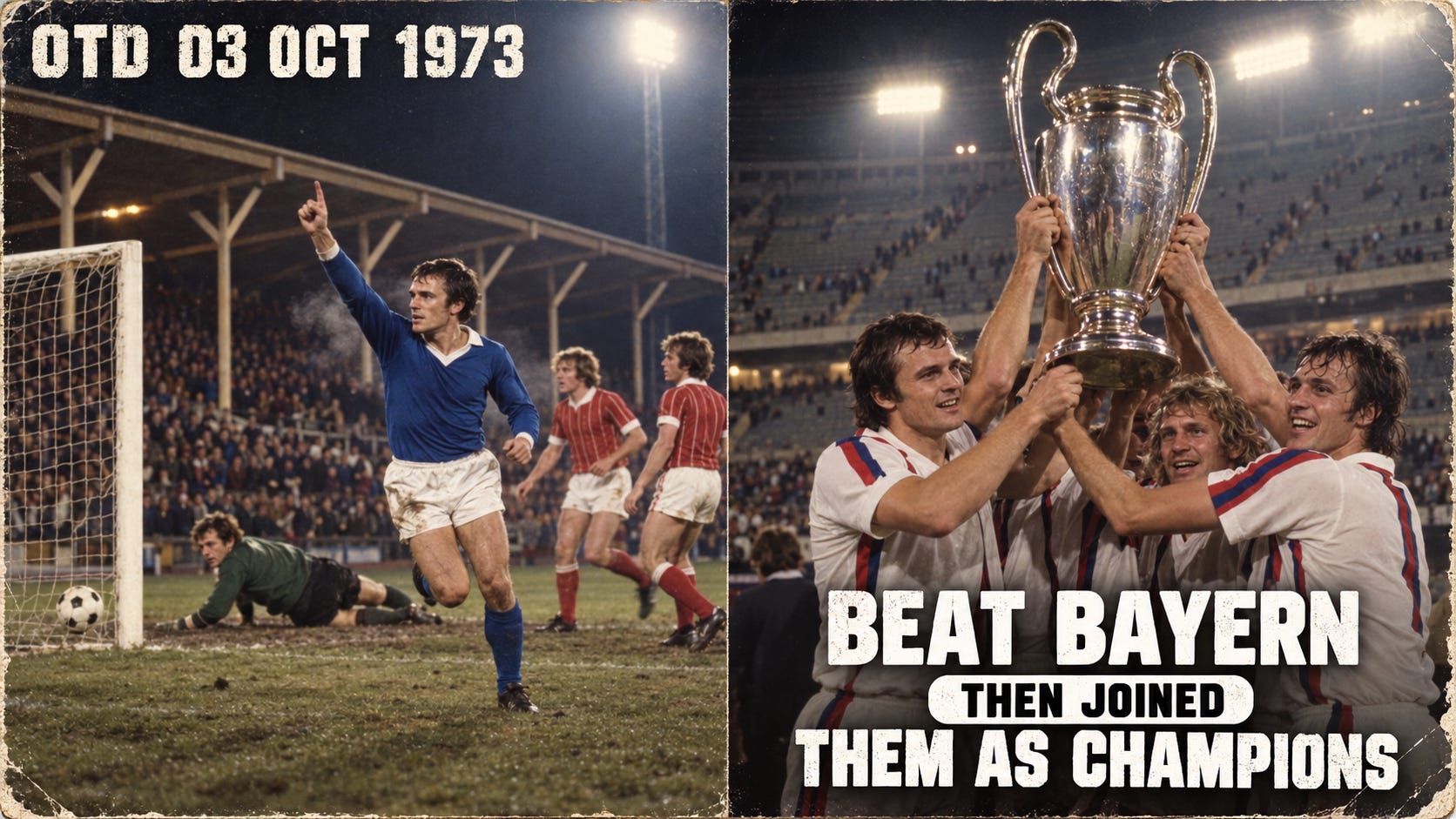
On October 3, 1973, Bayern Munich came within eleven minutes of being eliminated from the European Cup by a team from a Swedish factory town. Åtvidaberg led the tie 3-0 on the night, 4-3 on aggregate, and two of the goals belonged to Conny Torstensson, a 24-year-old attacker whose club occupied the strange borderland between amateur football and corporate employment. Bayern survived, barely. Then they bought him. Five months later Torstensson was scoring for Bayern in that same European Cup, and by the end of the season he stood alongside Franz Beckenbauer, Gerd Müller and Sepp Maier as a champion of Europe, having scored against a club, joined it, scored for it and won the competition, all in one campaign.
How did we get here?
Åtvidaberg is a small town in southeast Sweden, its population then around ten thousand, known internationally less for football than for Facit, the manufacturer of typewriters and calculators that employed much of the town. Åtvidabergs Fotbollförening, known as ÅFF, became inseparable from the company. Swedish football was officially amateur, but a talented player could be offered work, housing and security around the Facit plant and play for the local club in his spare time, a kind of company-assisted amateurism that was not professionalism as Bayern understood it, but was not eleven local men meeting after their shifts either. It let Åtvidaberg recruit, develop players and, crucially, keep a team together.
The club first reached Sweden’s top flight in the early 1950s before being relegated, and its real rise began after promotion back to the Allsvenskan in 1967. The trophies followed: Swedish Cups in 1970 and 1971, and in the 1971-72 Cup Winners’ Cup, a goalless draw at home to the defending champions Chelsea, followed by a one-one draw at Stamford Bridge that eliminated them on away goals, a genuine competitive knockout win over the holders, not a novelty scoreline against a careless big club in a friendly. In 1972, under Sven-Agne Larsson, ÅFF won the Allsvenskan for the first time, built around a generation that included Ralf Edström, Roland Sandberg, Jan Olsson and Conny Torstensson.
The triumph arrived just as Facit’s industrial world was collapsing. Electronic calculators from Japan were making the company’s mechanical machines obsolete almost overnight, and Facit refused to adapt quickly enough, clinging to a technology it had mastered while a cheaper, faster one ate its market. Electrolux absorbed the company in 1973, thousands of jobs vanished, and Facit even sold Kopparvallen, the stadium that had become the football club’s home. The failure became notorious enough in Swedish business circles to earn its own name, Facitfällan, the Facit trap, still taught as a textbook case of a dominant, well-resourced company failing to see a technology shift coming until it was too late. Åtvidaberg’s greatest sporting period therefore coincided almost exactly with the erosion of the economic structure that had made it possible, and the team itself began to break apart even as it kept winning: Edström left for PSV Eindhoven, Sandberg for Kaiserslautern, while new coach Otto Dombos somehow held the rest together and guided ÅFF toward a second consecutive Swedish title in 1973.
That season exposed a quirk of the European calendar. Sweden played its championship through the northern summer, while UEFA’s competitions ran on the western European autumn-to-spring schedule, so Åtvidaberg entered the 1973-74 European Cup as Sweden’s 1972 champion while still fighting to win the 1973 Allsvenskan, their domestic season reaching its climax just as Bayern’s had barely started. This was not a weak period for Swedish football generally. The national team had reached the 1970 World Cup and would finish fifth at the 1974 tournament, several of that squad current or former Åtvidaberg players, Torstensson among them; he would score Sweden’s winner against Yugoslavia at that World Cup. ÅFF were nowhere near Bayern’s financial equals, but technically and physically they were considerably more dangerous than their name suggested.
Torstensson embodied the team. Born in 1949 and raised around Gamleby and Hallingeberg, he arrived at Åtvidaberg as a teenager, not a glamorous number ten or a conventional center-forward but a player who could work across the attacking and midfield lines, running, pressing and arriving in scoring positions. His exact duties on Facit’s payroll have blurred with retelling, but he belonged to the same employment-and-football structure as his teammates. He later recalled that his first agreement with Bayern was written out on a hotel notepad and copied at Stockholm’s Grand Hôtel, which says something about how fast the whole transfer actually moved once it started.
First, though, Åtvidaberg had to frighten Bayern half to death. The European Cup draw paired the Swedish champions with a Bayern side built around the core of West Germany’s 1972 European Championship winners, Maier, Beckenbauer, Paul Breitner, Uli Hoeneß and Müller, already German champions and approaching the peak that would soon define a decade of European football. The first leg in Munich on September 19 finished 3-1, though the scoreline flattered the margin: Müller scored after three minutes, Åtvidaberg stayed level until the 66th minute when Bayern’s Bernd Dürnberger put through his own goal, Jan Olsson returned the favor with an own goal two minutes later, and Müller added a third in the 72nd minute. A comfortable scoreline. Not a comfortable tie.
The night at Kopparvallen
A little over nine thousand people packed into Kopparvallen, in a town of roughly the same size, on October 3. Bayern had the names, the money and a two-goal cushion. Åtvidaberg had Torstensson. He scored after seven minutes. Veine Wallinder made it two after fifteen. 2-0 on the night, 3-3 on aggregate, Bayern’s advantage gone inside a quarter of an hour. Then, in the 72nd minute, Torstensson scored again. Åtvidaberg 3, Bayern 0, 4-3 on aggregate, and the Swedish champions were eliminating Beckenbauer, Müller, Hoeneß and Maier from the European Cup. Legend holds that Bayern president Wilhelm Neudecker pointed at the field and announced the club had to sign the man in the red boots, though later accounts disagree on whether he had even correctly identified which Åtvidaberg player was wearing them. There was no disputing the performance itself. With roughly eleven minutes left, Hoeneß rescued Bayern, making it 3-1 on the night and 4-4 on aggregate, a mirror image that away goals could not separate. Extra time produced nothing, so the tie went to penalties. Here, Torstensson converted ÅFF’s first kick, yet Bayern eventually won the shootout 4-3 after Leif Franzén’s miss ended it, and Åtvidaberg went out of Europe eleven minutes from eliminating the club that would win the next three European Cups.
Within weeks, one of their executioners had become Bayern’s newest player. Torstensson’s transfer was registered on November 1, 1973, for a reported fee of roughly 580,000 Deutsche Marks. He did not replace anyone directly; he joined a rotating group of attacking and midfield players, his value his versatility and his work off the ball, able to support Müller, start wide, drop deeper or do the unglamorous running that freed Bayern’s stars to do what they did best. Remarkably, UEFA’s rules let him keep playing in the very same edition of the European Cup. He missed the second-round tie against Dynamo Dresden, but his Bayern debut in the competition came in the quarterfinal against CSKA Sofia on March 5, 1974. He scored after eight minutes, then again in the 88th minute as Bayern won 4-1. In the semifinal first leg away to Újpest he scored Bayern’s goal in a 1-1 draw, then opened the scoring in a 3-0 second leg win. Four European Cup goals for Bayern, on top of the two he had scored against them: six goals in the same tournament, first trying to eliminate the eventual champions, then helping make them champions.
So what?
Bayern won the Bundesliga that season ahead of Borussia Mönchengladbach, with Torstensson playing sixteen league matches in the second half of the campaign and scoring once; in the German Cup they reached the semifinal before losing to Eintracht Frankfurt. But Europe transformed the season. Torstensson started for Bayern in the European Cup final against Atlético Madrid, the same man who had lined up against them seven months earlier now lining up for them in the biggest match of all. The game stayed scoreless until extra time, when Luis Aragonés gave Atlético the lead from a free kick in the 114th minute; Torstensson had already been substituted by then. With seconds left, Hans-Georg Schwarzenbeck struck an improbable long-range equalizer. There were no penalty shootouts for European Cup finals in that era, so the entire match was replayed two days later. Torstensson played the full ninety minutes of the replay as Hoeneß and Müller each scored twice and Bayern won 4-0 to become champions of Europe for the first time. He stayed part of the Bayern sides that retained the trophy in 1975 and 1976, finishing with ten goals in twenty-one European Cup appearances for the club and the nickname Europacup-Conny. Very few Swedish players have ever held three European Cup winners’ medals. The nominal amateur from Facit’s football town had all three.
His story fits a recognizable pattern: the player who impresses an opponent so completely that the opponent simply buys him. Cristiano Ronaldo’s display for Sporting against Manchester United in a 2003 friendly is credited with accelerating his own move to Old Trafford. Paul Lambert played for Motherwell against Borussia Dortmund in the UEFA Cup, later joined Dortmund and won the Champions League with them. Takumi Minamino scored for Salzburg at Anfield in 2019 and signed for Liverpool three months later. None of them matches Torstensson’s full sequence: he scored twice against Bayern in a knockout tie, nearly eliminated them, joined them weeks later, scored four more times for them in the same tournament, then started both versions of the final and lifted the trophy. It is hard to find a genuine equivalent.
For decades, UEFA’s cup-tied rule would have made any repeat impossible, barring a player who had represented one club in a European competition from appearing for another club in the same competition that season; Philippe Coutinho, for instance, moved from Liverpool to Barcelona in January 2018 but could not play Champions League football for his new club that season because he had already played for Liverpool in it. UEFA changed that from 2018-19, allowing clubs to register new signings for the knockout rounds even if they had already featured for another club earlier in the competition. Erling Haaland promptly demonstrated it, scoring eight Champions League goals for Salzburg before moving to Borussia Dortmund and adding more in the same campaign, ten in total, including a brace on his Dortmund debut in the competition against Paris Saint-Germain. Under today’s rules, Torstensson’s path is technically possible again, provided transfer and registration deadlines line up. The texture of his particular story probably is not: a Swedish factory club defending one domestic title while opening another European campaign, its players balanced inside an official culture of amateurism, a deal improvised on hotel stationery, a club president identifying his transfer target by the color of his boots. Had Hoeneß not scored that late equalizer at Kopparvallen, Bayern’s first European dynasty might never have begun at all, and Conny Torstensson might have stayed in Sweden, a respected international from an extraordinary small-town team, rather than a three-time champion of Europe.
Three things to take away
Åtvidaberg were no curiosity. Backed by Facit, built around an exceptional generation and playing during a genuinely strong period for Swedish football, they won consecutive league titles, eliminated the holders Chelsea from Europe, and came within one goal of eliminating Bayern Munich too.
The mismatched Swedish and continental calendars created an opening nobody has really had since. ÅFF were defending one Swedish championship while competing in Europe as winners of the previous one, and Torstensson could change clubs in the middle of that same European campaign without ever sitting it out.
Torstensson’s achievement still sounds almost invented. He scored against Bayern, joined Bayern, scored four more goals for Bayern, and won the European Cup with Bayern, all inside one tournament.
On October 3, 1973, Conny Torstensson scored twice at Kopparvallen and brought Bayern Munich to the brink of elimination, eleven minutes from an upset that might have rewritten the next decade of European football. Hoeneß saved them instead. Five months later Bayern signed the man who had so nearly ended them, and sent him out to help win the trophy he had almost taken away.
---
📩 Got an idea to an OTD story? otd@17lawsguy.com