

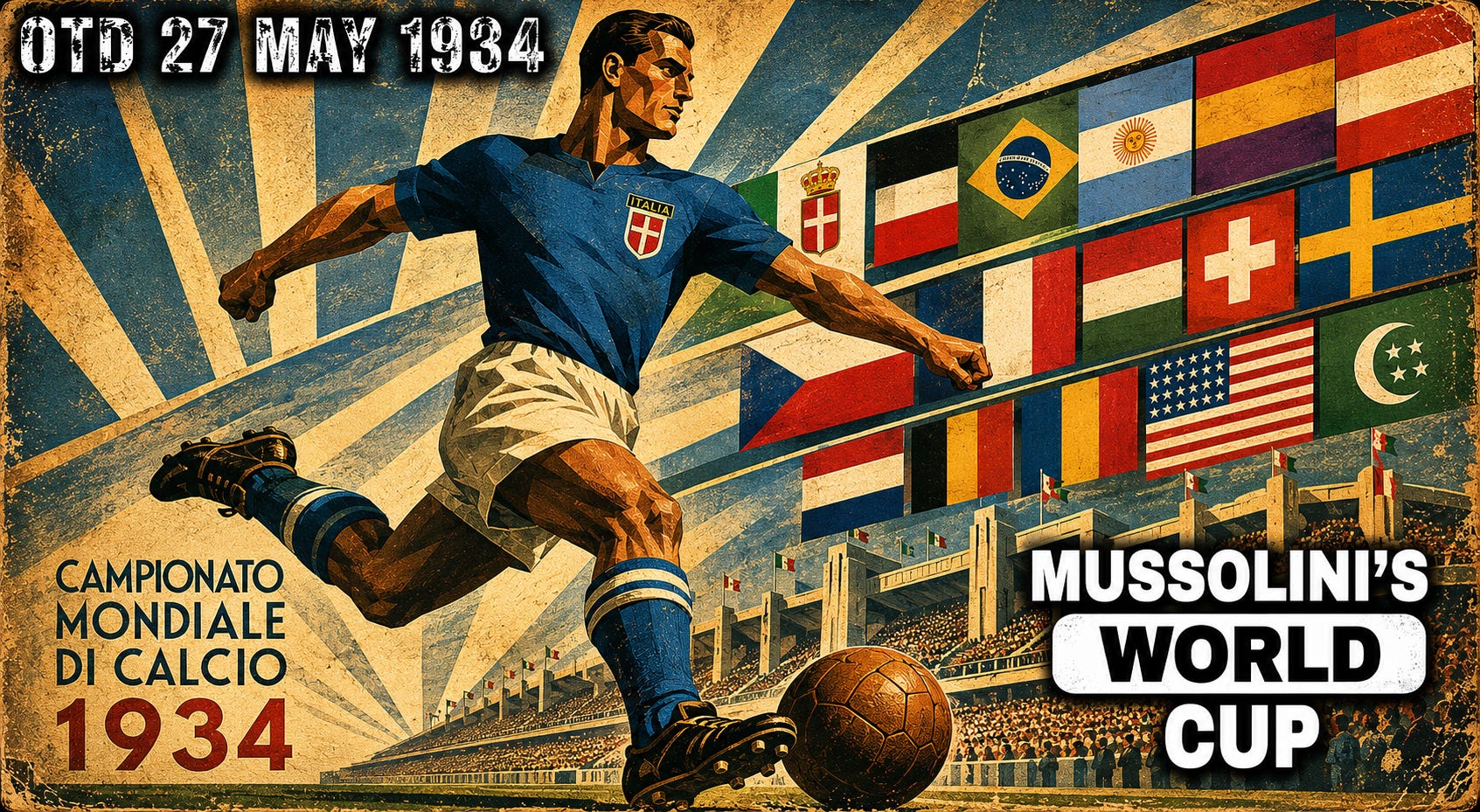
It is 27 May 1934. Italy. The second FIFA World Cup begins. And with the 2026 World Cup now just over two weeks away, this is where our long run of World Cup history starts.
It opens with a record that still stands. The only World Cup where the host had to qualify. Sixteen nations, straight knockout — but not Uruguay, the defending champions, who stayed home. Eight matches on the opening day. Forty-three goals. Every single nation scoring.
And from the first whistle, the World Cup is already what it will remain forever: football, logistics, politics, pressure, travel, controversy, and joy.
How did we get here? Start in 1930. Uruguay hosted and won the first World Cup — but many European nations had declined the long steamboat journey across the Atlantic. So when the tournament crossed to Europe in 1934, Uruguay refused to come: part protest, part spite. The British Home Nations were still outside FIFA entirely. Football was globalizing, but the World Cup was not yet the automatic centre of the game.
The second tournament went to Mussolini’s Italy — and the regime understood football as theatre: stadiums, crowds, radio, posters, discipline, national power. Even the ball was political: the Federale 102, made in Italy, for the first World Cup held in Europe. And Italy weren’t just hosts. Vittorio Pozzo had one of the strongest teams in the world: Meazza, Schiavio, Orsi, and Luis Monti — who’d played for Argentina in the 1930 final and would become the only man ever to appear in World Cup finals for two different countries.
But first, qualification. Thirty-two nations entered for sixteen places. Italy themselves had to qualify, beating Greece 4-0. And in the strangest travel story, the USA and Mexico played a final qualifier in Rome three days before the finals began — Mexico had crossed the Atlantic only to lose 4-2 and sail home without playing a single tournament match.
Then, on 27 May, all eight first-round matches kicked off at once.
In Rome, with Mussolini watching, Italy crushed the United States 7-1, Schiavio scoring a hat-trick. In Turin, Austria beat France 3-2 after extra time — the first extra-time match in World Cup history. In Florence, Germany came from 2-1 down to beat Belgium 5-2 (Edmund Conen, a hat-trick on debut). In Genoa, Spain beat Brazil 3-1, Ricardo Zamora saving a penalty. In Milan, Switzerland beat the Netherlands 3-2. In Bologna, Sweden knocked out the 1930 finalists Argentina, 3-2 — though Argentina had come with a weakened amateur side. In Trieste, Czechoslovakia beat Romania 2-1. And in Naples, Hungary beat Egypt 4-2 — Egypt becoming the first African team ever to play at a World Cup finals.
Eight matches. Forty-three goals. Every team scored. For all the politics and fatigue, it was an extraordinary advertisement for the World Cup.
And yet the quarter-finals were all-European. Argentina, Brazil, the USA and Egypt had all gone home immediately; Mexico never even played; Uruguay never came. The ‘world’ cup was, in practice, still deeply European. Italy went on to win it — needing a controversial replay past Spain, then beating Austria’s great Wunderteam, then Czechoslovakia in an extra-time final. Champions: the host nation of a fascist regime that understood football’s propaganda power with chilling clarity.
That’s why 27 May 1934 is such a rich date. It’s not just an opening day. It’s the moment the World Cup becomes unmistakably more than a tournament — a world stage, where the beauty of the game and the politics of the world enter the stadium together.
🎙️ THE PODCAST GOES DEEPER. The full episode has what this post compresses: the FIFA–Olympics amateurism fight that left football out of the 1932 Games; Pozzo’s squad and the late goalkeeper crisis; the full eight-match opening day with scorers and refereeing controversies; the infamous Spain replay and the Eklind questions; and how 1934 set up France 1938 and the road toward war. That’s the 10-minute version.
---
🎧 Listen on Spotify, Apple Podcasts, Amazon Music, Overcast, iHeart, and YouTube.
📩 Got an episode idea? otd@17lawsguy.com
Yesterday: 26 May 1989 — It’s Up for Grabs Now.
Tomorrow: 28 May 1888 — The First Old Firm.