

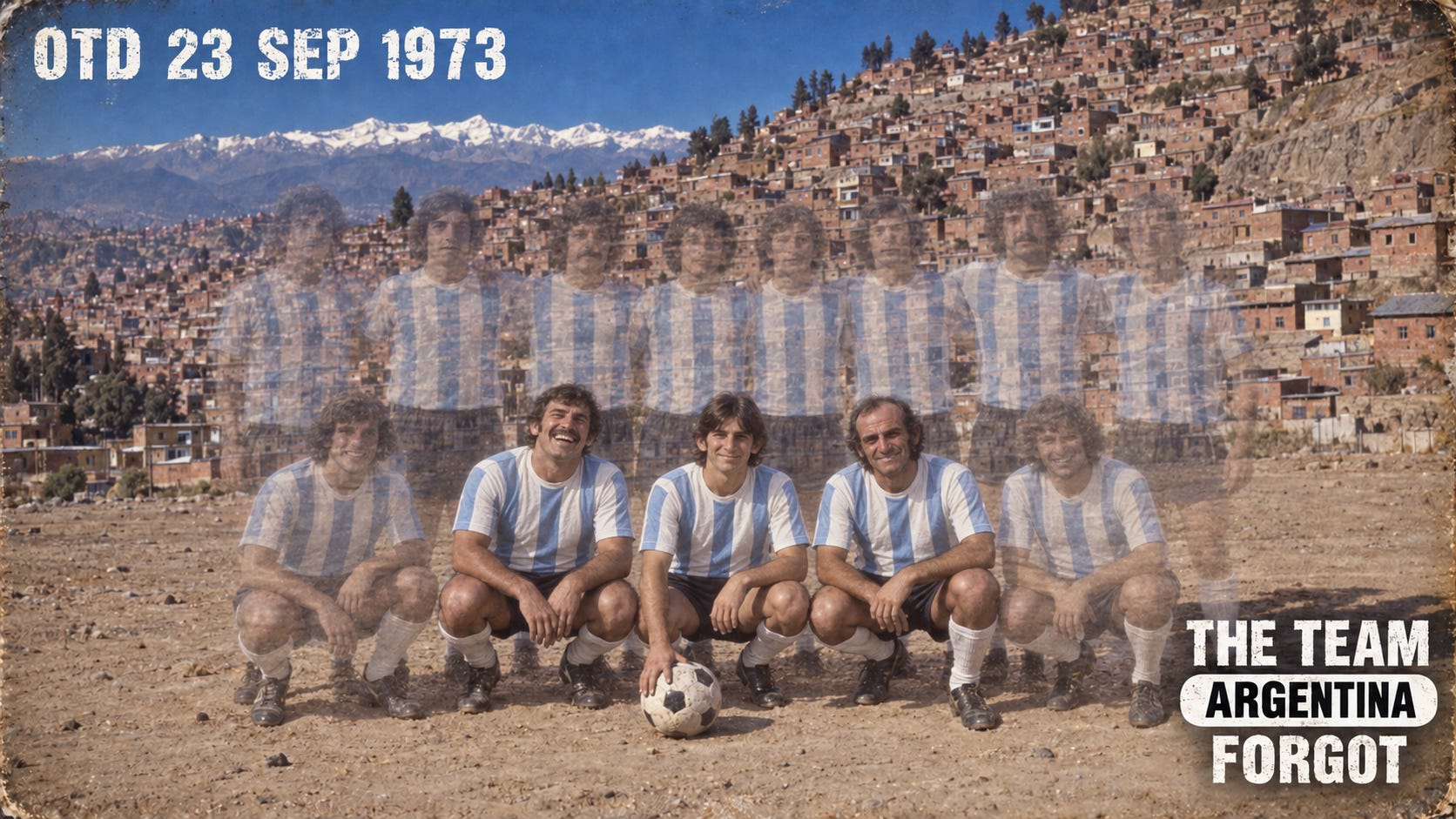
It is September 23, 1973, in La Paz, and Argentina take the field with a team assembled to solve one problem: how to play football more than three and a half kilometres above sea level. For weeks a special squad had lived and trained in the mountains. They had struggled for money, washed their own kit, and played friendlies to help pay their way. They had even posed for a photograph dressed as ghosts, hoping somebody would notice them. This was the Selección Fantasma, the Ghost Team. Argentina had remembered to prepare for the altitude. It had almost forgotten the players.
How did we get here?
Four years earlier, Argentina had failed to qualify for the 1970 World Cup, the final blow a draw with Peru at La Bombonera, though the damage had begun elsewhere, including a 3-1 defeat by Bolivia in La Paz. Now, for the 1974 tournament, they had drawn Bolivia again, alongside Paraguay: three teams, four matches each, only the group winner qualifying. There was very little room to repair a mistake. The coach was Omar Sívori, the former River Plate and Juventus star, working alongside Miguel Ignomiriello, an experienced developer of young players, and their solution was unusually ambitious. Rather than ask the regular squad to cope with La Paz after a brief visit, Argentina would prepare two teams at once. One would handle the other qualifiers. The second would spend weeks adapting to altitude, with the Bolivia away match as its special assignment.
At that elevation the thin air makes sustained effort far harder for visitors used to sea level, and even the ball behaves differently, meeting less resistance. This was not simply a question of courage; it was a physical problem that deserved real preparation, the same daunting setting where, a few years later, both Argentina and Brazil would lose in the Copa América. So on August 19, 1973, the special squad headed north to Jujuy and then based itself in Tilcara, roughly two and a half thousand metres up, with Ignomiriello in charge and a physical trainer to prepare the players. The names make extraordinary reading now: Mario Kempes, still a teenager; Ricardo Bochini; Marcelo Trobbiani; Rubén Galván; and the goalkeeper Ubaldo Fillol. Five future World Cup winners, scattered through a squad sent away to make one difficult afternoon manageable. But they were not yet the collection of legends we see in hindsight. They were young footballers trying to earn a place.
Almost immediately, the gap between the plan and its execution became painful. Accommodation was basic, travel uncomfortable, and promised supplies and money did not reliably arrive. Ignomiriello later recalled leaving the association a shopping list of sports clothing and food that never came. Rubén Glaría remembered the players washing their own kit because they had nothing else to wear. Two players, Reinaldo Merlo and Juan José López, left the expedition altogether, their memories emphasizing the isolation and the crushing effect on morale. The rest stayed, and the preparation became an itinerant tour through northern Argentina, Peru and Bolivia. The records give substance to what can sound like a tall story: a 5-2 win over a local selection in La Quiaca with Kempes scoring three, a 1-0 win at Melgar in Arequipa, a 4-3 win in Puno, a 3-1 win over San José in Oruro. These were practice matches, but they also helped meet the costs of the journey. Playing for your country had become, in a very practical sense, playing for your supper, and Kempes later remembered losing seven or eight kilograms along the way, his own recollection rather than any training target.
The nickname captured it exactly. They were Argentina, but out of sight, preparing for an important international while struggling to attract the attention of their own association. El Gráfico credited the journalist Carlos Ares with calling them the Selección Fantasma, and then the players made the metaphor visible, posing in ghost disguises for a Bolivian newspaper. It was funny, and it was also a protest: a national team dressing up as something invisible in order to be seen. Meanwhile the regular side beat Bolivia 4-0 in Buenos Aires and drew 1-1 in Paraguay. Then came La Paz, and one final disappointment. Sívori put four regular-squad players in the starting eleven, Daniel Carnevali, Ángel Bargas, Roberto Telch and Rubén Ayala, so seven starters came from the mountain expedition, with Bochini and Trobbiani to follow as substitutes. The Ghost Team was not discarded wholesale. Among those who did take the field was a teenage Mario Kempes, winning the first of his caps for Argentina; the ghost match was, though nobody knew it that afternoon, the quiet beginning of the career that would end with the 1978 World Cup Golden Boot. But for Fillol the decision was devastating: after enduring the whole preparation as goalkeeper, he watched Carnevali take the place he had worked toward for weeks. The sacrifice had been collective. The reward was not.
At the Hernando Siles stadium, Argentina finally faced Bolivia, and in the 18th minute Oscar Fornari scored with a diving header. One-nil. Now the assignment inverted: after weeks of preparing to survive the altitude, Argentina had to protect a lead for more than an hour. They did. Bolivia nil, Argentina one. Fornari was overcome afterward; his mother had died two months earlier, and he dedicated the goal to her, and to Fillol, the goalkeeper left out. Even in victory, somebody remembered the man on the bench. Back home, football was sharing the day with something much larger: Argentina was electing a president, and Juan Domingo Perón won, returning to the presidency for a third term. The footballers had come down from the mountains on a day when their country was looking elsewhere.
So what?
The first thing is that the victory mattered enormously, but it did not by itself qualify Argentina for the World Cup. That was completed two weeks later, with a 3-1 home win over Paraguay. La Paz made the final task safer; it did not remove it, and the qualification was not truly secure until Paraguay had been beaten in Buenos Aires. Nor should we turn Bolivia into an unbeatable opponent simply because the altitude was daunting, since Paraguay had already won there that same September and Bolivia lost all four of their qualifiers. Argentina’s preparation may have helped, but the result cannot tell us exactly how much.
The second and more revealing thing is the gap between winning a match and proving that everything around it was right. El Gráfico saw it at once. In its editorial after the win, the magazine praised the players while refusing to let the result erase the failures of leadership and logistics, warning that success could let everyone in the association congratulate themselves and leave the people who had actually endured the hardship unheard. This was not a criticism invented decades later in nostalgia; it was there at the time, and it remains the heart of the story. A good idea can be badly delivered. Dedicated people can rescue it. Their success does not make the neglect that preceded it necessary, or acceptable. It is one of the most seductive errors any organization makes: to read a good outcome backwards as proof that every decision leading to it was sound, when often it means the people at the sharp end simply overcame those decisions.
The third thing is that the road from that mountain did not run straight to glory, for the team or the men. Sívori was gone before the 1974 World Cup, and under Vladislao Cap, Argentina reached the second group stage only to be beaten 4-0 by the Netherlands. The Ghost Team had helped solve one qualifying problem; it had not solved Argentine football. And yet the individual afterlives are remarkable. Fillol, Kempes and Rubén Galván would belong to Argentina’s World Cup-winning squad in 1978, Bochini and Trobbiani to the winners of 1986. Fillol, overlooked in La Paz, would become the goalkeeper behind Argentina’s first world title, and Kempes would score twice in that final. For Fornari, the winning header stayed his defining international moment; for Fillol, the very same afternoon meant exclusion. One scoreline, very different memories. It is a useful reminder that a team result is never a single experience. The same ninety minutes can be the best day of one man’s career and the sharpest disappointment of another’s, and the record book, which stores only the score, keeps none of that.
Three things to take away
First, Argentina built a separate squad to prepare for Bolivia’s altitude, then failed to give that preparation the support it needed. The players trained for weeks in the mountains, short of money, supplies and even clean kit.
Second, the Ghost Team was real and its contribution substantial. Seven of them started the 1-0 win in La Paz and two more came off the bench, several went on to win World Cups, and it was on that neglected mountain assignment that a teenage Mario Kempes won his first Argentina cap.
Third, winning does not make every decision that preceded it a good one. Sometimes it just means the players overcame those decisions, and El Gráfico said exactly that at the time.
On this day in 1973, Argentina’s ghosts won in La Paz. They deserved to be remembered for the victory, without the neglect being forgotten.
---
📩 Got an idea to an OTD story? otd@17lawsguy.com
Yesterday: 22 September 2015, Robert Lewandowski scores five goals in under nine minutes.