

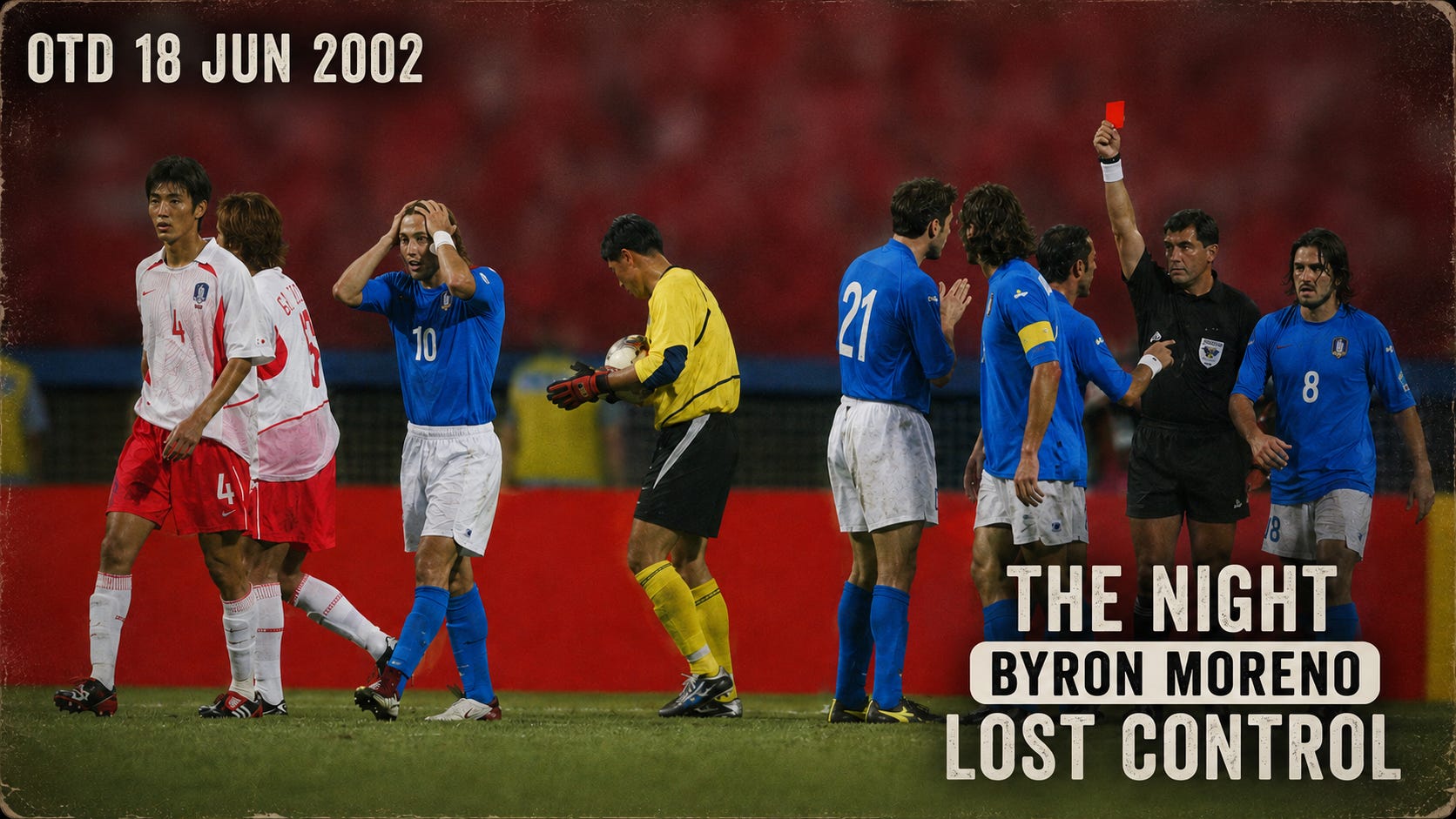
It is 18 June 2002, in Daejeon, South Korea. A World Cup round-of-16 match. South Korea against Italy. And once again, Italy are knocked out of a World Cup by a Korean side. In 1966 it was North Korea in Middlesbrough. In 2002 it is South Korea at home. South Korea 2, Italy 1, after extra time. A golden goal, a missed penalty redeemed, a nation in red delirium, and at the centre an Ecuadorian referee named Byron Moreno, whose decisions still make this one of the most uncomfortable matches in World Cup history.
How did we get here? For Italy, the Korean wound already existed. In 1966 they lost 1-0 to North Korea and were pelted with rotten tomatoes on their return. So when they faced South Korea in 2002, the past was in the stadium, where Korean fans held up a giant banner: Again 1966. But this Italy was powerful: three-time world champions, Euro 2000 finalists, with Buffon, Maldini, Cannavaro, Nesta, Pirlo, Totti, Del Piero, Vieri. Coached by Giovanni Trapattoni, they arrived as one of the teams nobody wanted to meet.
South Korea’s story was different. World Cup constants since 1986, but never past the group stage. Co-hosting in 2002 was a national showcase, and their coach was the Dutchman Guus Hiddink, blunt, unsentimental, initially unloved, criticized for heavy defeats and hard methods. But he was building exactly what Korea needed: stamina, pressing, belief, and a squad unafraid to look European opponents in the eye, with names soon to be famous, Hong Myung-bo, Lee Young-pyo, Park Ji-sung, Ahn Jung-hwan. As co-hosts they qualified automatically; their burden was to justify the stage. They did, beating Poland (their first ever World Cup win), drawing with the USA, and beating Portugal to top their group. Italy, meanwhile, stuttered through, advancing as runners-up.
And now Daejeon, with Byron Moreno refereeing. In 2002 he was not yet the symbol he would become, just a FIFA-listed referee at the biggest match of his career. And almost immediately he was inside the story. In the fifth minute Korea were awarded a penalty; Ahn Jung-hwan stepped up, and Buffon saved. Then, in the 18th minute, Italy led, Vieri heading in Totti’s corner. For a long stretch the old Italian script looked like holding: absorb, defend, wait. But Italy’s back line was patched together, Nesta injured and Cannavaro suspended, and the match got ugly, very physical and badly managed. Then, in the 88th minute, a cross caused confusion, Panucci could not clear, and Seol Ki-hyeon equalized. Golden-goal extra time.
And then the controversy turned white hot. In the 103rd minute Totti went into the Korean box, went down under a challenge, and Moreno showed him a second yellow for simulation. Italy were down to ten. Was it a dive? There was contact, and there was also a theatrical fall, but in a knockout match, in a pre-VAR world, from Moreno’s angle, that call became enormous. Then Damiano Tommasi appeared to finish what would have been Italy’s golden goal, and the flag went up for offside, a call that remains highly disputed, with no VAR to check it. Then, in the 117th minute, Lee Young-pyo crossed, and Ahn Jung-hwan rose above Maldini to head the golden goal. South Korea 2, Italy 1. The man who missed the penalty scored the winner. The co-hosts were in the quarter-finals. Italy were out.
In South Korea it was bedlam, millions in the streets, the country experiencing football as national revelation. They beat Spain on penalties next, in another match wrapped in controversy, then lost to Germany in the semi-final, finishing fourth, still the best ever finish by an Asian team. Hiddink became a national hero, Park Ji-sung went on to Manchester United, and a generation grew up with 2002 as proof that Korea could frighten giants. Ahn became immortal at home, but in Italy his club, Perugia, declared it would not keep a player who had eliminated Italy. The goal made him a national hero and professionally radioactive in the same night.
Italy were genuinely wronged by some decisions. Totti’s red card was, at minimum, extremely harsh. The Tommasi offside is highly disputed. Moreno lost control of the match’s temperature. And Moreno’s own later life makes it darker still: months later he was suspended in Ecuador after a match with extraordinary stoppage time and two very late home goals, and in 2010 he was arrested in New York with heroin hidden in his clothing, later serving prison time. That is the uncomfortable truth about Moreno. Not that it was proven he fixed the match against Italy, but that his record makes the suspicion impossible to fully dismiss.
And yet, the other truth has to stand beside it: South Korea were a genuinely excellent, relentless, superbly conditioned side who had already beaten Portugal and would push on to fourth place. Being wronged on some calls and being beaten by a better-prepared team on the night are not mutually exclusive. Italy can be victims of poor officiating and not the rightful winners. Two things can be true at the same time, and the refusal to hold both is what turns a complicated match into a simple grievance.
That is why 18 June 2002 matters. It is a story about controversy, but also about a host nation’s greatest night, and about how hard it is to hold a fair memory of a match that genuinely contained both injustice and a deserving winner.
🎙️ THE PODCAST GOES DEEPER. The full episode has more on Italy’s Korea wounds, Hiddink’s methods, Korea’s group-stage run, the physical match in detail, the Totti and Tommasi decisions, Ahn’s club fallout, Korea’s run to fourth, and Moreno’s later disgrace. That is the 10-minute version.
---
🎧 Listen on Spotify, Apple Podcasts, Amazon Music, Overcast, iHeart, and YouTube.
📩 Got an episode idea? otd@17lawsguy.com
Yesterday: 17 June 1970, Italy, Germany, and the Game of the Century.
Tomorrow: 19 June 1960, Peñarol and the first Libertadores crown.