

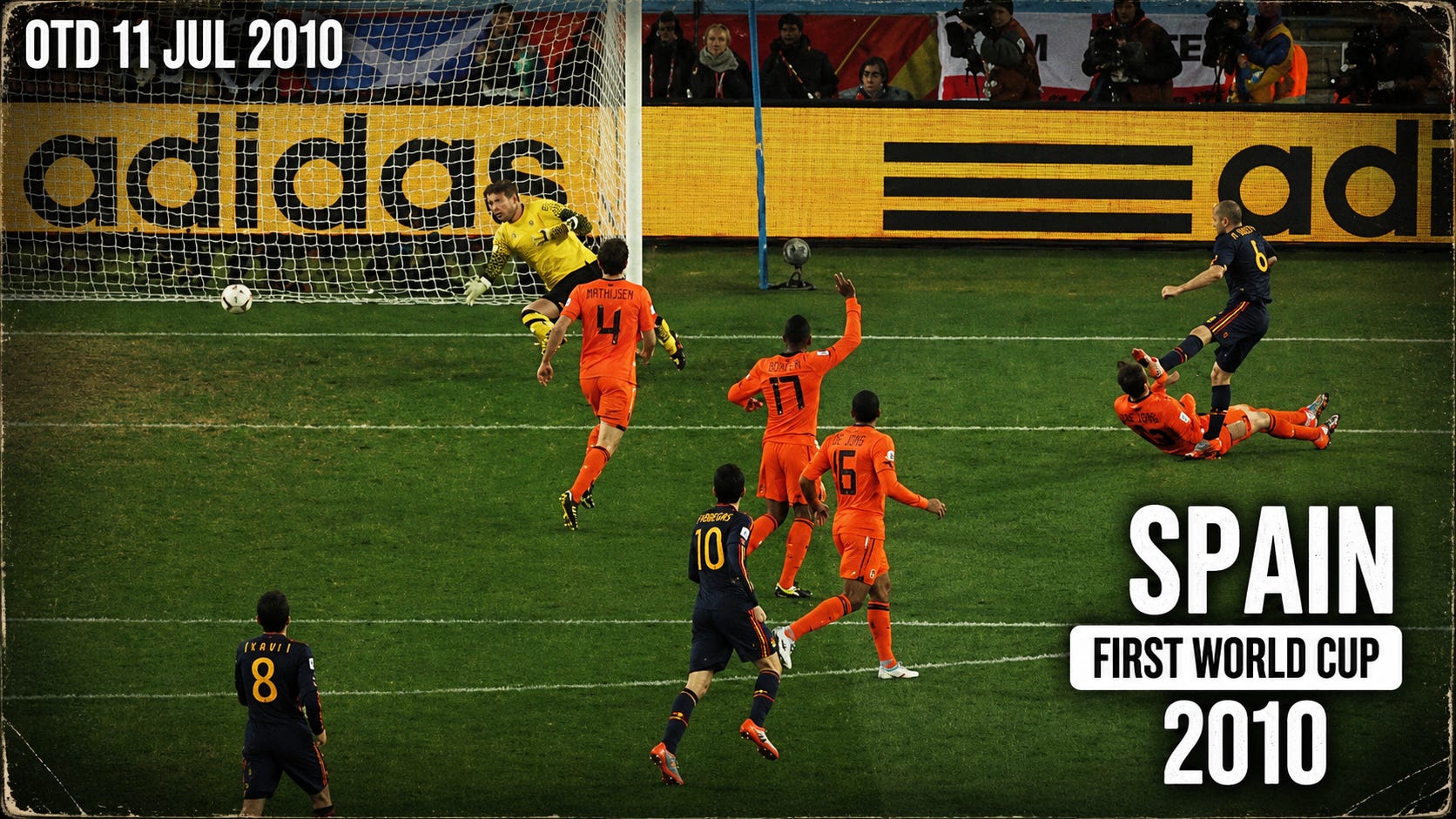
It is 11 July 2010, at Soccer City in Johannesburg. The Netherlands against Spain, the World Cup final. Two teams arrived with opposite burdens. The Dutch had lost the finals of 1974 and 1978, the most beautiful team of its age left with orange shirts and no trophy. Spain were the eternal underachievers, blessed with club talent for decades but carrying a single 1964 European title and a long history of quarterfinal exits and penalty heartbreak. One of these stories was going to change.
Spain had already built the answer. Out of Barcelona and their Euro 2008 triumph came tiki-taka, a way of playing that treated possession itself as a weapon: Xavi, Iniesta, and Busquets keeping the ball, passing and moving until the opponent’s shape finally cracked. By 2010 it had become a system almost nobody could solve. It was not always thrilling to watch, and Spain won four of their knockout matches 1-0, but it was ruthlessly effective, and it was theirs.
The final itself was not beautiful. The Netherlands, unable to match Spain on the ball, chose instead to try to kick them off the pitch, and the most infamous image is Nigel de Jong planting his studs into Xabi Alonso’s chest and somehow escaping with only a yellow card. The English referee lost control of the temperature, fourteen cards were shown, and for long stretches the football drowned in fouls. Spain kept the ball and kept probing, waiting for the one opening a match like this eventually gives.
It came four minutes from the end of extra time, with penalties looming. A move worked its way to the edge of the Dutch box, the ball dropped to Andres Iniesta, and he volleyed it low past the goalkeeper. One-nil. Spain were world champions for the first time in their history, and Iniesta had scored the most important goal his country had ever known.
For Spain, it was the middle jewel of a dynasty without real precedent: European champions in 2008, world champions in 2010, European champions again in 2012, three major titles in a row, a run of dominance no national team had strung together in that way. The underachiever label was gone for good, replaced by a template that shaped how a generation was coached everywhere.
For the Netherlands, it was another orange almost. A third World Cup final, a third defeat, and still no World Cup to show for one of the richest football cultures on earth. Enormous influence, a smaller trophy cabinet: the Dutch paradox, playing out one more time on the sport’s biggest stage. Spain found the one opening the night allowed, and Iniesta took it.
🎙️ THE PODCAST GOES DEEPER. The full episode has Spain’s rise through Euro 2008, the ugly final and its flashpoints, and how the 2008-to-2012 dynasty was built. That’s the 10-minute version.
---
🎧 Listen on Spotify, Apple Podcasts, Amazon Music, Overcast, iHeart, and YouTube.
📩 Got an episode idea? otd@17lawsguy.com
Yesterday: 10 July, Ronaldo and Messi’s first trophy days.