

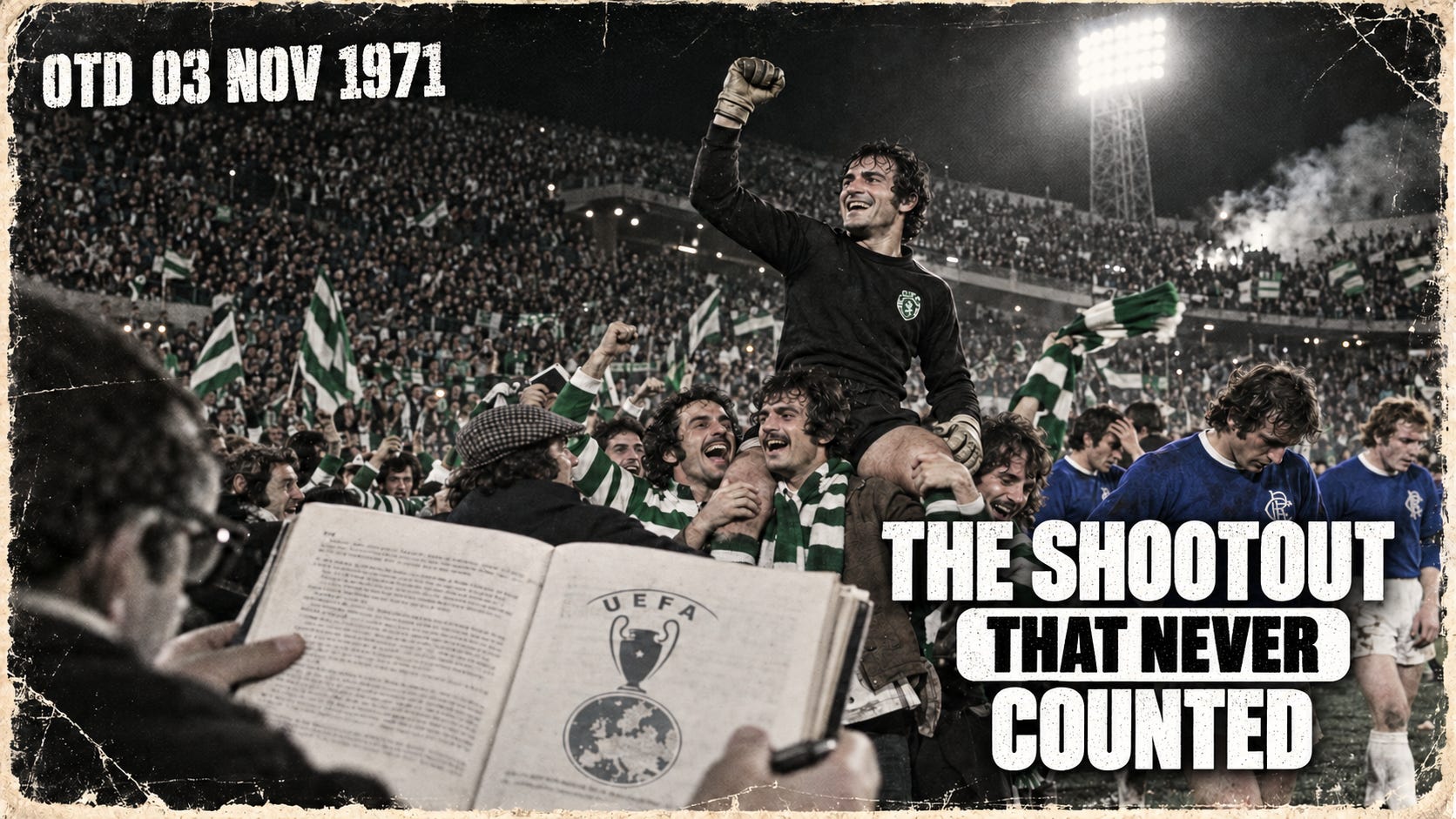
It is 03 November 1971 at the Estádio José Alvalade in Lisbon. The penalty shootout is over, or at least everybody thinks it is.
Vítor Damas has stopped every Rangers attempt that reached him. One kick has been saved, ordered retaken and saved again. Another has gone wide. Sporting’s goalkeeper is lifted onto the shoulders of supporters who have spilled toward the pitch. The stadium believes Sporting have completed a magnificent European comeback.
In the Rangers dressing room, the players sit with their heads down. They have lost 4-3 after extra time, 6-6 on aggregate, and now they have lost the shootout too.
Then Scottish journalist John Fairgrieve enters carrying a UEFA handbook.
The penalties should never have taken place. Rangers scored three times in Lisbon; Sporting scored only twice in Glasgow. Under the away-goals rule, Rangers had already qualified before the first spot kick was taken.
Sporting have won the shootout. Rangers have won the tie. For several extraordinary minutes, European football has two different winners.
How did we get here?
The European Cup Winners’ Cup was only in its twelfth season, but it already possessed a distinct character. The European Cup belonged to league champions. The Fairs Cup, soon to become the UEFA Cup, gathered clubs through league position or trade-fair origins. The Cup Winners’ Cup brought together domestic cup holders, which meant glamour, unpredictability and clubs whose qualifications sometimes depended on somebody else winning twice.
That was how Rangers entered in 1971. Celtic beat them in the Scottish Cup final replay, but Celtic had also won the league and therefore went into the European Cup. Scotland’s Cup Winners’ Cup place passed to the defeated finalists.
That administrative route added another peculiarity to a competition built on them. Cup football did not necessarily send the strongest side in a country, only the one that had survived a particular knockout path. A domestic champion could create a vacancy; a defeated finalist could inherit Europe; a club enduring a poor league season could suddenly look formidable over two legs. The Cup Winners’ Cup rewarded specialists in recovery, nerve and tactical adjustment. Rangers were about to become exactly that kind of team.
Rangers hardly arrived as fortunate novices. In 1961 they had become the first British club to reach a major European final, losing the inaugural Cup Winners’ Cup final to Fiorentina over two legs. In 1967 they reached it again, only for Franz Roth to score Bayern Munich’s extra-time winner in Nuremberg. That defeat came days after Celtic became the first British European champions. The comparison followed Rangers home.
By 1971, the club carried something heavier. On 02 January, after an Old Firm match at Ibrox, a crush on Stairway 13 killed 66 people and injured more than 140. The familiar story that departing supporters turned back after Colin Stein’s late equalizer has not survived later examination. The disaster was a structural failure in a dangerously congested exit. Manager Willie Waddell’s role extended far beyond football as the club supported bereaved families and began confronting the need to rebuild Ibrox.
The 1971-72 side was therefore chasing a trophy inside a season of grief, institutional change and poor domestic form. Rangers had lost four of their first five league matches. Their League Cup defence ended early. Europe became the place where Waddell’s disciplined, adaptable side made sense.
Rennes were beaten 2-1 on aggregate in the first round. Sporting were a different proposition. The Lisbon club had won this competition in 1964, its only European trophy, when João Morais scored directly from a corner in a replay against MTK Budapest. Sporting entered the 1971-72 tournament as Portuguese Cup holders after beating Benfica 4-1 in the final. Their side included Damas, soon to become one of Portugal’s defining goalkeepers, and Argentine striker Héctor Yazalde, who would win the European Golden Shoe in 1974 after scoring 46 league goals.
The first leg at Ibrox on 20 October appeared to settle the argument quickly. Stein scored twice and Willie Henderson added another as Rangers went 3-0 ahead in the first half. Each goal grew from a prepared free-kick routine. Sporting then changed the shape of the tie. Chico Faria pulled one back after the interval, and a second arrived near the end. Rangers won 3-2, but what had looked like a procession became a one-goal advantage carrying two dangerous away goals.
Those two replies mattered tactically as well as arithmetically. Sporting no longer needed to chase a three-goal miracle in Lisbon. A 1-0 or 2-1 victory would be enough under away goals. Rangers had dominated most of the evening, yet finished it knowing that every Sporting goal in Glasgow had altered the return leg. The new rule was doing precisely what UEFA intended: keeping an apparently settled tie alive and rewarding the visitors for attacking.
Even the trip to Portugal fought them. A baggage-handlers’ strike at Heathrow and fog stretched the journey to a day and a half. Rangers reached Lisbon roughly 24 hours before kick-off. Around 60,000 people packed Alvalade with drums, fireworks and relentless noise.
The rules travelling with them were in transition too.
For decades, European ties level after two legs could require a play-off or, if time and calendars ran out, the toss of a coin. UEFA introduced away goals during the 1965-66 Cup Winners’ Cup, partly to reduce play-offs and encourage visiting clubs to attack. The rule was simple in principle: if aggregate scores were level, the club with more goals at its opponent’s ground advanced.
Its application after extra time was less intuitive. When the second leg received an additional 30 minutes, only one club had the chance to score an away goal during them. In Lisbon, Rangers would receive that opportunity; Sporting had not received extra time at Ibrox. UEFA still counted those goals.
Penalty shootouts were even newer. UEFA adopted them for the 1970-71 season as a replacement for coin tosses. The first in the Cup Winners’ Cup came on 30 September 1970, when Honvéd eliminated Aberdeen. The European Cup’s first followed five weeks later, Everton defeating Borussia Mönchengladbach. By November 1971, the shootout felt dramatic precisely because it was not yet routine.
So Laurens van Ravens was working where two new pieces of tournament machinery met. He was no novice. The Dutch referee had handled the 1969 Cup Winners’ Cup final, two matches at the 1970 World Cup and major domestic finals. He was also a beer-company salesman, officiating at elite level in an era when even the leading referees built careers around ordinary employment.
Sporting took the lead after roughly 25 minutes. Yazalde followed up after Peter McCloy could not hold Fernando Peres’s fierce free kick. Within a minute, Stein equalized. Before half-time, Tomé restored Sporting’s advantage. One minute after the restart, Stein scored again.
At 2-2 on the night, Rangers led 5-4 on aggregate. Then the evening’s human cost arrived. Yazalde’s challenge broke Ronnie McKinnon’s leg. The Scotland defender never played for Rangers again.
Sporting kept attacking. Pedro Gomes finally made it 3-2 late in normal time. The two legs were now mirror images, each won 3-2 by the home club. Aggregate score: 5-5. Away goals after 180 minutes: 2-2. Extra time was correct.
Henderson changed the equation in the 100th minute. His shot took a deflection from João Laranjeira and beat Damas. The match was 3-3, Rangers led 6-5 on aggregate, and more importantly they now possessed a third away goal.
With around five minutes remaining, Sporting received a penalty for handball. Peres scored. Sporting led 4-3 on the night. The aggregate score was 6-6.
Van Ravens blew for the end of extra time and ordered a shootout.
Rangers protested immediately. The arithmetic was not complicated once the relevant rule was applied: Sporting had scored twice at Ibrox; Rangers had scored three times at Alvalade. Rangers were through. Even UEFA delegate Andrés Ramírez reportedly tried to stop the procedure. Van Ravens persisted.
The psychological situation was absurd. Sporting had just found what appeared to be a last-minute lifeline. Rangers believed they had already qualified and were being asked to gamble that qualification again. Damas saved kick after kick, including a retaken attempt. Rangers failed to convert. Sporting scored theirs. Supporters invaded the edge of the field and carried Damas away as a hero.
Some newspapers had no time to wait for the administrative ending. Early editions reported Rangers eliminated “on penalty goals.” Inside Alvalade, celebrations had begun. Sporting’s players had followed the referee’s instructions and won the contest placed in front of them.
In the Rangers dressing room, Fairgrieve supplied the missing authority in print. Waddell took the handbook to the officials. The relevant regulation was identified. Van Ravens accepted that he had been wrong, and the kicks were declared irrelevant. The referee later described the criticism from UEFA and the press, and admitted that he cried in his hotel room that night.
Only around 1:30 in the morning did Sporting receive the final verdict. The 4-3 victory would stand as the match result. Rangers would advance on away goals.
That distinction produced the strangest possible record. Sporting could truthfully say they had beaten Rangers and won the penalties conducted afterward. Rangers could truthfully say they had eliminated Sporting before those penalties began. Damas’s saves remained things that thousands had seen, but not events the tournament could count. The night had created sporting facts without creating a sporting result.
So what?
The correction preserved the difference between a referee’s judgment and a referee using the wrong procedure. A foul can be debatable. A ball crossing a line can be missed. Those decisions normally belong to the match and remain final, however poor they appear afterward. Van Ravens’s mistake was different: he had ordered a tiebreaker that the competition regulations did not permit.
That is also why Fairgrieve’s role matters. He did not overrule the referee, and Rangers did not win through influence in a committee room. The journalist supplied the document that allowed officials to identify which rule governed an already completed tie. In an age before regulations could be searched on a phone, a printed handbook in the right hands became a form of match technology.
Football has occasionally drawn that distinction again. In a 2005 World Cup qualifier, Uzbekistan scored a penalty against Bahrain, but the referee penalized encroachment by awarding Bahrain an indirect free kick rather than ordering a retake. FIFA classified it as a technical error in applying the Laws and annulled the 1-0 result. The match was replayed. Uzbekistan eventually went out on away goals, an especially cruel echo of Lisbon.
The correction in 1971 did not require a replay because the lawful outcome already existed. Six hours of football across Glasgow and Lisbon had produced 6-6. The away-goals count produced 3-2 to Rangers. The shootout was not overturned so much as erased.
That erasure changed a club’s history.
Rangers met Torino in the quarter-finals. A 1-1 draw in Italy and Alex MacDonald’s goal at Ibrox carried them through. Bayern Munich waited in the semi-finals, stronger than the side that had beaten Rangers in the 1967 final and approaching the run of domestic, European and international triumphs that would define the decade. Rangers survived a 1-1 draw in Munich and won 2-0 at Ibrox.
The final against Dynamo Moscow took place at Camp Nou on 24 May 1972. Stein scored, Willie Johnston added two, and Rangers led 3-0 before Dynamo recovered to 3-2. Supporters entered the field before the final whistle and again afterward. Captain John Greig eventually received the trophy away from the pitch, inside the stadium. Crowd disorder brought Rangers a two-year European ban, reduced on appeal to one.
The Barcelona Bears had nevertheless secured Rangers’ first major European trophy. It remains the club’s only one recognised by UEFA. For Waddell and players who had lost the 1967 final, it was redemption. For a club still living with the Ibrox disaster, celebration and grief could not be cleanly separated.
Sporting’s defeat was no moral failure. Damas had done everything asked of him and more. The club later won a domestic league and cup double in 1974, powered by Yazalde’s extraordinary scoring season. Damas became a symbol of Sporting and Portugal. Yet Sporting have never won another major UEFA trophy. The goalkeeper’s greatest European shootout performance was deleted from the competition before he had left the stadium.
The rule that saved Rangers also developed a long argument around fairness. Counting an extra-time goal as an away goal gave the visiting club 30 additional minutes in which to earn that advantage. The home club, in return, enjoyed the extra period on its own ground. Whether those benefits balanced each other was never resolved to everyone’s satisfaction.
UEFA abolished away goals from the 2021-22 season after 56 years. Tied aggregates now go to extra time and, if still level, penalties. Apply today’s regulations to the exact scores from Glasgow and Lisbon and Van Ravens’s instinct becomes correct: at 6-6 after extra time, Sporting and Rangers really would contest a shootout.
That is the final irony. The referee was wrong according to a rule that no longer exists, and ordered the ending that football would now require. But rules cannot be applied across eras. On 03 November 1971, Rangers had three away goals, Sporting had two, and a journalist’s handbook mattered more than anything that happened from the penalty spot.
Three things to take away
The shootout was never part of the lawful result. Rangers advanced because Henderson’s extra-time goal was their third in Lisbon. Sporting had scored only twice at Ibrox, so 6-6 on aggregate became a Rangers victory on away goals.
The error occurred where two young rules collided. Away goals had been used in the Cup Winners’ Cup since 1965-66, while UEFA shootouts arrived only in 1970-71. Van Ravens wrongly moved from the first tiebreaker to the second.
The correction created the road to Barcelona. Rangers went on to eliminate Torino and Bayern Munich before beating Dynamo Moscow. The club’s only UEFA trophy survived because the regulation was found before everybody left Alvalade.
On This Day...
On 03 November 1971, Vítor Damas left the field on supporters’ shoulders, John Fairgrieve entered a dressing room with a handbook, and Willie Waddell went looking for UEFA. Sporting won a shootout that vanished. Rangers lost it and continued all the way to the trophy.
---
(This story was first published as a podcast episode on 03 Nov 2025.)
Questions, corrections or story ideas: otd@17lawsguy.com
Yesterday: 02 November 2013, Thirteen Seconds, One Bounce, and a Goalkeeper’s Nightmare.