

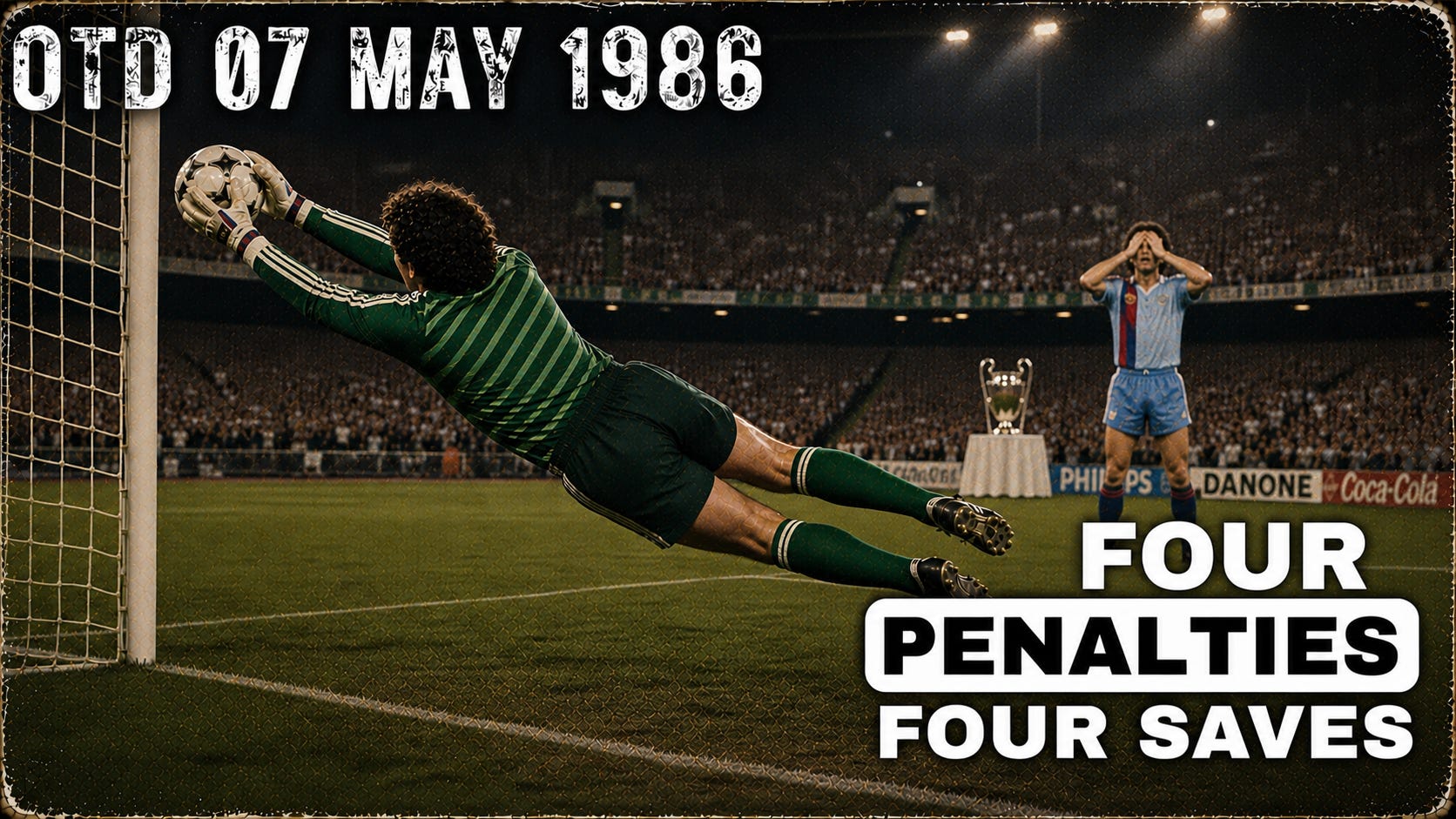
It is 7 May 1986. Seville. European Cup final. Barcelona against Steaua București.
For Barcelona, this is supposed to be the night. The final is in Spain. The crowd is overwhelmingly Catalan. English clubs are absent after Heysel. Juventus are gone. The path to the club’s first European Cup looks open.
But Steaua have not come to Seville to play Barcelona’s story.
They have come to suffocate it.
For 120 minutes, the Romanian champions reduce the final to frustration: no goals, few clear chances, and a stadium growing more irritated by the minute. Then comes the penalty shootout — and Helmuth Duckadam turns himself into one of the most unlikely immortals in European football.
Barcelona take four penalties. Duckadam saves all four.
Steaua win 2-0 in the shootout. And for the first time, the European Cup crosses the Iron Curtain.
The shadow over the whole season was Heysel. The 1985 European Cup final between Juventus and Liverpool had ended in catastrophe before it had properly begun. Thirty-nine people died. Juventus won the trophy, but English football was removed from Europe.
That changed the tournament immediately. From 1977 to 1985, English clubs had reached eight of nine European Cup finals and won seven. Liverpool, Nottingham Forest, Aston Villa, then Liverpool again. The European Cup had almost become an English property deed.
Now no English club was there. Italy, surely, would fill the vacuum. Juventus were holders. But Verona were drawn against Juventus and went out. Then Juventus met Barcelona in the quarter-finals and went out too. Bayern Munich? Lost to Anderlecht.
The old order had opened. And through that opening came Steaua.
Only once before had a club from the east of Europe reached the European Cup final: Partizan Belgrade in 1966, when they led Real Madrid in Brussels before losing 2-1. But Steaua were different. They were Romania’s army club, from inside Ceaușescu’s communist sporting system, part of that world of so-called “state amateurs”: players officially framed through the state, but trained, protected and organized like elite professionals.
Their road to Seville was not soft. Vejle, Honvéd, Kuusysi Lahti, Anderlecht — every round, Steaua had to solve for something.
Barcelona’s road was dramatic too. Sparta Prague, survived on away goals. Porto, survived on away goals. Juventus, beaten 2-1 on aggregate. Then IFK Göteborg. Barça lost the first leg in Sweden 3-0. At the Camp Nou, Pichi Alonso scored a hat-trick, the tie went to penalties, Carrasco missed, Urruti saved from Roland Nilsson — and then Urruti himself scored. Barcelona were going to Seville.
That is why the final felt like destiny.
But Steaua’s manager Emeric Jenei had no interest in Barcelona’s destiny. His side sat deep, compressed the space, closed the midfield, and turned Barça’s ambition into repetition. Miodrag Belodedici read danger calmly. László Bölöni worked. Lăcătuș ran. Pițurcă battled. Duckadam waited.
Barcelona wanted style. Steaua gave them geometry.
Venables tried to change it. With five minutes of normal time left, he substituted Bernd Schuster. That became the emotional rupture. Schuster did not sit down with the rest of the bench. He walked away and reportedly left the stadium. In extra time, Steve Archibald was taken off too. Barcelona’s two biggest foreign names were no longer on the pitch when the final reached penalties.
And that left the night to Duckadam.
Steaua’s Mihail Majearu first. Urruti saves. Barcelona can lead. Alexanko shoots. Duckadam saves. Still 0-0.
Bölöni next. Urruti saves again. Barcelona can lead again. Pedraza shoots. Duckadam saves again.
Four penalties taken. Four saves. No goals.
Then Marius Lăcătuș finally breaks the spell. 1-0. Pichi Alonso, the semi-final hero against Göteborg, has to answer. Duckadam saves. Gavril Balint makes it 2-0. Marcos Alonso must score to keep Barcelona alive. Duckadam saves again.
Four Barcelona penalties. Four Duckadam saves. There are penalty shootouts that decide matches. And then there are penalty shootouts that create a name that never leaves history.
Steaua were champions of Europe. Barcelona, in front of what was supposed to be their crowd, had lost the most winnable European Cup final of their lives.
It was the high point of Eastern bloc club football. Five days earlier, Dynamo Kyiv had beaten Atlético Madrid 3-0 in the Cup Winners’ Cup final. Then Steaua won the European Cup. When the Super Cup was eventually played, Steaua beat Dynamo 1-0 in Monaco through Gheorghe Hagi.
Europe’s first trophy and second trophy were in eastern hands. Then the Super Cup too. This was peak state football: army clubs, police clubs, ministry clubs operating inside systems that could keep players, centralize training, and build sides that Western clubs could not simply buy apart.
It never happened quite like this again.
Then Ceaușescu fell. And with him fell the political world that had made Steaua’s structure possible. The club survived, but the identity later fractured into one of Europe’s strangest legacy disputes: Steaua, CSA Steaua, FCSB, court rulings, crests, records, symbols. Today, the 1986 triumph is not only a football memory. It is an ownership-of-history argument.
And then there is Duckadam. The Hero of Seville should have had the world open in front of him. Instead, his career almost ended immediately after its greatest night. A fall during a barbecue at a friend’s led to a rare blood condition in his arm and surgery that kept him from playing again at the same level. He became Romanian Footballer of the Year in 1986, but the match that made him immortal was effectively the summit he never had the chance to climb beyond.
That makes the legend even stranger. Some players build greatness over fifteen years. Duckadam built his in four dives. When he passed in December 2024 at age 65, the obituaries did not need much explanation. Four penalties. Four saves. Barcelona. Seville. That was enough.
For Barcelona, the meaning was trauma. Venables had won La Liga in 1984-85, the club’s first league title for eleven years. Seville became the wound. He was gone early in the 1987-88 season. Schuster’s relationship with the club never recovered either. He eventually crossed to Real Madrid, which tells you how poisonous things had become.
Two years later, Johan Cruyff returned as manager. Then came the Dream Team. Then came Wembley in 1992.
That is the cruel Barcelona symmetry. In 1986, a goalkeeper humiliates them in Seville and they still have no European Cup. In 1992, Ronald Koeman scores at Wembley and they finally have one.
The bridge between those moments is pain.
---
🎧 Also available on Apple Podcasts, Amazon Music, Overcast, iHeart, and YouTube.
📩 Got an episode idea? otd@17lawsguy.com
Yesterday: 6 May 1970 — Feyenoord Launch the Dutch Decade.