

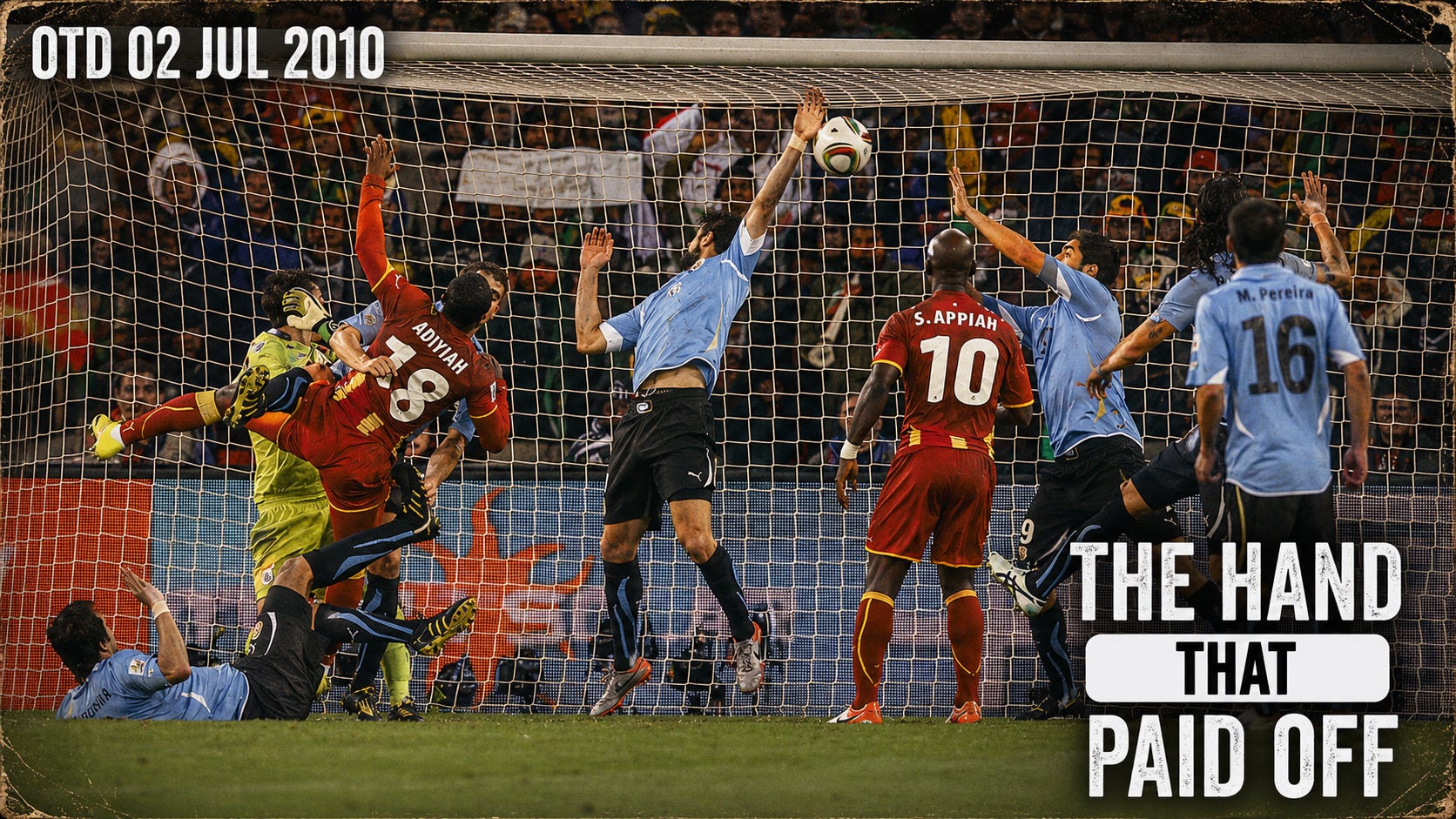
It is 2 July 2010, at Soccer City in Johannesburg. Uruguay against Ghana, a World Cup quarterfinal, one-one, deep into the final seconds of extra time. Ghana are one header from becoming the first African team ever to reach a World Cup semi-final, on African soil. Dominic Adiyiah’s header is going in. And Luis Suárez, standing on the line, raises both hands and stops it. A red card, a penalty to Ghana, and one of the most argued-over moments in the sport’s history.
To feel the weight, you have to know who was carrying it. This was the first World Cup held in Africa, and by the quarter-finals Ghana were the last African side standing, the whole continent’s hope pressed onto a young, brave team. They had come further than Cameroon in 1990 or Senegal in 2002. Across from them stood Uruguay, one of football’s founding powers, garra charrúa and all, back in the last eight for the first time since 1970, with Forlán and Suárez leading a genuine revival.
The match had swung both ways. Muntari’s long strike just before half-time, Forlán’s swerving free-kick to level, both teams tiring, both missing chances, the tension almost unbearable as it stretched into the last moments of extra time. Then the goalmouth scramble, the shot cleared off the line, and Adiyiah’s header arcing in behind everyone but Suárez.
Here the Law was not ambiguous. Deliberately handling to deny a goal is a sending-off, and a penalty to the other side. The referee got it exactly right: Suárez off, Ghana awarded the kick. But there is a gap the Law cannot close. It can punish the offence, yet it cannot award the goal that was prevented. A near-certain goal was converted into a penalty, and a penalty can be missed. Asamoah Gyan struck it against the crossbar. Suárez, walking off, saw it and celebrated. Then Uruguay won the shootout, and went to the semi-final.
This is what makes the moment sit so strangely in the memory. It is not the Hand of God, and not Thierry Henry against Ireland the year before. Those handballs were missed by the officials, and the teams benefited from an error. Suárez’s was seen, and punished to the full extent the Law allowed. The discomfort is not that justice failed. It is that justice was done, in full, and still did not restore what Ghana had lost. The cynical act was illegal, punished, morally ugly, and, in that one desperate second, entirely rational.
Football has never fully resolved it. There is no penalty-goal in the sport the way rugby has a penalty try, because the game stays cautious about awarding certainty that a referee cannot truly guarantee. So the remedy remains the red card and the spot-kick, which in most minutes of most matches is a heavy punishment, and in the last seconds of a tied quarterfinal becomes a gamble worth taking.
Gyan’s own courage is the detail that lingers. Seconds after the miss that will follow him for years, he took Ghana’s first kick in the shootout, and scored it. He has said since that he does not hate Suárez, and that he might have done the same for his own country. That may be the truest thing anyone said about it.
🎙️ THE PODCAST GOES DEEPER. The full episode has more about Uruguay’s founding history and 2010 revival, Ghana’s rise and the weight of a home-continent World Cup, the match goal by goal, the wording of Law 12 on deliberate handball, the shootout and Abreu’s Panenka, the comparisons with Maradona and Henry, and the argument over whether football should award a goal in these cases. That is the 10-minute version.
---
🎧 Listen on Spotify, Apple Podcasts, Amazon Music, Overcast, iHeart, and YouTube.
📩 Got an episode idea? otd@17lawsguy.com
Yesterday: 1 July 1990, Cameroon’s impossible run ends.
Tomorrow: 3 July 2018, England finally win a shootout.