

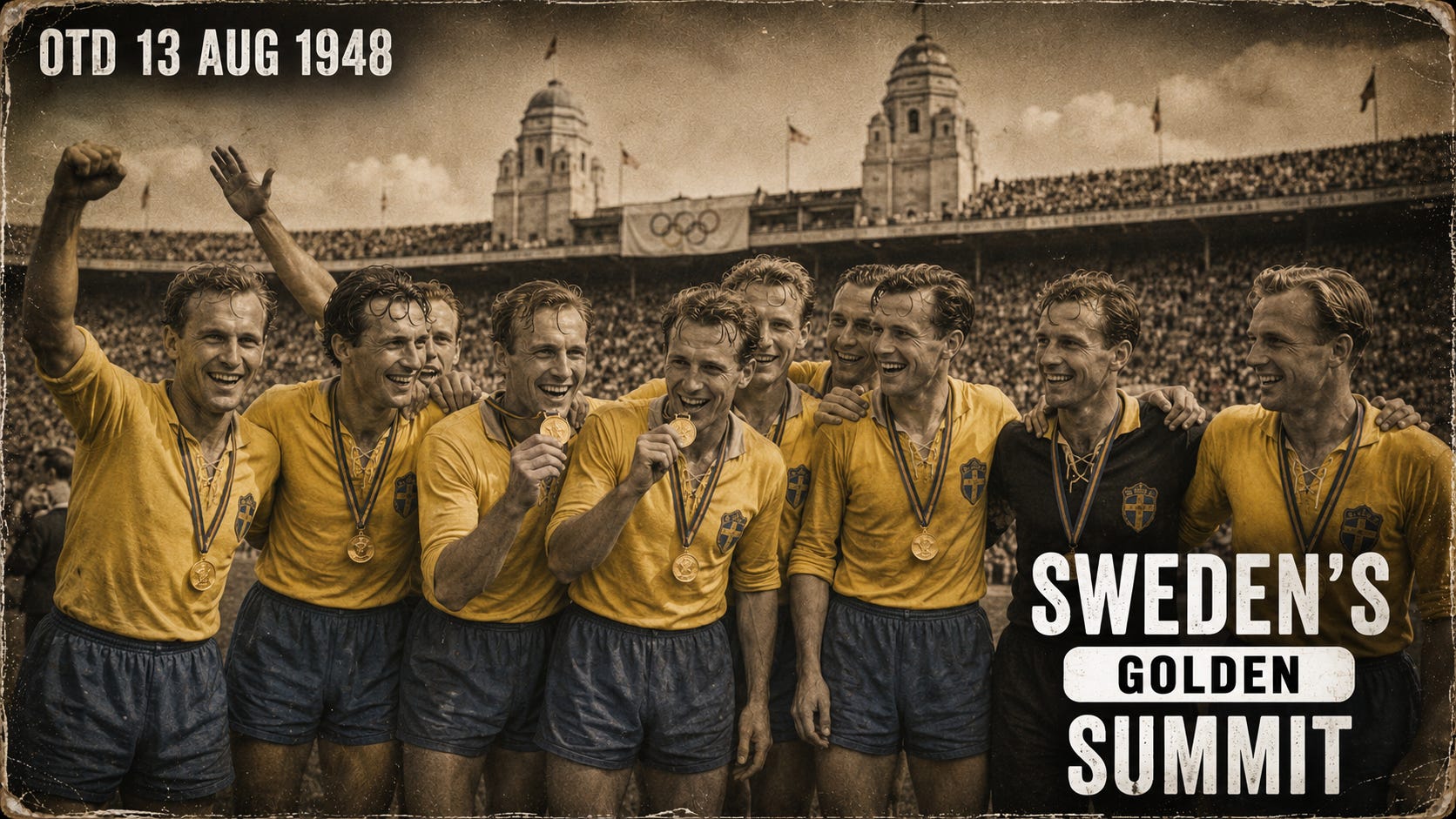
It is August 13, 1948. Wembley. The Olympic football final. Sweden against Yugoslavia. In the twenty-fourth minute Gunnar Gren scores. Just before half-time Stjepan Bobek equalizes. Then, early in the second half, Gunnar Nordahl scores, and in the sixty-seventh minute Gren scores again from the penalty spot. Sweden 3, Yugoslavia 1. Olympic gold. Sweden has its greatest men’s football title, and ten years before hosting the World Cup final, Swedish football is at its peak.
Start with Sweden’s football geography. The Swedish FA was founded in 1904, Sweden was one of FIFA’s founding members, and the national team played its first international in 1908. The neighbors mattered immediately, especially Denmark: Scandinavian football is intimate, every meeting a referendum on who understands the game best. Sweden took Olympic bronze in 1924, the Allsvenskan began in 1925, and by the 1940s Swedish club football had real strength. But the national team was still bound by amateurism, talented enough to produce major players but reluctant to professionalize like Italy, Spain, or England.
Then came the Second World War. Sweden was neutral, which did not mean untouched, but did mean Swedish football was not shattered like much of continental Europe. Stadiums were not bombed, the league was not ripped apart, a generation was not consumed. So when international football returned in 1948, Sweden was unusually intact, and it hired an Englishman, George Raynor, a very important organizer of the golden decade. The team was exceptional: the Nordahl brothers, above all Gunnar, plus Carlsson, Gren, and Liedholm. This was not only a good Olympic team. It was a future export list.
Now London 1948, the Austerity Games, post-war Britain with rationing still in the background. Germany and Japan were absent, the Soviet Union not yet competing, but the tournament was strong. Sweden arrived as favorites: 3-0 over Austria, then a 12-0 storm against Korea, Nordahl scoring four. Then the semi-final at Wembley against Denmark. Denmark were serious, the Bronze Team generation, having just beaten Italy 5-3 with John Hansen scoring four. But Sweden were too strong, winning 4-2, and Denmark later beat Great Britain 5-3 for bronze. So the Nordic countries took gold and bronze at Wembley. The British hosted, and the Scandinavian amateurs walked away with two medals.
Now the final. Yugoslavia were no background character, the beginning of a powerful generation, socialist but, after 1948, not simply Moscow’s satellite. A serious opponent, and they fought. Gren scored, Bobek equalized, half-time 1-1. Then Nordahl, then Gren again from the spot. Three-one. Sweden were Olympic champions, having scored twenty-two goals in four matches and conceded three.
This is the highest Swedish men’s football achievement by trophy. 1958 is bigger in visibility because it is a home World Cup final against Pelé’s Brazil, but in terms of winning a major senior men’s tournament, 1948 is the summit. And the gold immediately created a labor-market shock, because Sweden’s amateur system could not hold the players. Gunnar Nordahl went to AC Milan, then Gren, then Liedholm: Gre-No-Li, one of European club football’s great forward lines, with Nordahl becoming one of Serie A’s greatest scorers. Henry Carlsson went to Atlético Madrid. Sweden had produced a golden team, and the market started taking it apart.
Denmark felt the same pull. John Hansen and Karl Aage Præst went to Juventus, and because the Danish federation still insisted on pure amateurs, those players were lost to the national team. The DBU later admitted that team might have done something at the 1950 World Cup, but professionalism took its best men away. The irony is sharp. Olympic amateurism gave Sweden and Denmark the stage in 1948; professional football then stole the cast. Sweden eventually adapted, allowing professionals for the 1958 home World Cup, bringing Gren and Liedholm back to reach the final before a 17-year-old Pelé announced another future in a 5-2 Brazil win. So 1948 and 1958 are connected: the Olympic gold is the first peak, the World Cup final the last act of the same golden age. Where does 1948 rank? Right at the top, because before the Cold War state-amateur era distorted Olympic football, this was still an elite tournament, and Sweden won it beautifully.
🎙️ THE PODCAST GOES DEEPER. The full episode has the 12-0 win over Korea, gold and bronze for the Nordics at Wembley, and Gre-No-Li leaving for Milan. That’s the 10-minute version.
---
🎧 Listen on Spotify, Apple Podcasts, Amazon Music, Overcast, iHeart, and YouTube.
📩 Got an episode idea? otd@17lawsguy.com
Yesterday: 12 August 1964, Independiente become the King of Cups.