

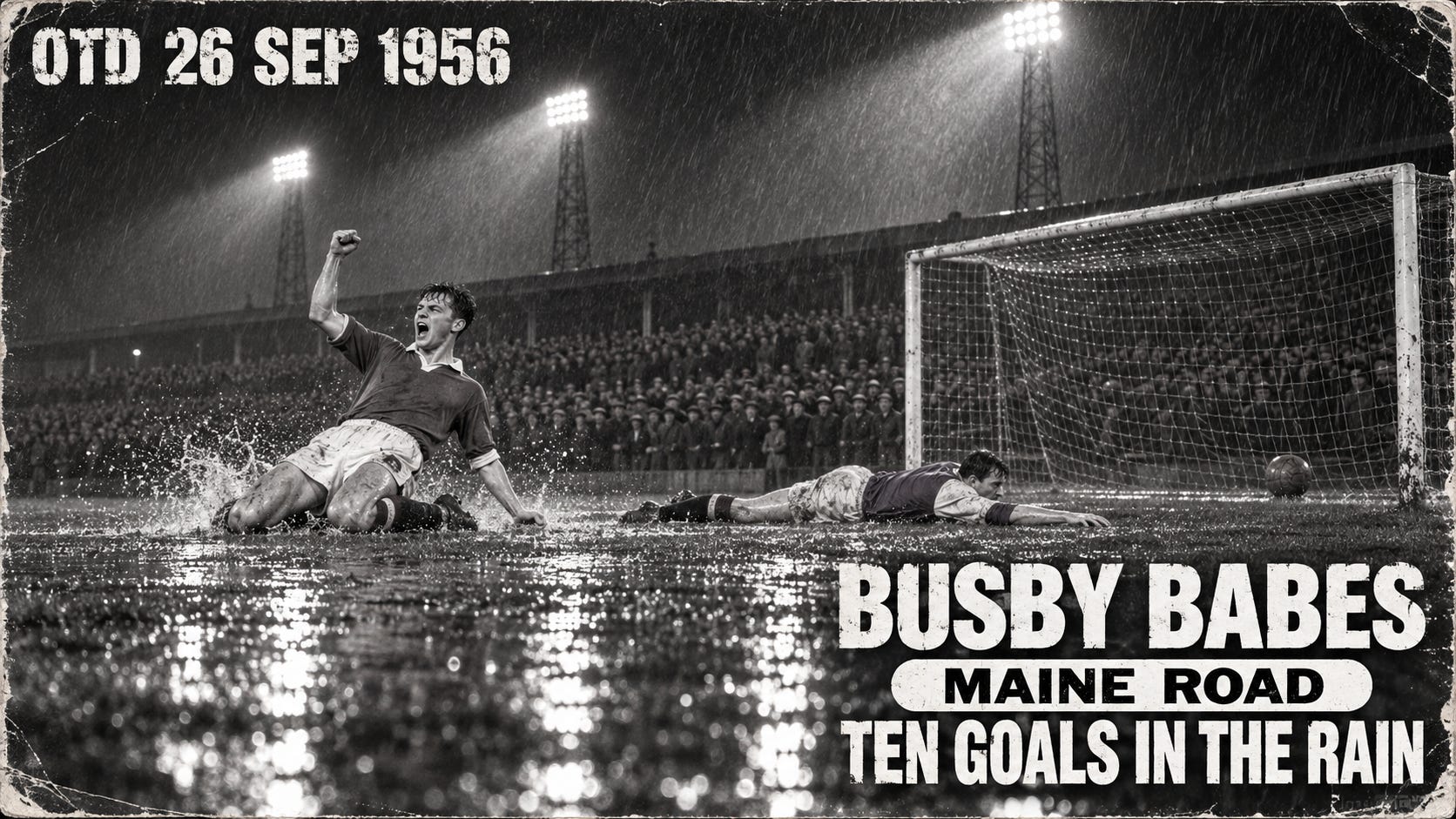
It is Wednesday night, September 26, 1956, and Manchester United are playing their first European home match. Except they are not at home. Old Trafford has no floodlights, so United have crossed Manchester to borrow Maine Road from their neighbors. Their opponents are Anderlecht, champions of Belgium, winners of seven league titles in ten seasons, and most certainly not a village team that has wandered into Europe by accident. After eight minutes, Tommy Taylor scores. After twenty, he scores again. By halftime, Manchester United lead 5-0. By full time, it is ten. It is the first double-digit score in the history of UEFA club competition, and Manchester United’s largest competitive victory before or since. This is the story of how it happened.
How did we get here?
The European Cup was only in its second season, its creation part of the great postwar effort to make European football genuinely European. International club matches were not new; the Mitropa Cup had linked Central Europe before the war, Latin clubs had contested the Coupe Latine, and Wolverhampton Wanderers’ floodlit friendlies against sides such as Honvéd had fueled the English boast that Wolves might be “champions of the world.” But there was no season-long competition bringing together the champions of Europe’s domestic leagues. That changed in 1955, when Gabriel Hanot and the French newspaper L’Équipe pushed the idea of a European champions’ tournament. UEFA took it on, sixteen clubs entered the inaugural edition, and Real Madrid beat Stade de Reims 4-3 in the first final. England should have been represented by Chelsea, but the Football League objected. Its secretary, Alan Hardaker, regarded the new tournament as a distraction that would interfere with domestic fixtures, and Chelsea accepted the pressure and withdrew. Scotland did enter, and Hibernian reached the semifinals, showing that British clubs could compete with Europe’s best.
Then Manchester United won the English championship in 1955-56, and Matt Busby was not prepared to stay at home. Busby had taken over at United in 1945, when Old Trafford was still damaged by wartime bombing and the club had to play temporarily at Manchester City’s Maine Road while its own ground was rebuilt. United won the FA Cup in 1948 and the league in 1952, their first title in forty-one years. But Busby’s great project was not simply to buy an experienced winning team. It was to build one. With his coach Jimmy Murphy, United developed a youth system that came to dominate English football, winning the first five editions of the FA Youth Cup from 1953, and the graduates moved quickly into the first team: Duncan Edwards, Eddie Colman, David Pegg, Liam Whelan, Mark Jones, Albert Scanlon, and increasingly Bobby Charlton. They were joined by young signings such as Tommy Taylor and the goalkeeper Ray Wood, and guided by the captain Roger Byrne and the slightly older Johnny Berry. When United won the 1955-56 league, their average age was around twenty-two.
The “Busby Babes” were not only young. They played with a speed and freedom that seemed designed for the emerging European game: quick passing, aggressive movement, attacking full-backs, and forwards encouraged to interchange rather than sit inside rigid positional boxes. Busby wanted to discover how good they really were. The Football League again objected to an English champion entering the European Cup, but this time United, backed by the Football Association, refused to retreat. There was still a practical problem, because European ties were commonly played in the evening under floodlights, and Old Trafford did not yet have them. Maine Road did; Manchester City had installed permanent floodlights in 1953. So Busby proposed hiring City’s ground for United’s European home matches, arguing that the revenue from large European crowds could help pay for Old Trafford’s own lights. There was a symmetry in it. United had used Maine Road while Old Trafford recovered from the war; now they would use it again while Old Trafford prepared for Europe.
Their opponents were Royal Sporting Club Anderlecht, and this point matters: Anderlecht were not European minnows. Led by the English manager Bill Gormlie and the prolific striker Jef Mermans, the “Bomber,” they had won their first Belgian championship in 1947 and, by 1956, had collected seven titles in ten seasons, including the previous three in a row. They had also played in the inaugural European Cup, though that ended painfully against the Hungarian side then known as Vörös Lobogó, later MTK Budapest, by 6-3 and 4-1. Anderlecht arrived in the second European Cup as an established national champion still learning the dimensions of continental football. The first leg, in Brussels on September 12, went to United 2-0, Dennis Viollet driving in the first and Taylor heading the second from David Pegg’s cross, and it could have been closer: Anderlecht were awarded a penalty after Mark Jones handled, but Martin Lippens struck the post and Wood stopped the follow-up. Even so, a two-goal lead did not settle the tie. Anderlecht had scored eighty-three goals in thirty league matches that season, and on paper the return was still a contest between the champions of England and Belgium.
Then came the rain. Maine Road’s pitch was sodden, with water lying on the surface, and conditions that might normally slow an attacking side instead widened the gap between the teams. United adapted; Anderlecht did not. Taylor scored after eight minutes and again after twenty, Viollet added a third in the twenty-sixth minute, and then, just before the interval, the match stopped resembling a European Cup tie at all. Viollet scored in the thirty-ninth minute, and one minute later completed his hat-trick. Five-nil at halftime. The explanation was not merely that Anderlecht defended badly; it was that United denied them every recovery, their forwards moving faster than Anderlecht could reorganize, attacking directly when space opened and combining quickly when it did not. Taylor completed his hat-trick nine minutes into the second half, Whelan made it seven, Viollet scored his fourth, and Berry added the ninth before Whelan scored again with a minute left. Ten-nil, and twelve-nil on aggregate: Taylor three, Viollet four, Whelan two, Berry one. Estimates of the crowd differ, from around 40,000 in United’s own records to 43,635 elsewhere, but whatever the figure, those inside Maine Road had seen something European club football had never produced before. Busby later called it the most exquisite ninety-minute exhibition any of his teams had ever given, and the word matters. He remembered it not as a slaughter but as an exhibition, speed and movement and attacking football working exactly as he had imagined they could.
So what?
For Manchester United, ten-nil announced that the Busby Babes belonged in Europe. They had defied the Football League to enter, and in their first European home match they produced an answer so emphatic that the argument about whether English clubs should take part already looked obsolete. Europe grew harder at once. United edged past Borussia Dortmund and then Athletic Bilbao, losing 5-3 in the snow in Spain before winning 3-0 back at Maine Road to go through 6-5 on aggregate, and in the semifinals they met the holders, Real Madrid. Alfredo Di Stéfano’s side won the first leg 3-1 at the Santiago Bernabéu, and although United drew the return 2-2 at an Old Trafford now finally fitted with floodlights, they went out 5-3 on aggregate. Real Madrid kept the cup; United kept the English league. Their European adventure had not distracted them from domestic football, as the Football League had feared. It had enlarged them. Viollet finished as the tournament’s leading scorer with nine, Taylor scored eight, and United had reached the last four at the first attempt with a team whose best years still seemed to lie ahead.
That is what makes the Anderlecht score feel different in hindsight. It was not merely the record victory of a fine team; it was evidence of a future that looked almost limitless. The following season United again entered the European Cup, eliminating Shamrock Rovers, Dukla Prague and Red Star Belgrade, and on February 5, 1958, they drew 3-3 in Belgrade to reach another semifinal. The next day, their aircraft stopped to refuel in Munich, and it crashed on its third attempt to take off. Twenty-three people died, among them eight Manchester United players. They included Tommy Taylor, who had scored three against Anderlecht; Liam Whelan, who had scored two; David Pegg, who had supplied the width; Mark Jones, Eddie Colman, Roger Byrne, Geoff Bent and Duncan Edwards. Viollet and Wood survived, and so did Bobby Charlton and Matt Busby, who was twice given the Last Rites before he recovered. He returned and rebuilt the club around survivors such as Charlton, new stars such as Denis Law and Paddy Crerand, and another extraordinary young player named George Best. In 1968, twelve years after Anderlecht and ten years after Munich, Manchester United beat Benfica at Wembley to become the first English winner of the European Cup, Charlton scoring twice, Best once, and the nineteen-year-old Brian Kidd the fourth. The journey that began at Maine Road had finally reached its intended destination.
And Anderlecht? Ten-nil remains the heaviest defeat in the club’s history, a reminder of how large the gap could still be between powerful domestic champions in the European Cup’s early years. But it did not define them. They won another Belgian title in 1959, became a more accomplished European side in the 1960s under Paul Van Himst, and later won the Cup Winners’ Cup in 1976 and 1978 and the UEFA Cup in 1983. The club humiliated at Maine Road became one of Western Europe’s most successful institutions outside the largest leagues, which is exactly why the result stays startling: Anderlecht did not vanish when serious European football began, they became one of its important names.
Nor did ten-nil stay European football’s largest score for long. As the competitions expanded, early rounds increasingly threw full-time champions from major leagues against opponents from smaller or semi-professional cultures. In 1963, Sporting Club of Portugal beat APOEL of Cyprus 16-1, still the highest-scoring match in a senior men’s UEFA club competition; in 1971, Chelsea won a Cup Winners’ Cup tie 21-0 on aggregate; in 1984, Ajax beat Red Boys Differdange 14-0 with Marco van Basten scoring five; and within the European Cup itself, Dinamo București’s 11-0 over Crusaders in 1973 passed United’s margin, as did the 12-2 that Feyenoord ran up against KR Reykjavík in 1969 on their way toward Dutch dominance of Europe. There is a pattern here. Most double-digit results come near the start of competitions, when open entry based on domestic achievement places clubs with radically different resources against one another, and the same small nations recur among the heavy losers, not because their champions were frauds but because the word “champion” never meant every European league operated at the same level. Anderlecht are the great early exception: serial champions, experienced internationals and future European trophy winners, beaten not in a routine destruction of amateurs but on one of those nights when pace, movement, finishing, conditions and confidence all pulled the same way. Modern structures make such nights rarer, since qualifying rounds filter teams, seeding separates the strongest, scouting removes mystery, and substitutions let a struggling side change shape. Yet the great rout has not vanished. Liverpool and Real Madrid have both won Champions League matches 8-0, and Bayern Munich beat Barcelona 8-2 in a 2020 quarterfinal, a smaller margin than United’s ten but perhaps the modern game’s most shocking demolition because of Barcelona’s status. The largest score is not always the greatest humiliation. Context decides.
Three things to take away
First, United’s first European home match was not played at home. Old Trafford had no floodlights, so the champions of England borrowed Manchester City’s Maine Road, and paid for their own lights with the European gate receipts.
Second, the first double-digit score in Europe was not inflicted on an unknown. Anderlecht were reigning Belgian champions with seven titles in ten years, which is what makes the result remarkable rather than routine.
Third, the ten-nil belongs to an unfinished story. It announced the Busby Babes as a European force, a force largely lost at Munich eighteen months later, and finally honored when United won the European Cup in 1968.
On this day in 1956, Manchester United beat Anderlecht 10-0 at Maine Road, the first double-digit score in UEFA club competition, and the night English football’s youngest champions introduced themselves to Europe.
---
📩 Got an idea to an OTD story? otd@17lawsguy.com