

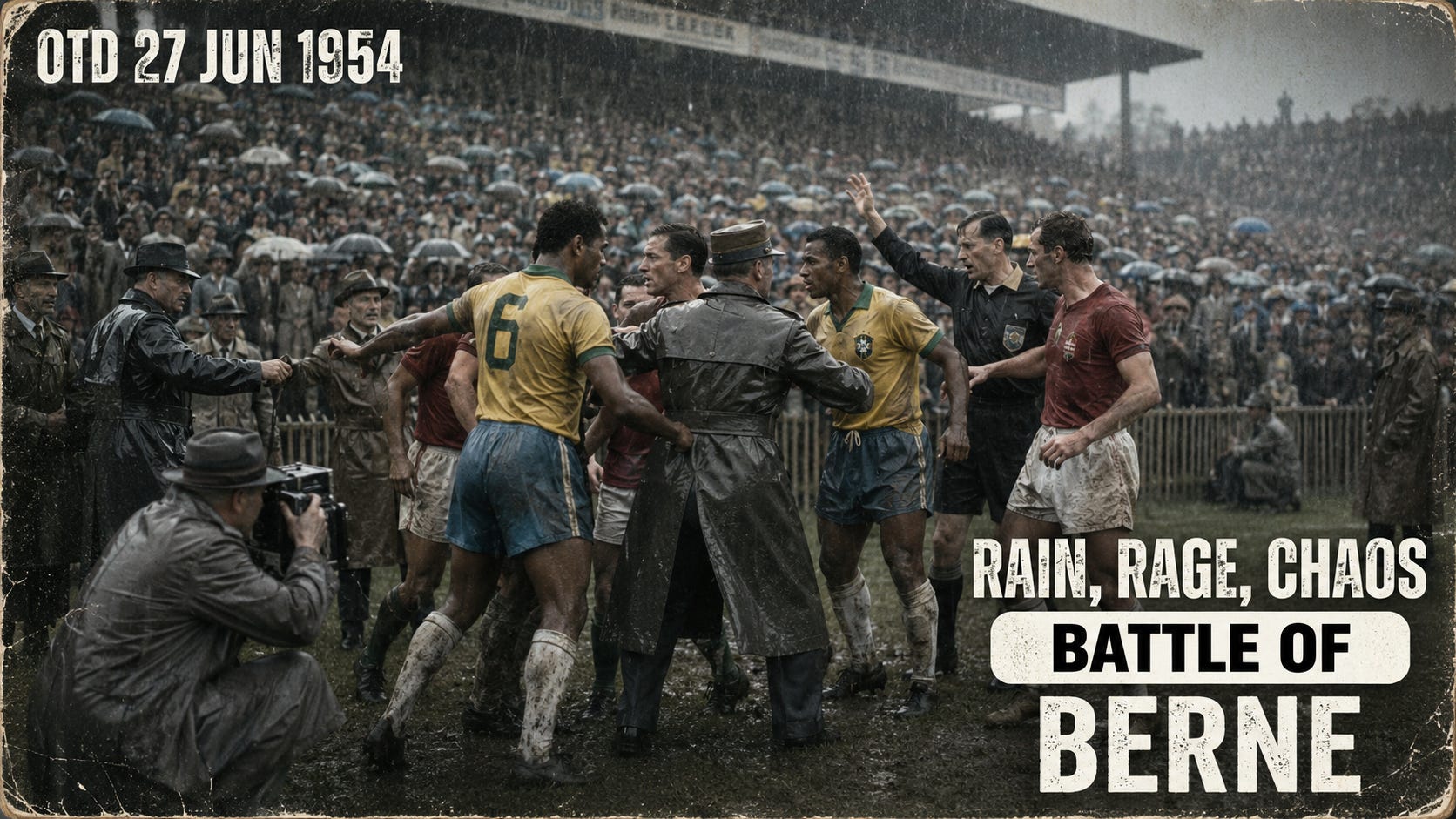
It is 27 June 1954, in Bern, in the rain. Hungary against Brazil, a World Cup quarter final. It should be one of the most beautiful matches ever played: the Magical Magyars, the greatest team in the world, against a gifted Brazil. Instead, it becomes one of the ugliest. Forty-two free kicks. Two penalties. Three players sent off. Fighting on the pitch, officials and photographers spilling onto it, and the violence carrying on after the whistle, into the tunnel and the dressing rooms. Hungary win 4-2. The match is remembered forever as the Battle of Berne.
Both teams arrived carrying weight. Hungary were unbeaten for years, Olympic champions, the side that had just humiliated England home and away, a genuine football revolution, though here without their injured talisman. Brazil were still haunted by losing the 1950 final at home, a wound the whole country carried, and this was their chance to beat the best team alive and begin to heal it. So the pressure was immense before anyone kicked the ball.
For an hour it was tense but recognizably football. Then a disputed penalty lit the fuse, officials came onto the pitch, tackles curdled into hacks, and two captains-of-the-moment were sent off for fighting. A third dismissal followed. Brazil finished with nine. And the worst of it came after the final whistle, away from the cameras. The specifics are grim and contested and best heard in full.
Here is what makes the match more than a brawl, and why it still rewards attention. The violence was real. But the way Europe described it tells you almost as much about 1954 as about the football. Newspapers reached for a familiar vocabulary: hot-blooded Brazilians, sly Hungarians, civilized football degraded by primitive violence. That is not neutral reporting. It is the prejudice of the era written into the match report, a way of saying football has been disgraced, and saying, more quietly, by them. The Battle of Berne is a window into how Europe explained violence when the teams involved were a communist Eastern European power and a racially mixed South American nation.
And the result, so easily swallowed by the nickname, mattered enormously. Hungary then beat the defending champions Uruguay in the semi-final, removing both 1950 finalists from the tournament, and yet still did not win the World Cup, losing a final everyone expected them to win, before their golden generation was scattered for good two years later. Brazil’s defeat became one of their last great setbacks before the yellow shirt, Pelé and immortality arrived. Berne sits on a hinge: before cards, before television replays, before Brazil became Brazil, and before Hungary’s great team turned tragic.
🎙️ THE PODCAST GOES DEEPER. The full episode has the goal-by-goal before the collapse, the penalty that lit the fuse, the Bozsik and Nilton Santos fight and the third dismissal, the dressing-room violence in detail, referee Arthur Ellis’s own account, and how the racialized press coverage reveals the politics of 1950s football. That is the 10-minute version.
---
🎧 Listen on Spotify, Apple Podcasts, Amazon Music, Overcast, iHeart, and YouTube.
📩 Got an episode idea? otd@17lawsguy.com
Yesterday: 26 June 1992, Denmark’s Euro 1992 Fairytale.
Tomorrow: 28 June 1942, La Máquina takes the field.