

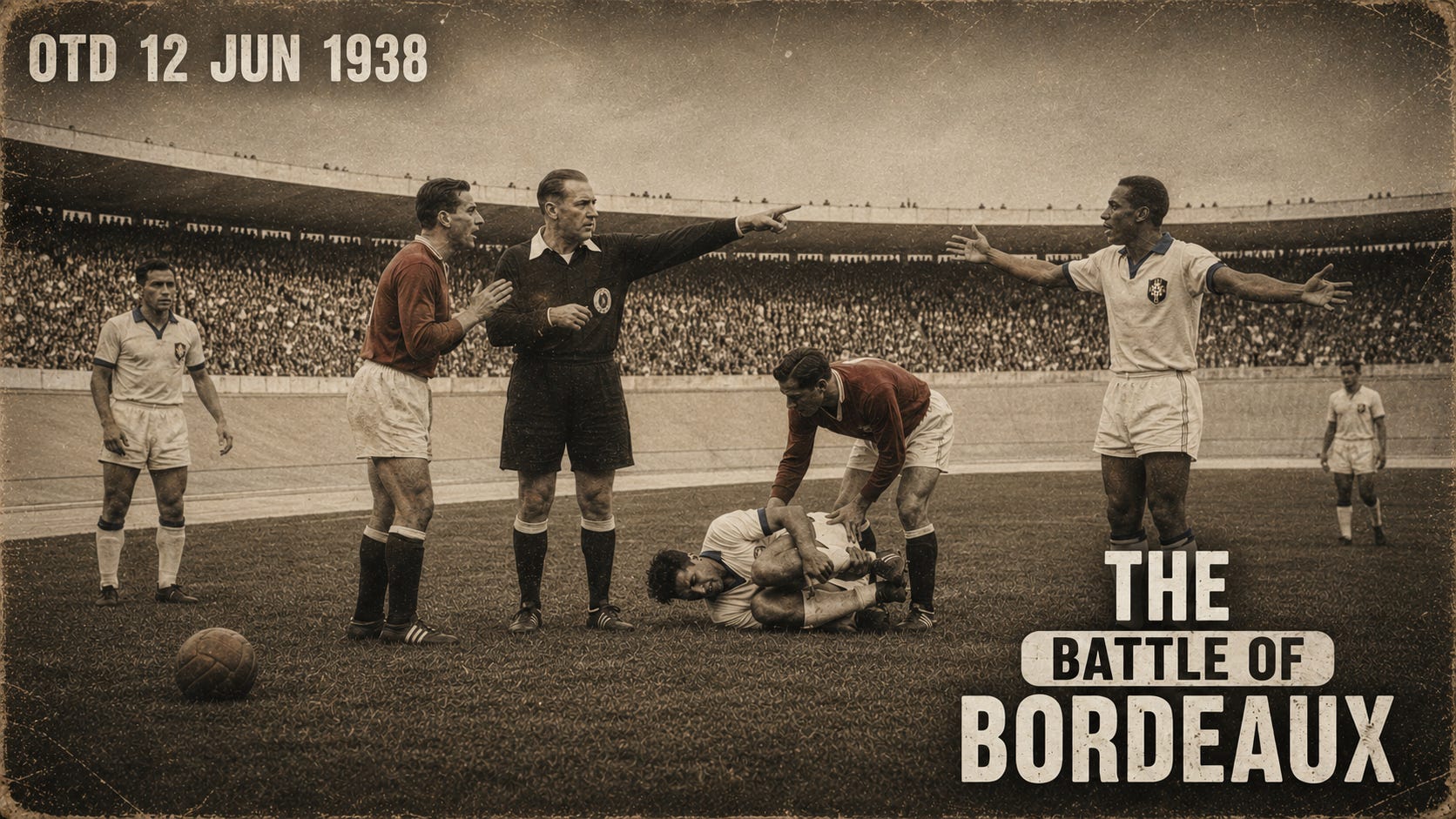
It is 12 June 1938, at the Parc Lescure in Bordeaux. Brazil against Czechoslovakia, a World Cup quarter final. And today the World Cup gets its first great “Battle of ..”. One-one after extra time. Three players sent off. Multiple broken bones. A goalkeeper playing on with a broken arm. A match so violent and so unresolved that they had to play it again two days later. This is the Battle of Bordeaux.
How did we get here? The 1938 World Cup sat in one of football’s most dangerous atmospheres, less than fifteen months from war. Italy were reigning world and Olympic champions, and fascist Italy understood football’s propaganda value. Central Europe was still one of the game’s intellectual centres, its clubs linked by the Mitropa Cup. But the Danubian world was being swallowed by politics: Hugo Meisl died in 1937, and Austria itself disappeared into Nazi Germany in March 1938 after the Anschluss.
Czechoslovakia belonged deeply to that world. A young state with a rich football culture, Prague a football city, Sparta and Slavia major clubs. In 1934 they reached the World Cup final, losing 2-1 to Italy after leading. Their goalkeeper and captain, František Plánička, was one of the great symbols of pre-war football: brave, elegant, immense in reputation. Oldřich Nejedlý had been the 1934 top scorer. By 1938 Czechoslovakia were not tourists. They were one of Europe’s best.
Brazil’s story was different. Uruguay had refused to defend their title in 1934, and Argentina, furious that France rather than South America got the 1938 tournament, withdrew. So Brazil were South America’s great representative in France. Not yet the Brazil of Pele and 1970, but Brazil becoming Brazil: more coherent, more dangerous, led by the genius forward Leônidas da Silva, the Black Diamond, with the elegant Domingos da Guia behind him. In the first round they had won one of the wildest World Cup matches ever, 6-5 after extra time against Poland, Leônidas scoring a hat-trick while Ernest Wilimowski scored four and still lost.
Now they came to Bordeaux, to the new Art Deco stadium, Parc Lescure, with a crowd of just over 22,000 and an experienced Hungarian referee, Pál von Hertzka. This was not some random official. But today the match ran away from him.
It started badly. After only fourteen minutes, Brazil’s Zezé Procópio was sent off. Remember: there were no red cards yet. The referee dismissed a player by voice and whistle, because the symbol had not been invented. Brazil were down to ten, and yet in the 30th minute Leônidas struck. Brazil 1, Czechoslovakia 0. In the 65th minute Czechoslovakia equalized: Domingos da Guia handled, and Nejedlý scored the penalty. One-one. Then the violence deepened. Challenges arrived late, retaliation followed retaliation, and the pitch became a series of private wars.
Czechoslovakia lost bodies. Josef Košťálek was hurt in the stomach. Nejedlý suffered a broken leg. And Plánička, the captain, broke his right arm. But this was 1938. No substitutes. No concussion protocols. No fourth official. If you could stand, you carried on. Nejedlý could not finish. Plánička did, playing on in goal with a broken arm through the second half and extra time. That image alone is almost unbearable: one of the world’s great goalkeepers, arm broken, still standing between Brazil and the semi-final. Near the end, two more players were expelled, one from each side. Three dismissals in total, in a single World Cup match. That had never happened before.
The match went to extra time, still one-one. No penalty shootout existed. So the solution was simple and brutal: a replay. And the replay itself told you how much damage the first match had done. Two days later, Brazil made nine changes and Czechoslovakia made five. That is not rotation, that is triage. The Czechs led through Kopecký; Leônidas, now stand-in captain, equalized; then Roberto scored, and Brazil won 2-1. They were through to the semi-final, but the price of Bordeaux followed them: weakened, they lost 2-1 to Italy in Marseille, and Italy went on to retain the World Cup. Brazil still finished third, beating Sweden 4-2, with Leônidas the tournament’s top scorer on seven goals. So 1938 became Brazil’s first great World Cup run. Not victory, but arrival, and Bordeaux was part of it, the moment Brazilian brilliance and Brazilian toughness both entered the European imagination.
The violence was rare enough to become a landmark. Three expulsions plus multiple serious injuries made Bordeaux the first great World Cup Battle of. That disciplinary record would be equaled in 1954 by the Battle of Berne, Hungary against Brazil. Then came the Battle of Santiago in 1962, Chile against Italy, so chaotic that the referee Ken Aston later helped invent yellow and red cards. Then the Battle of Nuremberg in 2006, Portugal against the Netherlands, four reds and sixteen yellows. More recently some have called Argentina against the Netherlands in 2022 the Battle of Lusail. But Bordeaux came first.
And we should be fair to the referee. Pál von Hertzka is easy to blame, and his control was loose. But referees in 1938 had fewer tools: no cards, no fourth official, no substitutions, no television, no VAR. FIFA does not seem to have held him uniquely responsible, and Hungary later honored him with a referee-of-the-year prize in his name. That does not absolve what happened in Bordeaux, but it complicates the judgment. Maybe the referee failed, maybe the players failed, maybe the Laws had simply not yet developed the tools to control what football had become. That is often how the game evolves: not by abstract wisdom, but by matches that reveal what the old machinery cannot handle.
That is why 12 June 1938 matters. It reminds us that football’s mythology is not only made of goals. Sometimes it is made of bruises, broken bones, and the matches that force the game to grow up.
🎙️ THE PODCAST GOES DEEPER. The full episode has more on the 1930s political backdrop, Czechoslovakia’s golden generation, Brazil’s 6-5 win over Poland, the replay in detail, the later World Cup Battles, and the case around referee Pál von Hertzka. That is the 10-minute version.
---
🎧 Listen on Spotify, Apple Podcasts, Amazon Music, Overcast, iHeart, and YouTube.
📩 Got an episode idea? otd@17lawsguy.com
Yesterday: 11 June 1933, The First Road to the World Cup.
Tomorrow: 13 June 1956, Real Madrid, Reims, and the first European Cup final.