

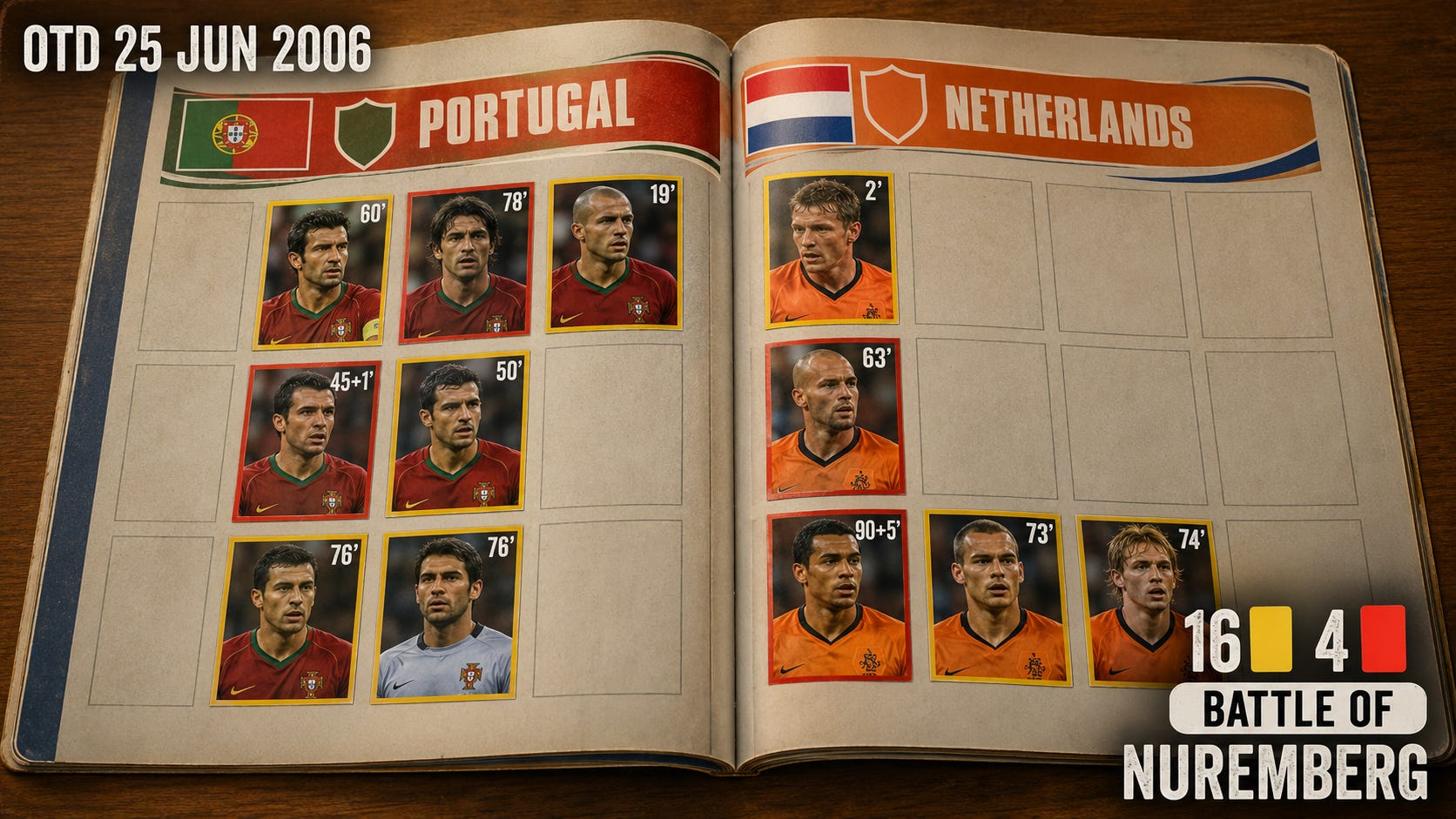
It is 25 June 2006, in Nuremberg. Portugal against the Netherlands, a World Cup round of 16. And tonight, the referee will reach into his pocket again, and again, and again. By the end: sixteen yellow cards, four reds, both teams down to nine men, and somehow only one goal. The match is remembered not by its score but by its nickname. The Battle of Nuremberg.
This was not neutral ground. The Dutch had missed the 2002 World Cup after losing to Portugal in qualifying, then lost the Euro 2004 semi-final to them as well. Two proud, technical, combustible squads, real recent history, and a knockout match with no margin for calm. The heat was there before kickoff.
It still needed a spark, and the cards became it. The referee, Valentin Ivanov, booked a player inside two minutes and essentially never stopped. The hinge moment came early: a brutal, studs-up challenge on Cristiano Ronaldo that many felt deserved red and got only yellow. Ronaldo limped out of the game in tears before half-time. Portugal felt their young star had been hunted. The Dutch felt the punishments were piling up without ever restoring order. Both, in a sense, were right.
What follows is one of football’s strangest spirals: a deliberate handball, a touchline headbutt that somehow stayed yellow, a benches confrontation, the breaking of football’s little unwritten courtesies, and dismissal after dismissal. Three of the sent-off players ended up sitting together near the benches like schoolboys outside the headmaster’s office. The specifics, and the running count, are best experienced in full, because the rhythm of the collapse is the story.
Portugal won it through an early Maniche goal, and the result mattered: they reached the semi-finals, their best World Cup since 1966. But nobody remembers the football. They remember the numbers.
And the numbers raise the real question, the one that makes this more than a curiosity. Did Ivanov lose control because he showed too many cards, or did he show too many cards because the players gave him no other choice? The honest answer is probably both. Some of the cards were obviously correct. Several of the reds were right under the Laws. And yet a match can be technically punishable at every turn and still be badly managed, because the punishments never changed the behavior. That is the uncomfortable lesson buried in the chaos: a card is a sanction, not authority. They are not the same thing.
It is why the Battle of Nuremberg endures as a kind of refereeing seminar disguised as a football match, and why it sits in the World Cup’s long “Battle of” tradition, the nights when football stops being fluent and turns into evidence.
🎙️ THE PODCAST GOES DEEPER. The full episode has what this post holds back: the card-by-card sequence and the running count, the Boulahrouz challenge on Ronaldo and the Figo confrontation, the broken unwritten courtesies that triggered the late reds, FIFA’s reaction and Sepp Blatter’s regret, and where Nuremberg ranks among Bordeaux, Berne, Santiago and Lusail. That is the 10-minute version.
---
🎧 Listen on Spotify, Apple Podcasts, Amazon Music, Overcast, iHeart, and YouTube.
📩 Got an episode idea? otd@17lawsguy.com
Yesterday: 24 June 1990, two World Cup rivalries on one Sunday.
Tomorrow: 26 June 1992, Denmark’s Euro 1992 fairytale.